

What are the differences between thermoset and thermoplastic powder coatings?
Thermoset powder coatings chemically cross-link during curing to form a permanent, heat-resistant finish that cannot be melted and reshaped, whereas thermoplastic powders melt and solidify without chemically cross-linking. Thermosets are commonly selected for durable industrial protection and appearance, while thermoplastics may suit applications requiring greater flexibility, impact resistance or a thicker coating.
Thermoset and thermoplastic powder coatings are distinguished mainly by how their resin systems respond to heat during processing. That difference affects the coating’s finished properties, repair options, recommended application thickness, resistance to chemicals and impact, and suitability for particular metal components. Neither category is universally better; the appropriate choice depends on the service conditions and the performance required from the coated part.
Thermoset powder coatings are formulated with resins and curing agents that react during the oven cycle. The resulting coating forms a tightly bonded film with a stable surface and consistent appearance. This makes thermoset systems suitable where the coating must retain its properties during prolonged exposure to weather, moisture, cleaning chemicals, abrasion or industrial handling.
Common thermoset chemistries include epoxy, polyester, epoxy-polyester hybrid and polyurethane systems. Their performance varies by formulation. For example, epoxy-based finishes are often selected for strong adhesion and chemical resistance in indoor or protected environments, while polyester systems are widely used where exterior durability and colour retention are important. Hybrid coatings can provide a balance between indoor protection and appearance, although the correct specification depends on the component’s environment.
Thermoplastic powder coatings use resin systems that form a film through heating and cooling rather than a permanent chemical reaction. Their properties can make them useful where flexibility, impact absorption, electrical insulation or a relatively thick protective layer is required. They are often considered for wire goods, baskets, racks, pipes, fencing, handles, playground equipment and other components exposed to knocks or demanding handling conditions.
The main practical differences can be summarised as follows:
- Heat response: thermoset coatings develop their final structure during curing, whereas thermoplastic films can soften when reheated. This affects how each coating behaves during later processing, repair or exposure to elevated temperatures.
- Flexibility and impact performance: many thermoplastic systems accommodate deformation and impact effectively. Thermoset coatings can also be formulated for impact resistance, but their performance is more closely linked to the specific resin, film thickness, cure and preparation of the substrate.
- Chemical and environmental resistance: thermoset formulations are often chosen for stable protection against corrosion, moisture, solvents and industrial contaminants. Thermoplastics can also provide strong resistance, but the result depends on the polymer and the chemicals involved.
- Film thickness: thermoplastic powders are commonly capable of producing a thicker film in a single application. Thermoset systems are generally selected where a controlled, uniform film is needed for appearance, dimensional accuracy and protection.
- Rework and recycling: a thermoplastic coating may be softened by heat and can sometimes be removed or reprocessed more readily. A cured thermoset film does not return to a liquid state, so defective areas normally require mechanical preparation and recoating rather than simple remelting.
- Temperature limitations: the maximum service temperature is formulation-specific. A component that will operate near a heat source should be assessed against the coating manufacturer’s technical data rather than categorised by resin family alone.
The surface and design of the component also influence the decision. Thermoset powder is often suitable for fabricated steel, aluminium and other conductive metal parts where the finish must be even and visually consistent. Thermoplastic systems may be preferable where the part has sharp handling demands, requires a more substantial barrier layer or needs a degree of flexibility. Complex shapes, recesses, edges and assembled components should be reviewed before specification because they affect powder coverage, grounding, masking and oven exposure.
Application method is another important difference. Both coating types require suitable cleaning and preparation so that contamination, rust, mill scale, oils and previous finishes do not compromise adhesion. The part must also be able to withstand the relevant heating conditions. Thermoset coatings require an accurately controlled cure, taking account of the metal’s actual temperature rather than relying only on oven air temperature. Thermoplastics require sufficient heat to melt and flow the powder into a continuous film, with the process adjusted to achieve the required coverage without damaging the substrate or distorting the component.
Finish requirements should be defined alongside performance requirements. Thermoset powders are available in a broad range of colours, gloss levels, textures and special-effect finishes, making them suitable where appearance and repeatability matter as well as corrosion protection. Thermoplastic powders can also provide attractive and durable finishes, but the available surface characteristics and achievable thickness may differ between formulations. A specification should therefore state the required colour, gloss, texture, thickness, adhesion, resistance and permitted visual variation.
For B2B coating work, the most useful comparison is based on the component’s complete operating conditions:
- Identify the metal type, component dimensions, geometry and any areas that must remain uncoated.
- Record exposure to sunlight, moisture, salt, chemicals, abrasion, impact and operating heat.
- Decide whether flexibility, a thicker barrier, dimensional control, colour retention or chemical resistance is the main priority.
- Check whether the part will be repaired, recoated, assembled or exposed to further heat after coating.
- Select a coating system supported by the relevant technical data and confirm that the proposed preparation and curing process suits the component.
In general, thermoset powder coatings are a strong option for durable, controlled finishes on industrial metalwork, particularly where long-term appearance and resistance to the surrounding environment are important. Thermoplastic powders become more relevant where flexibility, impact resistance, insulation or a heavier protective film is central to the application. A coating specialist can compare the two systems against the part’s substrate, design and service conditions before production, helping ensure that the chosen finish is technically appropriate rather than selected solely by colour or initial appearance.
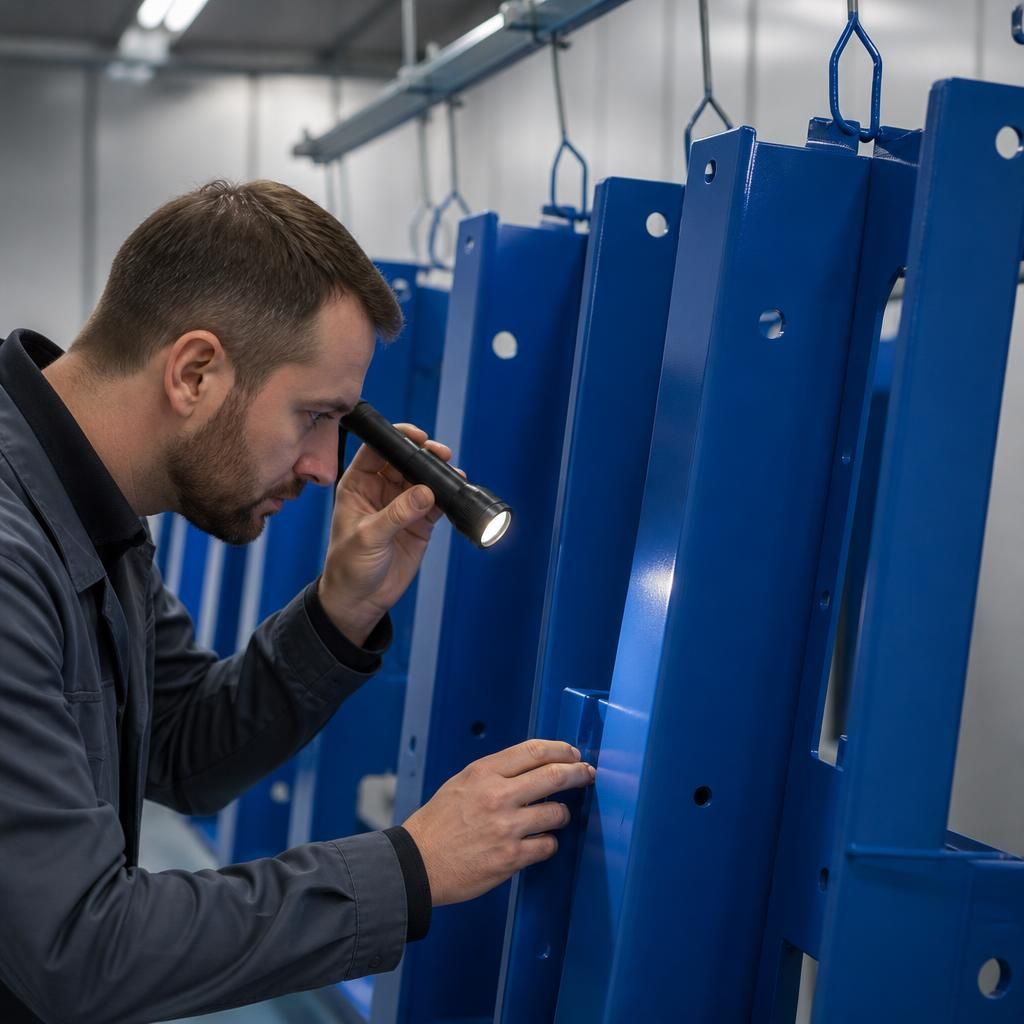
A key difference between thermoset and thermoplastic powder coatings is how the finished film is assessed after application. A thermoset coating must develop the intended cross-linked structure during curing; insufficient or excessive heat exposure can affect its final performance. A thermoplastic coating does not undergo this chemical cure, so assessment focuses more on whether the powder has melted, flowed and cooled into a continuous, well-adhered film.
This distinction matters when reviewing production results. Inspection should consider film continuity, adhesion, thickness, coverage of edges and recesses, and the required visual finish, but the acceptance criteria should reflect the selected coating system. Using the same process assumptions for both powder types can lead to unsuitable results, particularly on components with complex geometry or strict dimensional requirements.
Compare Coating Options for Your Metal Components
Share your component’s substrate, geometry and operating conditions with a powder coating specialist to identify whether a thermoset or thermoplastic system is the better fit. The coating specification can then be matched to the required protection, finish and application process.