

What are the environmental and performance benefits of using epoxy polyester hybrid powder coatings?
Epoxy polyester hybrid powder coatings provide a durable balance of hardness, adhesion and flexibility for coated metal components, helping finishes resist wear and corrosion. Their solvent-free application produces minimal airborne emissions, while unused powder may often be reclaimed, reducing material waste compared with liquid coating processes.
Epoxy polyester hybrid powder coatings combine the strong adhesion and chemical resistance associated with epoxy resin with the processing characteristics and surface finish of polyester resin. Their main benefits are a balanced performance for suitably prepared metal components, efficient material use during application and reduced reliance on solvent-based coating systems.
From a performance perspective, the hybrid chemistry produces a coherent film that can protect metal parts against handling damage, abrasion and many commonly encountered chemicals. It is suitable where a coating must retain a sound bond to the substrate while tolerating normal movement and service conditions. The exact result depends on the resin formulation, film thickness, curing schedule, substrate preparation and the environment in which the component will be used.
- Adhesion and film integrity: the epoxy component supports strong bonding to correctly prepared metal, helping the coating remain attached rather than lifting or flaking when the part is handled or exposed to routine service stresses.
- Chemical resistance: cured hybrid films can withstand contact with a range of oils, greases, cleaning agents and industrial contaminants. Resistance is formulation-specific, so aggressive chemicals, immersion or elevated temperatures should be checked against the coating specification.
- Consistent coverage: powder is applied as a dry, electrically attracted material, allowing the applicator to build an even coating over accessible faces and profiles. Careful control is still needed around recesses, sharp edges and Faraday cage areas, where electrostatic application can be less uniform.
- Stable appearance: the coating can provide a smooth, consistent decorative finish in a range of colours and textures. Gloss retention and colour stability depend on the formulation and exposure conditions.
The environmental benefit is principally related to the way powder coating is handled and cured. Because the coating is supplied as a dry powder rather than a liquid containing organic solvent, the process avoids the routine addition of solvent carriers that can evaporate during application. This can simplify air-emission management and reduce the need to handle solvent-containing materials.
Powder application also supports efficient use of coating material. Overspray can often be collected through a suitable recovery system and returned to the process where the equipment and powder specification allow it. This reduces discarded material, although recovered powder must be controlled carefully to prevent contamination, colour mixing or changes to the required finish. Not every powder or application arrangement is suitable for unrestricted reuse.
A further environmental consideration is service life. A coating that remains attached and protective for longer can reduce the frequency of stripping, recoating, replacement or transport of the underlying metal component. This is a lifecycle benefit rather than a guarantee: it depends on selecting a hybrid formulation appropriate to the exposure, applying it to a properly prepared surface and curing it fully.
Epoxy polyester hybrids are generally most appropriate for interior or moderately exposed applications. Although the polyester element improves weathering behaviour compared with a wholly epoxy-based system, standard hybrid coatings may still chalk, fade or lose appearance under prolonged ultraviolet exposure. For external architectural, marine or highly weather-exposed components, an exterior-grade polyester system or another specified coating may be more suitable.
To obtain the intended environmental and performance benefits, the specification should address the whole coating process. Important checks include:
- identifying the metal substrate and removing oil, grease, scale, rust and other contaminants;
- choosing a pretreatment compatible with the substrate and service environment;
- confirming the required film thickness and ensuring the powder is applied evenly;
- following the powder manufacturer’s stated curing time and metal temperature rather than relying only on oven air temperature; and
- checking the finished part for coverage, adhesion, appearance and any defects before it enters service.
In practical terms, epoxy polyester hybrid powder coating is a useful compromise where a manufacturer needs a robust, chemically resistant finish with controlled material use and fewer solvent-related process concerns, but does not require the long-term ultraviolet resistance of a dedicated exterior polyester coating. The correct choice should therefore be based on the component’s indoor or outdoor exposure, chemical contact, temperature, appearance requirements and expected service conditions.
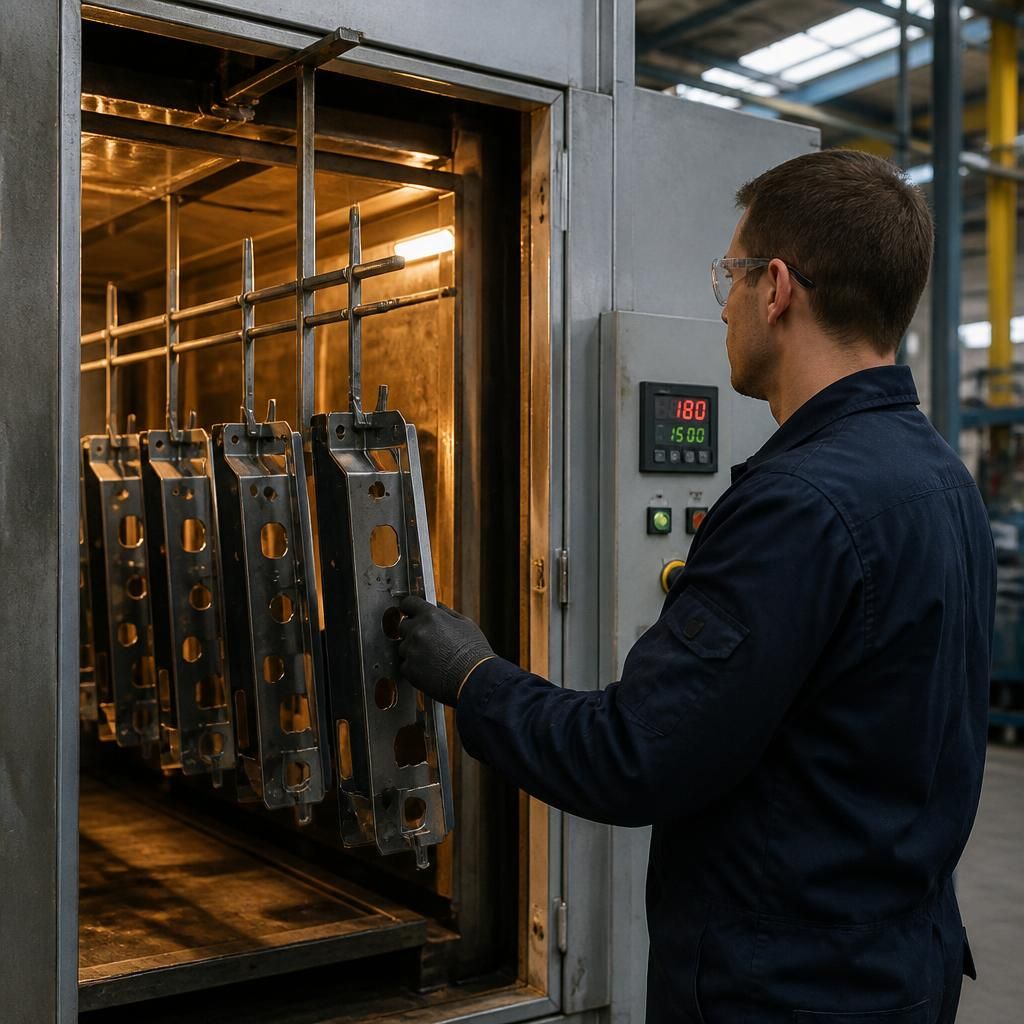
The environmental profile of an epoxy polyester hybrid powder coating should include curing energy, not only solvent use and material waste. The coating requires controlled heating to form its final film, so oven efficiency, loading and the specified cure schedule influence the overall process impact. Powder coating is therefore not automatically a lower-impact option in every situation; its benefits are strongest when the component, batch size and production method suit an efficient curing process.
For manufacturers, this makes process control part of the environmental assessment. Accurate temperature management helps prevent under-cured or over-cured parts, avoiding unnecessary rework and wasted material while preserving the intended mechanical performance of the finished coating.