

How do zinc and fusion bonded coatings differ in terms of application and performance?
Zinc coatings protect steel through a metallic layer that can provide sacrificial corrosion protection, while fusion bonded coatings are thermoset powders melted and cured onto the prepared surface to form a continuous barrier. Zinc is often preferred where sacrificial protection is important; fusion bonded coatings can provide strong resistance to moisture, chemicals and abrasion when correctly applied.
The main difference is that zinc coating performance depends on the type of zinc system and the way it bonds to the steel, whereas fusion bonded coating performance depends heavily on surface preparation, powder formulation and curing. Zinc is often selected for its electrochemical protection of steel; fusion bonded coatings are selected where a continuous, engineered polymer layer is needed to isolate the substrate from its environment.
Application methods differ considerably. Zinc may be applied by hot-dip galvanising, electroplating, thermal spraying or a zinc-rich coating process. These methods produce different surface profiles, coating thicknesses and levels of coverage. Hot-dip galvanising can coat complex steelwork by immersion, but drainage, venting and access for the molten zinc must be considered. Electroplating is more suited to smaller components and controlled deposit thicknesses, while thermal spraying is useful for larger structures or components that cannot be immersed.
Fusion bonded coating is normally applied to steel that has been thoroughly cleaned and abrasively blasted. The powder is then deposited onto the prepared surface and heated so that it melts, flows and cures into a uniform film. The component must reach the specified temperature for the particular powder system, and the coating needs sufficient time at that temperature to cure correctly. Incomplete curing can reduce chemical resistance and adhesion, while excessive heat can affect the coating or the substrate.
Surface preparation is critical for both systems, but the requirements are not identical. Zinc processes need the steel to be free from contaminants that interfere with the metallurgical, chemical or mechanical bond. Fusion bonded systems are particularly sensitive to oil, salts, mill scale, rust and abrasive residues because any contamination beneath the film can create adhesion failure or corrosion creep. Weld spatter, sharp edges and fabrication marks may also need to be removed before coating. Rounded edges generally support more consistent coverage than sharp corners.
Component design affects the choice as well. Zinc application can alter dimensions, particularly on threaded sections, close-fitting parts and components with narrow openings. Allowances may therefore be required during fabrication. Fusion bonded coating also adds film thickness and may not fully cover deep recesses, internal passages or shielded areas unless the application method and component geometry allow adequate powder access. Masking may be needed on threads, machined faces, earth points or other areas that must remain free of coating.
Their performance mechanisms are different. Zinc can provide sacrificial protection when exposed steel is connected to the zinc layer. This means a small damaged area may receive a degree of protection from the surrounding zinc, although the extent depends on the coating type, damage, environment and electrical continuity. Fusion bonded coating does not normally provide this sacrificial action. Its protection relies on maintaining an intact, strongly adhered barrier that limits the movement of water, oxygen, salts and chemicals towards the metal.
Fusion bonded coatings can offer strong resistance to moisture, abrasion and many chemicals when the correct formulation and cure have been selected. They can also provide a smooth, continuous finish that is useful where cleanability or reduced surface roughness matters. Their limitations include sensitivity to poor preparation, impact damage and unsuitable service temperatures. Different formulations vary in flexibility, chemical resistance and resistance to ultraviolet exposure, so the coating must be matched to the operating conditions rather than chosen by appearance alone.
Zinc coatings can be highly effective in atmospheric and outdoor conditions, but their behaviour changes with exposure. White corrosion products may form on newly galvanised zinc in damp, poorly ventilated storage conditions. Acidic, alkaline or high-salt environments can also affect the rate at which zinc is consumed. Where appearance, additional barrier protection or a particularly aggressive environment is involved, a compatible topcoat may be considered. This combined approach is often called a duplex system, but compatibility and preparation between the two layers are essential.
Temperature and movement are further considerations. Metallic zinc tolerates heat differently from a polymer coating and does not soften in the same way as a thermoset film. A fusion bonded coating will remain cured after application, but prolonged exposure beyond its specified service range can cause embrittlement, loss of flexibility or other changes in performance. Thermal expansion between the coating and the substrate, repeated heating and cooling, and movement at joints should be reviewed for components used in fluctuating conditions.
Inspection also differs. Zinc systems may be assessed for coating thickness, continuity, adhesion, surface condition and coverage around edges, welds and recesses. Fusion bonded coatings are commonly checked for film thickness, visual defects, pinholes or holidays, adhesion and cure. Holiday detection is particularly relevant where the coating is intended to provide an impermeable barrier, as a small discontinuity can become a starting point for corrosion beneath the film.
In practical terms, zinc is generally favoured where sacrificial protection, metallic durability or a galvanised construction system is required. Fusion bonded coating is generally favoured where a sealed polymer barrier, chemical resistance, abrasion resistance or a specified coloured finish is more important. The best choice depends on the base metal, component size and geometry, preparation route, exposure conditions, temperature range, dimensional tolerances and the consequences of coating damage.
For some applications, the two technologies can be used together rather than treated as mutually exclusive options. A zinc layer can provide the underlying corrosion protection, while a compatible fusion bonded or other polymer top layer adds barrier protection and helps limit direct environmental exposure. This requires control of surface condition, intercoat adhesion and curing, so the complete coating specification should be agreed before manufacture rather than selected after fabrication.
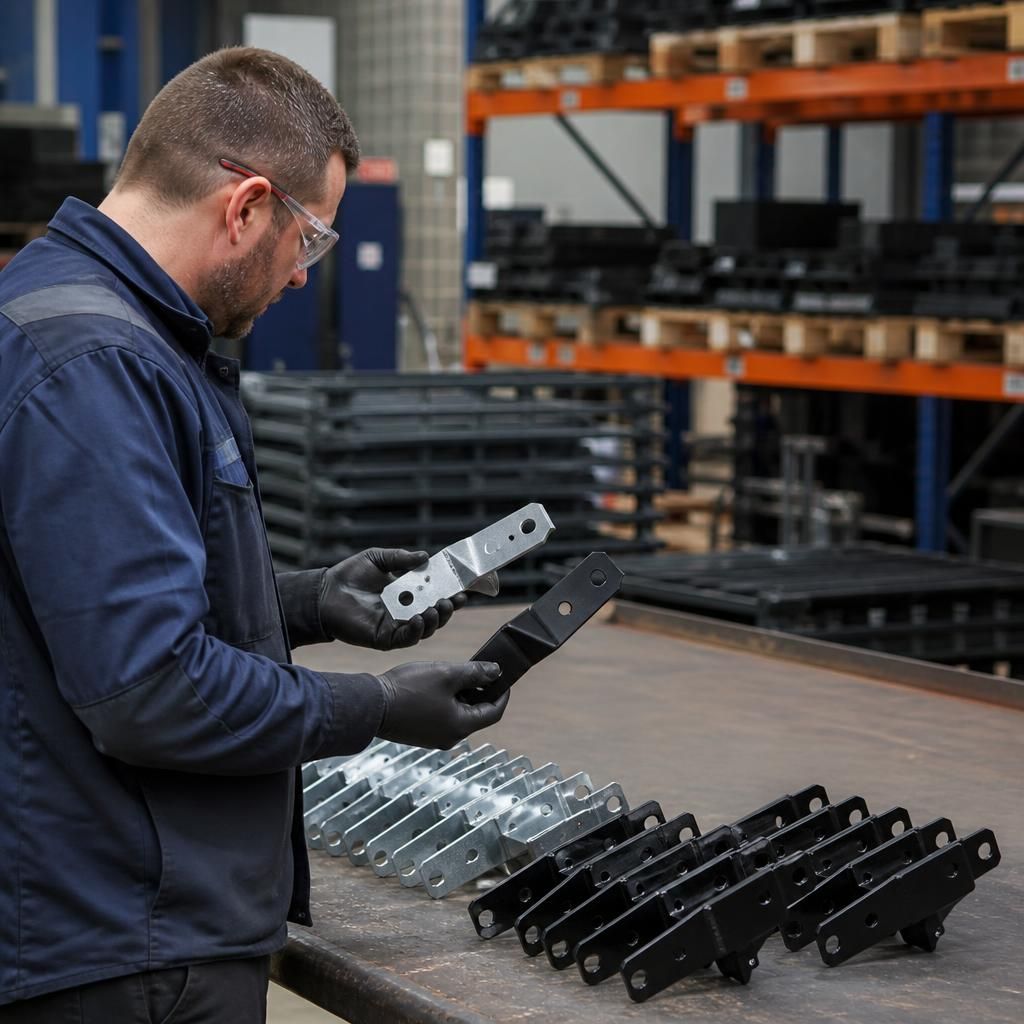
Coating thickness should not be used as a direct like-for-like measure when comparing zinc with fusion bonded systems. Zinc thickness contributes to the available sacrificial material and the service life of the metallic coating, whereas fusion bonded thickness supports the continuity and mechanical robustness of the polymer barrier. A thicker layer is not automatically the better option: excessive build can affect fit, flexibility or edge coverage, while insufficient coverage can leave the substrate vulnerable.
For that reason, the specification should set an appropriate thickness range for the selected process rather than simply requesting the maximum achievable coating. The requirement should also identify the exposure conditions, dimensional tolerances and likely forms of contact or wear. This produces a more meaningful comparison of application quality and expected performance than coating thickness alone.
Discuss Your Zinc or Fusion Bonded Coating Requirements
Discuss your component drawings, service conditions and coating requirements with our Midlands-based powder coating specialists to help determine whether zinc, fusion bonded or a combined system is appropriate. Collection and delivery options are available for businesses across the Midlands and surrounding areas.