

What are the main benefits of using fusion bonded epoxy in industrial applications?
Fusion bonded epoxy provides a continuous, strongly adhered barrier that protects steel and other metal components from corrosion, moisture and chemical attack. Its tough, abrasion-resistant finish is well suited to demanding industrial environments where long-term protection and reliable coating performance are required.
Fusion bonded epoxy (FBE) is a thermoset powder coating that is heated until it melts, flows over a prepared metal surface and chemically cures into a continuous polymer layer. Its main industrial benefits are consistent coverage, efficient application, electrical insulation, high film build and dependable protection of steel components used in demanding service conditions.
Consistent, uniform coverage
FBE can produce an even coating across complex metal shapes, including pipes, fabricated sections, valves, fittings and structural components. Because the powder melts and flows before curing, it can cover the substrate without the runs, sags or solvent-popping associated with some liquid coating processes. Correct control of substrate temperature, powder application and curing is still essential, particularly around edges, welds, recesses and areas with varying thickness.
Efficient single-coat application
Where the specification permits, FBE can achieve the required protective film in one application rather than relying on several liquid layers with separate drying stages. This can simplify the coating system and reduce handling between coats. The process is particularly suitable for repeatable production work because application parameters can be monitored and reproduced across batches.
Strong dielectric performance
Cured epoxy is electrically insulating, which makes FBE useful where the coating must separate a metal substrate from an electrolyte or prevent unwanted electrical contact. This property is relevant to buried or immersed steelwork and other components where electrical continuity, stray currents or galvanic interaction need to be considered. The coating specification must account for service voltage, immersion conditions, coating thickness and the consequences of any defect.
High film build and edge protection
Powder application can provide a substantial protective layer without the solvent content found in conventional liquid coatings. A correctly specified FBE system can also provide useful coverage around edges and fabricated details, although sharp corners should normally be eased during manufacture. Good edge preparation reduces the risk of thin spots, while inspection helps identify pinholes, holidays or other discontinuities before the component enters service.
Reduced solvent-related concerns
FBE powder contains no liquid solvent that needs to evaporate during curing. Compared with solvent-based liquid systems, this can reduce solvent emissions and remove some handling concerns associated with flammable coating liquids. It does not make the process risk-free: powder handling, heated equipment, ventilation, personal protective equipment and safe control of curing ovens remain important parts of an industrial coating operation.
Adaptable performance through formulation
FBE is not a single universal formulation. The resin, curing agent, additives and pigment package can be selected to influence properties such as flexibility, impact resistance, operating-temperature capability, chemical compatibility and resistance to disbondment. This allows the coating system to be matched more closely to the component, service environment and preparation standard instead of treating every application in the same way.
Suitable for demanding handling and service conditions
Once cured, FBE forms a hard, infusible thermoset layer. It does not remelt when reheated in the way a thermoplastic coating does, so the finished film can retain its shape under suitable service conditions. This is useful for components that must be transported, installed or operated without the coating flowing or softening at ordinary process temperatures. The permitted service range remains formulation-specific and should be confirmed against the technical specification.
These benefits depend on the complete coating system rather than the powder alone. The steel must be suitably cleaned and profiled, contamination and flash rust must be controlled, and the component must reach the specified application and curing conditions. Poor preparation can leave contaminants beneath the film, while insufficient or excessive curing can affect the coating’s final properties.
FBE also has limitations that should be assessed during selection. Standard epoxy coatings may chalk or lose colour when exposed to prolonged ultraviolet radiation, so an exposed external application may require a compatible topcoat or a different coating system. Damage caused during transport or installation can expose the substrate, and repairs must use a method compatible with the original coating and the service environment.
For an industrial project, the most useful assessment is therefore to compare the required dielectric, mechanical, thermal and chemical performance with the actual preparation, application and inspection arrangements. When those requirements align, fusion bonded epoxy offers a controllable powder-coating process with a robust cured film and a wide range of industrial uses.
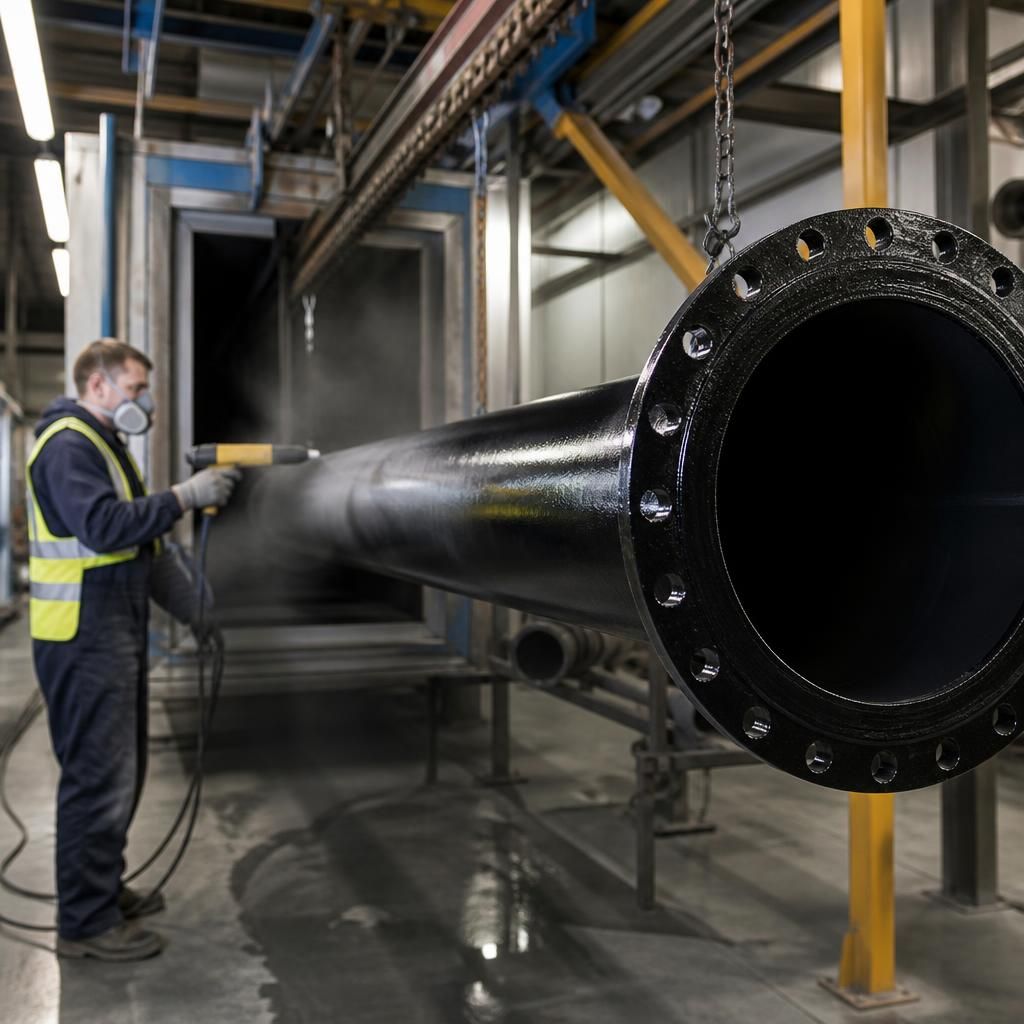
One important benefit of fusion bonded epoxy is the barrier created by its dense, crosslinked structure. Once cured, the film restricts the movement of water, oxygen and dissolved salts towards the steel substrate, helping to reduce corrosion initiation beneath an intact coating. This makes FBE particularly valuable where metal components may be exposed to soil, moisture or immersion.
The barrier effect is most reliable when the coating specification matches the service environment. Factors such as immersion, temperature, chemical exposure and the required film thickness should be assessed before selecting the formulation, rather than treating all fusion bonded epoxy coatings as interchangeable.