

What are the benefits of powder coating steel and aluminium over traditional painting methods?
Powder coating steel and aluminium provides a tougher, more uniform and longer-lasting finish than traditional liquid paint, with stronger resistance to chipping, scratching, corrosion and weathering. The dry powder process also produces less liquid waste and can deliver a consistent finish across batches when the metal is correctly prepared.
Powder coating is generally preferable to traditional liquid painting for steel and aluminium when the component can be prepared, coated and oven-cured as part of a controlled production process. The main advantages are the way the coating is applied, the controllable film thickness, the range of available finishes and the reduced risk of application defects associated with wet paint.
A more controlled application process
Liquid paint is applied as a wet film using spray equipment, brushes or rollers. Its performance can be affected by solvent evaporation, humidity, temperature, application technique and the time allowed between coats. Powder coating uses electrically charged dry particles, which are attracted to the earthed metal component before being melted and cured in an oven. This gives the coater greater control over how the material is deposited and cured.
The dry application also avoids several common wet-paint problems, including runs, sags and some brush or spray marks. Correct preparation remains essential, but the coating process itself is well suited to repeat production of brackets, frames, panels, enclosures, fabricated assemblies and other metal components.
Film thickness and edge coverage
Powder can produce a substantial protective film in a single controlled application, rather than relying on several liquid coats to achieve the required build. This can be useful on fabricated steel and aluminium parts with exposed edges, corners and formed sections. The result depends on the powder specification, application settings, component geometry and curing conditions; powder coating is not a substitute for suitable design or preparation.
Liquid paint can collect at corners or flow away from edges while drying. Powder application can provide more consistent deposition around many profiles, although recessed areas, Faraday cage effects and inaccessible faces still need to be considered during racking and spraying. Components should therefore be reviewed before coating if they have deep recesses, narrow cavities or close-tolerance mating surfaces.
Fewer wet-process limitations
Traditional painting often involves primer, intermediate coats and a topcoat, with drying or flash-off periods between stages. Powder coating can combine the required finish in a more streamlined coating sequence where the specification allows it. This may simplify handling and reduce the opportunity for contamination between wet coats. It also avoids the storage and handling issues associated with open tins of liquid paint and solvent-containing materials.
These benefits do not mean that powder coating is suitable for every part. The component must normally tolerate the curing temperature, and the design must allow it to be cleaned, racked and exposed to the spray equipment. Large fixed structures, heat-sensitive materials and components requiring on-site application may still be better suited to liquid paint.
Choice of colour, gloss and texture
Powder systems are available in a wide selection of colours and surface effects, including different gloss levels, fine textures and more pronounced textured finishes. This allows steel and aluminium components to be specified for appearance as well as function. A finish can be selected to support a product design, identify different assemblies or provide a particular visual texture.
Colour selection should be agreed before production because changes in powder formulation, gloss level, substrate, film thickness and curing can affect the final appearance. Parts intended to be viewed together should be processed under comparable conditions. A physical sample or approved reference can be useful where colour matching is important.
Suitability for steel and aluminium
Powder coating can be used on both steel and aluminium, but the preparation requirements are not identical. Steel may require degreasing, mechanical preparation and a suitable chemical pretreatment to remove contamination and provide an appropriate surface. Aluminium has its own oxide layer and requires preparation that supports adhesion without damaging the substrate.
For either metal, the coating specification should reflect the component’s expected environment and use. Areas such as welds, sharp edges, drilled holes and joints need particular attention because poor preparation in these locations can affect the finished system. Masking may also be required where threads, earth points, bearing faces or close-fitting surfaces must remain free of coating.
Important comparison points
- Powder coating is normally applied and cured as a dry-to-finished coating system, whereas liquid paint commonly requires wet coats and intervening drying stages.
- The powder process can reduce defects linked to wet paint flow, solvent evaporation and handling between coats.
- A broad choice of colours, gloss levels and textures is available for both functional and decorative requirements.
- Steel and aluminium need appropriate, metal-specific cleaning and pretreatment; neither material should be coated successfully by relying on powder alone.
- Oven curing and component size are practical constraints that should be checked before selecting the process.
For B2B projects, the most suitable comparison is therefore not simply powder versus paint, but which coating system matches the metal, component design, operating environment, appearance requirements and production method. Powder coating is particularly effective where repeatable factory processing, a defined finish and controlled preparation can be built into the specification.
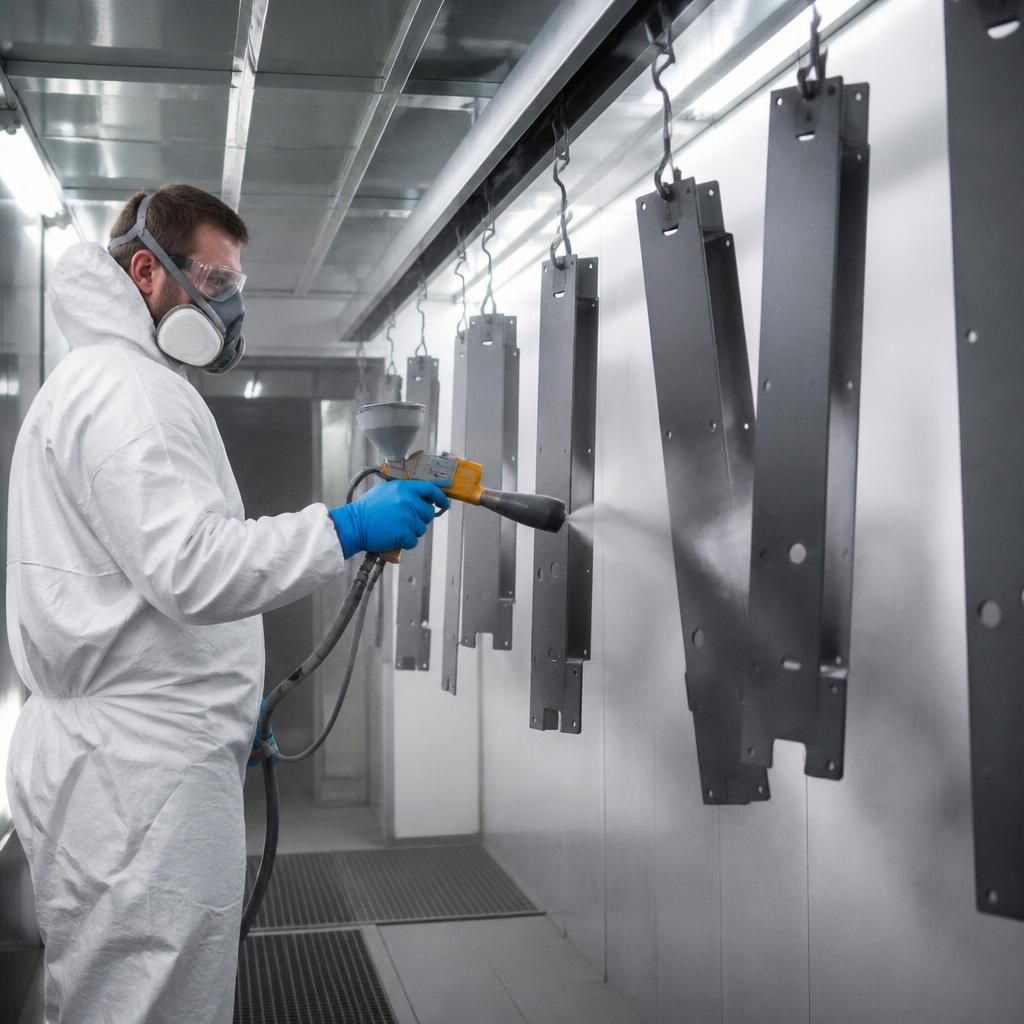
Powder coating can reduce reliance on solvent-based materials because the coating is supplied as a dry powder rather than a liquid containing solvent. This means there is no solvent evaporation during application or curing, helping to reduce solvent-related emissions compared with solvent-borne liquid paint.
For manufacturers and fabricators, this can simplify the handling and storage of coating materials. Any environmental benefit still depends on the powder formulation, preparation methods and overall process controls, so the coating specification should be assessed alongside the component’s performance requirements.
Discuss the right coating for your steel or aluminium components
To compare powder coating with liquid paint for a specific component, discuss its substrate, dimensions, operating environment and finish requirements with the team. They can help identify whether the part is suitable for powder coating and what preparation the specification should include.