

What are the advantages of using conveyorised powder coating lines for large-scale production?
Conveyorised powder coating lines support large-scale production by moving components through preparation, coating and curing in a controlled, continuous sequence. They increase throughput, reduce manual handling and help produce repeatable finishes across high-volume batches, making production easier to plan and monitor.
The main advantages of conveyorised powder coating lines for large-scale production are scalable capacity, controlled process flow, lower reliance on repetitive manual work and more efficient use of production resources. Components are mounted onto a moving conveyor and pass through the required preparation, application and curing stages at a managed rate, allowing the coating operation to function as an integrated manufacturing process rather than a series of disconnected tasks.
For manufacturers handling sustained demand, a conveyorised line can provide a more suitable production structure than standalone coating equipment. The line can be configured around the size, weight and geometry of the parts, with suitable hooks, jigs or fixtures supporting components during movement. This helps a business establish a repeatable production route for its regular product range while retaining scope to accommodate different component types where the system has been designed for that purpose.
A further advantage is the ability to separate production roles more effectively. Loading, unloading, inspection and process supervision can be organised around the line, while the conveyor controls the movement of parts between stages. This allows skilled staff to concentrate on checks, adjustments and exception handling rather than spending all their time transferring components between individual operations. The result is a more structured use of labour, particularly where large quantities of similar parts are being processed.
Conveyorised systems can also improve the relationship between coating and the wider manufacturing process. They can be positioned as part of a planned production route, with component flow linked to fabrication, assembly or dispatch requirements. This reduces the need to treat coating as an isolated subcontracting or finishing step and makes it easier to define responsibilities for loading, inspection, curing and release. For businesses coordinating several production stages, that integration can simplify handovers and reduce uncertainty about where parts are within the finishing process.
Controlled movement through the line supports more stable operating conditions. Conveyor speed, oven temperature, spray settings and booth arrangements can be selected to suit the coating specification and component design. Once the process has been properly established, these settings provide a defined operating framework for production staff to follow. This is valuable when the finish must meet a documented specification across a substantial order, although the appropriate settings still depend on the metal substrate, part geometry, powder system and required film performance.
There may also be operational and cost advantages from making better use of equipment. A curing oven, spray booth and preparation equipment can be coordinated around a planned flow of work instead of being repeatedly started, stopped and reconfigured for individual items. Where the line is correctly sized and loaded, this can support more predictable use of energy, booth capacity and floor space. Powder recovery and application efficiency may provide additional benefits when the equipment is designed to collect and reuse suitable overspray, subject to the powder manufacturer’s requirements and colour-management considerations.
Conveyorised lines can support expansion as production requirements change. A business may begin with a line designed for a particular range of components and later modify fixtures, add preparation or application equipment, or adjust the layout to accommodate increased demand. The practical scope for expansion depends on the available building space, extraction and curing capacity, electrical supply, component mix and required finish. These factors should be considered before installation because a conveyorised system is a fixed production asset rather than a fully flexible replacement for every type of coating work.
The advantages are strongest where:
- the business processes regular volumes of components with broadly compatible handling requirements;
- parts can be loaded onto suitable fixtures and presented consistently to the coating equipment;
- the required finish and curing conditions can be defined clearly;
- there is sufficient space for preparation, coating, curing, cooling, inspection and unloading; and
- production demand justifies investment in dedicated line equipment.
A conveyorised line is less automatically advantageous for highly irregular one-off work, very large components that cannot be safely supported on a standard conveyor, or production with frequent colour and specification changes. In those circumstances, a batch-based system may offer greater flexibility. The best choice therefore depends on the balance between volume, component variety, finish requirements, available space and the need for future capacity.
For large-scale production, the central benefit is not simply moving parts from one point to another. It is creating a defined, scalable manufacturing route in which equipment, people and process controls are arranged around the coating requirement. When the line is properly specified for the work, it can make high-volume powder coating easier to resource, control and expand.
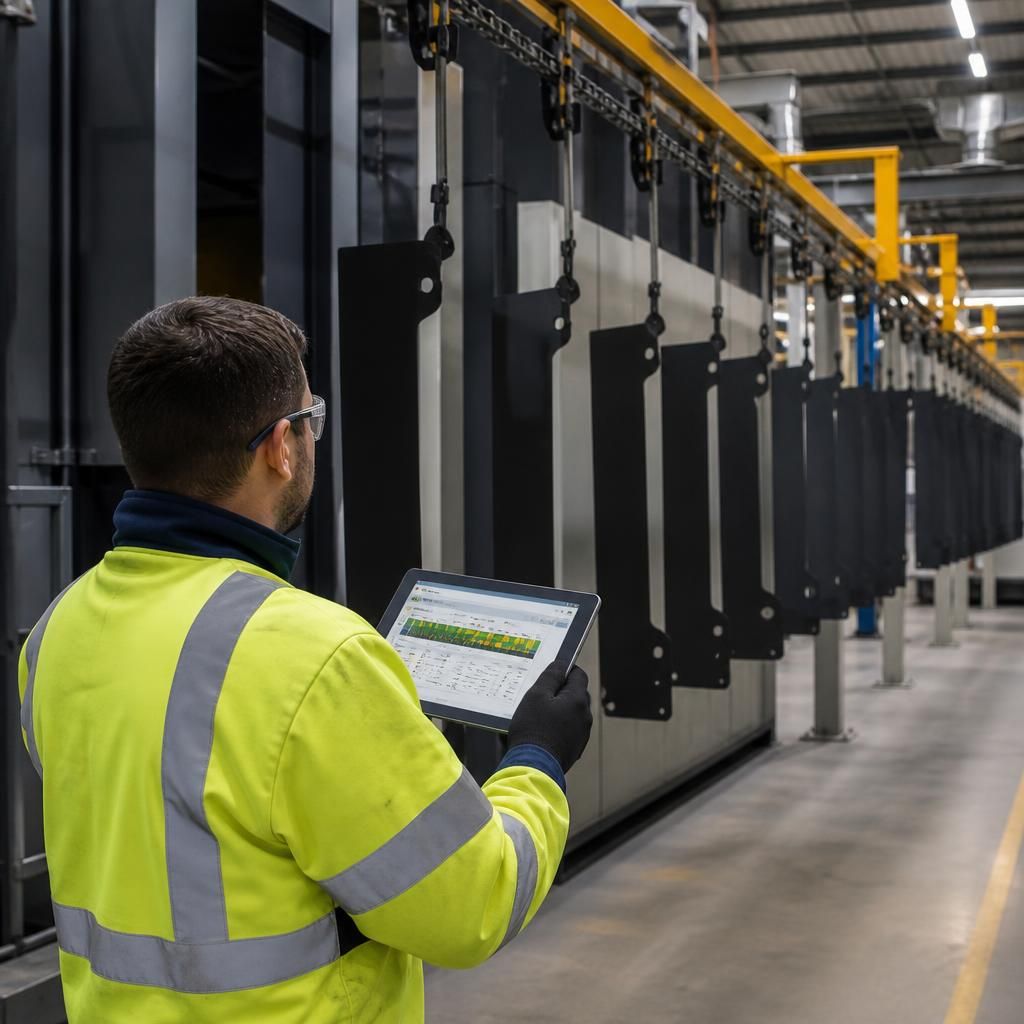
A further advantage of a conveyorised powder coating line is clearer process traceability. Parts move through defined stages, making it easier to identify which load, fixture or process stage was involved if an inspection identifies a problem. Components can then be held for review before they move into assembly or dispatch, rather than allowing an issue to pass unnoticed through a less structured route.
This visibility also supports more disciplined production records. Businesses can document coating specifications, line settings, inspection points and batch movements against the relevant order or component group. For large-scale work, that information helps production and quality teams investigate non-conformances, repeat an established process and demonstrate that the finishing route was controlled.