

How can the choice of pretreatment chemicals influence the visual outcomes, such as different finishes like matte grey or custom powder coatings, in the powder coating process?
Pretreatment chemicals influence the final appearance by removing contaminants and creating a consistent conversion layer, helping the powder coat form an even, uniform finish. They do not create the colour or texture themselves, so matte grey, gloss and custom powder coating results depend mainly on the selected powder, while suitable pretreatment supports consistent coverage and reduces visual defects.
Pretreatment chemicals influence visual outcomes mainly by determining how clean, chemically stable and receptive the metal surface is before powder application. The choice affects whether the finished coating appears even and defect-free or shows problems such as staining, craters, pinholes, blistering, patchy gloss and premature local failure. The powder formulation still determines the chosen colour, gloss level and texture, but pretreatment has a significant influence on how consistently that finish appears across the component.
Cleaning chemistry and surface appearance
Alkaline cleaners are commonly used to remove oils, drawing compounds, handling contamination and other residues left by fabrication. If the cleaner is too weak, contamination can remain beneath the powder and cause fisheyes, craters or areas of poor wetting. If it is too aggressive, or remains on the part because of inadequate rinsing, it may alter the surface or leave alkaline deposits. These deposits can show as dull patches, streaks or localised colour variation after curing.
Acidic cleaners and deoxidising stages can be important for aluminium and other substrates where oxide, scale or light corrosion needs to be controlled. Their concentration, contact time and compatibility with the metal must be managed carefully. Uneven treatment can produce differences in surface activity across one component, which may become visible as inconsistent gloss or shade after powder coating.
Conversion coatings and visual uniformity
Phosphate and chromate-based processes, as well as newer chrome-free systems, create a chemically treated surface intended to support the coating system. They can influence how uniformly the powder wets and cures over broad faces, corners, welds and recessed areas. A suitable process helps reduce differences between these areas; an unsuitable one can leave visible variation even when the same powder has been applied throughout.
The appearance of the conversion coating itself is not necessarily the appearance of the final powder coat. For example, a grey or iridescent chemical film should not be treated as a prediction of the finished shade. Its relevance is the condition it leaves behind, including coverage, continuity and the absence of loose or reactive deposits. Excessive coating build-up, poor rinsing or an incompatible chemistry can interfere with the powder film and create local changes in sheen.
Why rinsing and drying affect the result
Rinsing is a visual-quality control stage as well as a preparation step. Residual cleaner, phosphate, chromate or rinse salts can dry on the metal and form marks that remain visible through the powder finish. Such residues may also react during curing, contributing to blistering, pinholing or small areas that appear flatter or glossier than the surrounding surface.
Water quality, spray coverage, drainage and drying are therefore relevant to the final appearance. Complex fabrications need particular attention because liquid can collect in seams, folded sections and hollow areas. If trapped solution reaches the powder application stage, it can cause isolated defects that are difficult to distinguish from application or curing problems.
Matching chemistry to the metal and the powder system
The substrate should be identified before selecting the chemical sequence. Steel, galvanised steel and aluminium have different oxide layers and respond differently to cleaning and conversion treatments. A process suitable for one metal may etch another unevenly or fail to control existing surface contamination. Mixed-metal assemblies require additional care because galvanic effects, dissimilar surface reactions and different drainage behaviour can produce inconsistent results on the same job.
The powder system also matters. Smooth high-gloss finishes tend to reveal small surface and pretreatment variations more readily than textured or low-gloss products. A matte grey powder can mask some fine irregularities, but it will not conceal residue, craters, runs, blisters or substantial shade variation. Custom colours can make batch-to-batch consistency particularly important, because a change in surface condition may be perceived as a colour difference even when the powder is nominally the same.
Process control is as important as chemical selection
Choosing the correct chemical family is only the first decision. Concentration, temperature, contact time, spray pressure, bath contamination, rinsing and drying must remain within the process requirements. A suitable chemical operated outside its intended range can produce a worse visual result than a less complex system that is properly controlled.
When investigating an uneven finish, it is useful to separate pretreatment-related causes from powder application and curing causes. Check for:
- streaks or water marks that follow drainage paths;
- defects concentrated around welds, seams or recessed sections;
- differences between exposed faces and areas with limited spray contact;
- powder loss, cratering or poor wetting in particular zones; and
- changes that coincide with a new chemical bath, rinse condition or metal supplier.
These patterns can indicate whether the issue lies in cleaning, conversion treatment, rinsing or drying rather than in the selected colour. For a matte grey or custom powder coating, the most reliable approach is to specify the substrate, required appearance, service conditions and powder system together, then validate the pretreatment sequence on representative components before full production. This avoids selecting chemicals solely by their name or colour and focuses on the surface condition needed for a consistent finished appearance.
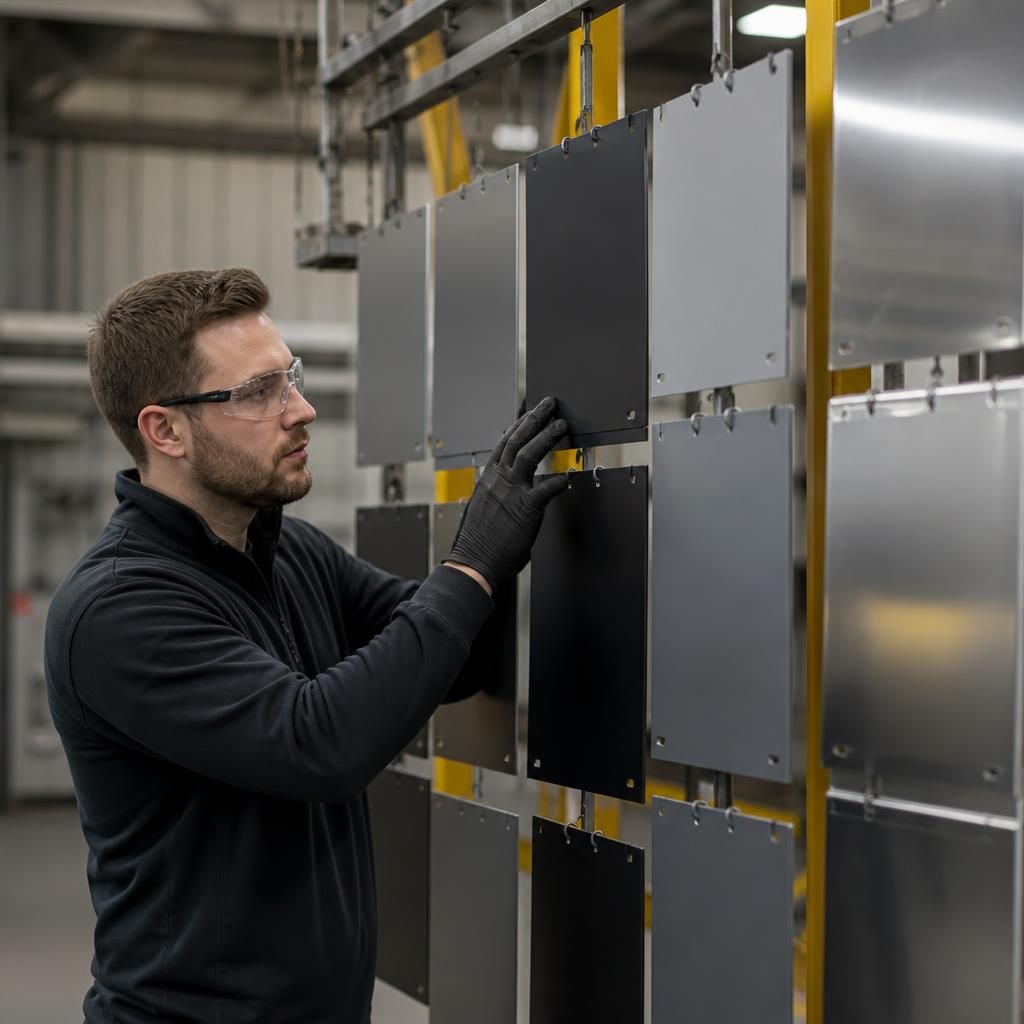
Pretreatment can influence perceived colour more directly when the powder coating is translucent, clear, metallic or otherwise sensitive to the surface beneath it. With an opaque powder, the chemical stage mainly supports consistent coverage; with a more transparent or reflective finish, variation in the substrate or conversion layer may affect apparent shade, depth and visual uniformity. This is particularly relevant when specifying custom powder coatings where the intended effect depends on the underlying metal.
For this reason, the pretreatment should be assessed with the actual substrate and powder system rather than judged only by the appearance of the treated metal. A process that produces an acceptable result beneath a standard solid colour may not give the same visual outcome beneath a special-effect finish. Representative test pieces allow the coating system to be reviewed as a complete combination of metal, pretreatment and powder before production parts are processed.
Discuss the Right Pretreatment for Your Powder Coating Finish
Share your metal substrate, required appearance and service conditions with the powder-coating team to discuss a pretreatment route suited to your chosen finish. Representative components can then be considered before the process is applied to a full production batch.