

What are the potential impacts of using inadequate pretreatment chemicals on the final powder coating performance and longevity?
Inadequate pretreatment chemicals can leave contaminants, oxides or residues on the metal, weakening powder coating adhesion and reducing resistance to corrosion, moisture and chemical exposure. The resulting finish may blister, peel, discolour or fail prematurely, shortening the component’s service life and increasing rework or replacement requirements.
Inadequate pretreatment chemicals can compromise powder coating performance by producing an inconsistent or chemically unsuitable surface before powder is applied. The effects are not limited to early coating failure: poor pretreatment can also reduce finish uniformity, impair process control, create defects that are difficult to diagnose and leave the coated component unsuitable for its intended environment.
Surface preparation may become incomplete. A cleaning stage with insufficiently effective chemistry may fail to remove oils, drawing compounds, machining fluids, dirt or handling residues. If the solution is too weak, incorrectly specified or contaminated, these materials can remain in patches across the component. The powder may then wet out differently from one area to another, producing variations in texture, gloss or coverage. Residues can also interfere with subsequent conversion treatment, so the problem may originate before the powder is applied.
The conversion layer may be uneven or poorly developed. Pretreatment chemicals must be suitable for the substrate and controlled within the process requirements. Incorrect concentration, pH, temperature, contact time or solution condition can result in areas with little or no conversion coating alongside areas with excessive or irregular deposits. This variation makes the metal surface less consistent and can lead to differences in coating appearance and performance between parts from the same batch.
Residual chemicals can create coating defects. Inadequate rinsing or poor drainage may leave alkaline cleaner, acidic treatment, salts or other process residues on the component. During oven curing, trapped residues or moisture can contribute to pinholing, cratering, bubbling, outgassing or localised surface roughness. Hollow sections, folded edges, threaded areas and overlaps are particularly important because they can retain liquid after processing. The resulting defects may be visible immediately or only become apparent during inspection, assembly or service.
Dimensional and functional details may be affected. Excessive chemical attack or unsuitable treatment can alter fine edges, precision surfaces or threaded features. Deposits trapped in recesses can affect fit, while residue on contact points may interfere with electrical continuity, bonding or assembly. For fabricated and manufactured components, these issues can matter even when the main visible faces appear acceptable.
Different metals require different chemical control. Aluminium, galvanised steel, mild steel and other alloys do not respond identically to cleaners, deoxidisers and conversion treatments. A formulation suitable for one substrate may be ineffective, overly aggressive or incompatible with another. Mixed-metal assemblies therefore require particular care: the process must clean and prepare each exposed metal without creating excessive etching, staining or residue on the others.
Inadequate pretreatment can also reduce the consistency of batch production. Parts at the front and rear of a treatment run may experience different chemical loading, drainage or rinse conditions as the solution becomes depleted or contaminated. This can produce variable results across a single order, making visual inspection alone an unreliable indicator of long-term performance.
Common process causes include:
- incorrect chemical concentration or dosing;
- pH or temperature outside the treatment supplier’s specified range;
- insufficient contact time or incomplete coverage;
- cleaner, rinse water or treatment stages contaminated by accumulated oils, salts or metal residues;
- poor rinsing, drainage or drying between stages;
- using a treatment designed for a different metal or coating system; and
- failure to adjust the process after changes to the substrate, component design or production load.
The practical consequences include additional inspection, sorting, stripping and recoating, as well as difficulty identifying whether a defect arose from the metal, pretreatment, powder application or curing stage. A coating that looks acceptable after curing can still have reduced service capability if the underlying pretreatment was inconsistent, so visual approval should be supported by process records and appropriate testing for the required application.
Control measures should include verified chemical dosing, documented operating ranges, regular checks of pH and temperature, monitoring of bath contamination and rinse quality, and confirmation that components are fully drained and dried. The treatment sequence should be selected for the actual substrate and powder coating system, with particular attention to welds, edges, cavities and assembled parts. Where a failure occurs, examining the pretreatment stages alongside powder application and curing is more reliable than attributing the problem to the powder alone.
For components intended for demanding industrial, construction or automotive environments, the pretreatment specification should be agreed before production begins. This helps ensure that the chemical process, conversion coating, rinsing and inspection method are appropriate for the metal, service conditions and required finish rather than relying on a generic treatment.
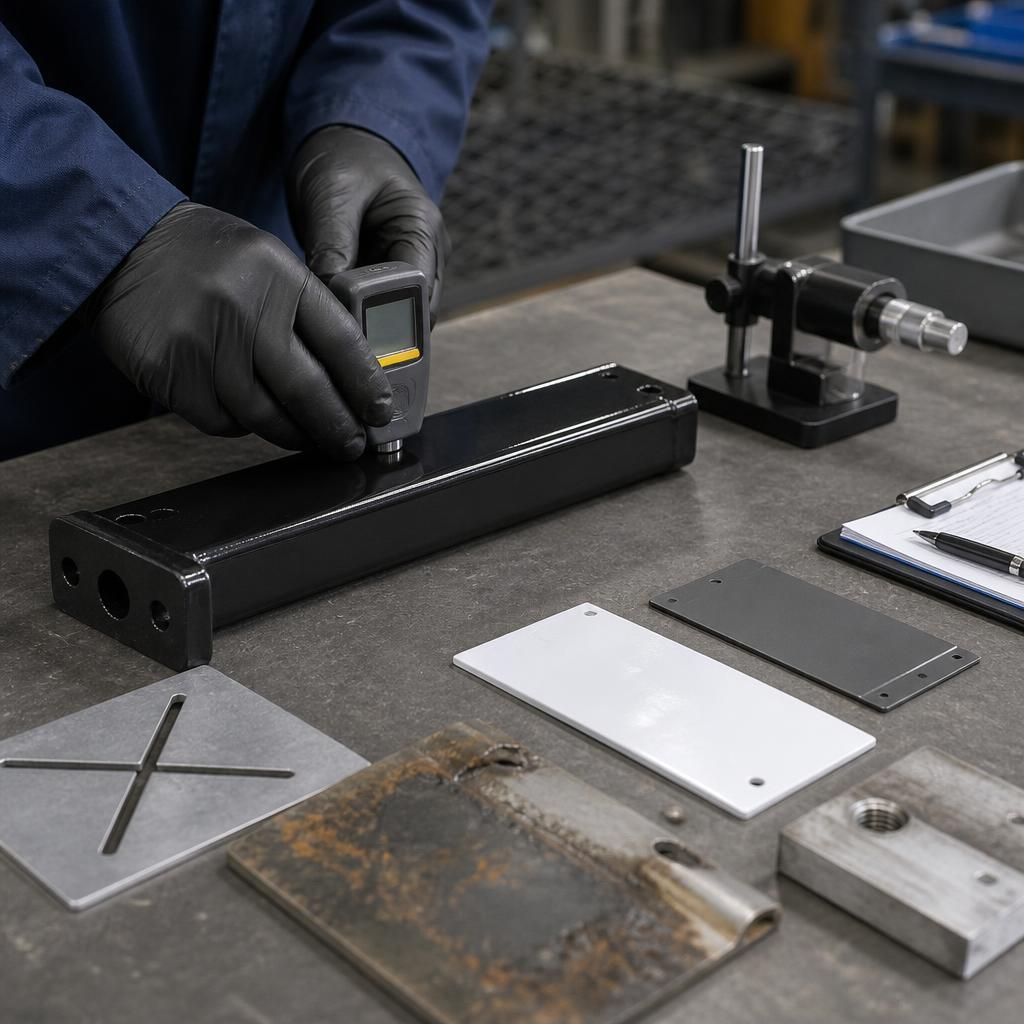
The most serious impact of inadequate pretreatment is that a coating can pass a visual inspection while lacking reliable performance under service conditions. Surface-related failures may develop gradually, so the finish can appear uniform immediately after curing but lose adhesion or protective capability when exposed to moisture, salts, chemicals, abrasion or temperature changes.
Testing should therefore assess more than colour, gloss and visible defects. Depending on the component and specification, useful checks may include:
- adhesion testing to identify weak bonding between the coating and substrate;
- coating thickness measurements to confirm consistent application, while recognising that thickness does not prove the pretreatment was suitable;
- inspection of cut edges, joints and concealed areas where treatment coverage may be less reliable; and
- controlled exposure testing where the component requires evidence of resistance to a defined service environment.
These checks help separate a pretreatment-related failure from problems in powder application or curing. If results indicate weak surface preparation, applying another powder layer without correcting the chemical process may conceal the defect rather than resolve its cause.