

What role does surface cleanliness play in ensuring the success of powder coating applications, and how can sandblasting contribute to achieving this cleanliness?
Surface cleanliness is essential because oil, rust, mill scale, moisture and other contaminants can prevent powder from bonding consistently to the metal. Sandblasting removes these impurities and creates a suitable surface profile, helping the powder coat adhere evenly and form a durable finish.
Surface cleanliness determines whether a powder coating can form a continuous, well-bonded film. Preparation must remove substances that separate the coating from the metal, while leaving a consistent surface for the powder to key into. Sandblasting contributes by using controlled abrasive impact to clean, texture and expose the substrate before coating, but the result depends on suitable media, equipment settings and careful handling after blasting.
Cleanliness is more than making a component look bright. A surface may appear acceptable while still carrying thin residues such as oil, grease, salts, marking materials, cleaning chemicals or loose oxide. These contaminants can interfere with electrostatic powder deposition, curing and adhesion. Some may also draw moisture beneath the coating, creating localised blistering, corrosion or loss of adhesion later in the component’s service life.
Sandblasting tackles contamination mechanically. Abrasive particles strike the surface at controlled velocity, breaking away rust, mill scale, old coatings and other firmly attached layers. This is particularly useful on fabricated parts with weld areas, heat-affected zones, corners or uneven profiles where hand preparation may be inconsistent. The process can also reveal defects that need attention before coating, including sharp edges, weld spatter, pits and areas of remaining corrosion.
The abrasive and blasting settings must suit the metal and the required finish. A coarse or aggressive treatment may be appropriate for heavy corrosion or a robust steel component, whereas a softer or finer abrasive may be preferable for aluminium, thin sheet or a surface that could distort. Excessive pressure or dwell time can remove too much material, round defined edges or create an unsuitable profile. Insufficient treatment can leave isolated contamination or produce uneven adhesion across the same part.
A suitable surface profile is important because it provides a mechanical key for the powder film. However, a deeper profile is not automatically better. The texture needs to be compatible with the coating system and the thickness of the component. If the profile is too pronounced, the powder may not cover the recesses consistently; if it is too shallow or variable, adhesion may be less reliable. Consistency across the whole component is therefore as important as the average appearance.
Effective preparation normally involves several checks:
- Assessment before blasting: identify the base metal, existing coating, corrosion level, weld condition and any areas requiring masking or special treatment.
- Controlled blasting: select media and settings that clean the surface without damaging the substrate or creating excessive roughness.
- Visual inspection: check that rust, scale, previous coatings and embedded residues have been removed from faces, edges, recesses and welds.
- Contamination control: prevent blasted parts from being touched with dirty gloves or exposed to fresh oil, dust, water or workshop debris.
- Pre-coating protection: move prepared parts into suitable conditions for powder application without allowing corrosion or contamination to develop again.
Timing and handling after blasting matter because freshly prepared metal is more vulnerable to moisture and airborne contamination than a previously coated surface. Flash rust can develop on ferrous metals where humidity, condensation or water-based residues are present. For this reason, the prepared surface should be kept dry and handled with clean equipment. If contamination or oxidation appears before coating, the affected area may need further preparation rather than simply being covered with powder.
Sandblasting also supports more reliable coating inspection. A uniformly prepared substrate makes it easier to identify thin coverage, missed areas, embedded debris and edge-related problems after powder application. Where a component has complex geometry, preparation should account for internal corners, holes, threads and contact points, since these areas can collect abrasive or remain insufficiently cleaned. Masking and subsequent removal of media may be necessary before coating proceeds.
It is important to distinguish abrasive cleaning from degreasing. Blasting can remove many surface deposits, but heavy oil or grease may smear across the metal or contaminate the abrasive rather than being removed cleanly. Pre-cleaning may therefore be needed, depending on the condition of the component and the blasting process. The prepared surface must ultimately be free from both visible residues and substances that could affect coating performance.
For industrial components, the appropriate cleanliness level should be agreed against the coating specification and the environment in which the part will be used. More demanding exposure conditions generally require tighter control of preparation, inspection and handling than a component used in a mild indoor setting. A documented preparation requirement can help ensure that repeat batches receive the same treatment and that any variation in substrate condition is addressed before powder coating.
In practical terms, sandblasting improves powder coating preparation by creating a clean, compatible and consistently textured substrate. It cannot compensate for unsuitable metal condition, poor handling or incorrect curing, but when integrated with inspection and controlled powder application, it gives the coating the foundation needed for dependable adhesion and a uniform finished surface.
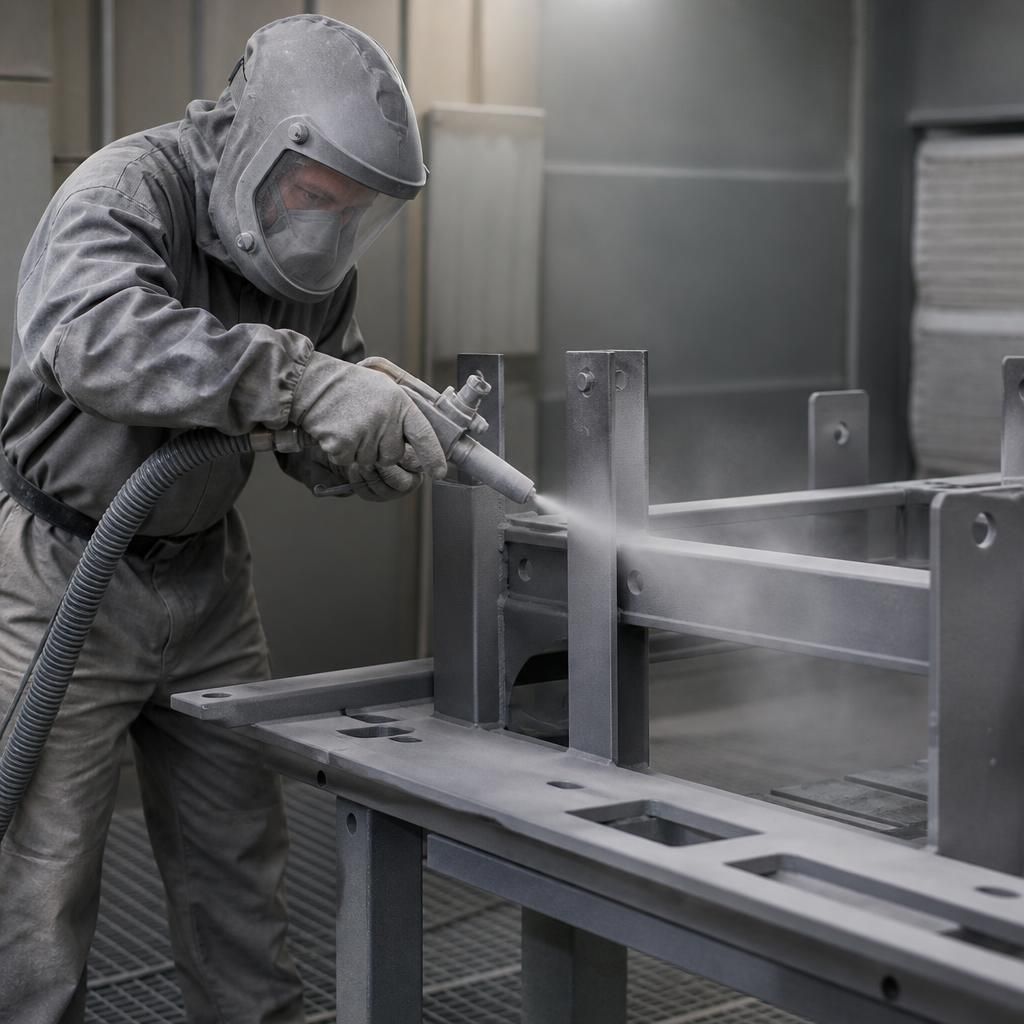
Surface cleanliness affects the visual quality of a powder-coated part as well as its adhesion. Fine dust, abrasive residue or embedded debris can become trapped in the film, producing raised particles, rough areas or local coating defects that may only become apparent after curing. Sandblasting therefore needs to be followed by thorough removal of loose media, particularly from holes, threads, joints and recessed sections.
Good preparation also requires the component to be presented consistently during blasting. Fixtures, masking and access points should allow the abrasive to reach each coating surface without creating untreated shadows. Once blasting is complete, the part should be transferred using clean handling methods and checked under suitable lighting before powder application. This links the blasting process to the finished result: a clean, evenly prepared substrate gives the powder a more consistent foundation across the entire component.