

What factors should be considered when deciding between sandblasting and shotblasting for surface preparation in powder coating?
The choice between sandblasting and shotblasting depends on the metal substrate, component size and geometry, existing contamination, required surface profile and the powder coating system to be applied. Shotblasting generally suits robust steel parts requiring more aggressive preparation, while sandblasting allows greater control on delicate, intricate or heat-sensitive components when an appropriate non-silica abrasive is selected.
The decision between sandblasting and shotblasting should be based on the required surface condition, the part’s dimensional sensitivity, the type of metal and the powder coating system that will follow. Neither method is automatically better: the correct choice is the one that removes unwanted material without damaging the component and leaves a clean, suitably keyed surface for the coating process.
Consider the level of preparation required. Shotblasting is typically selected where a robust cleaning action is needed. Metallic shot or grit can remove mill scale, rust, old coatings and tightly bonded residues from durable steel components. It is often effective for preparing fabricated or structural parts that can tolerate a more forceful impact. Sandblasting, more accurately described as abrasive blasting when a non-silica medium is used, provides a broader choice of abrasive types and can be adjusted for a less aggressive treatment.
Assess the substrate and its thickness. Thick steel generally tolerates the impact energy associated with shotblasting. Thin sheet, light-gauge sections, aluminium and other softer metals require greater control because excessive blast energy can cause distortion, edge damage, warping or an unwanted change in the surface texture. The hardness, shape and condition of the metal should therefore be considered alongside the name of the blasting method.
Match the abrasive to the required surface profile. Powder coating needs a clean, stable surface with enough mechanical key for the coating to bond consistently. A profile that is too shallow may provide limited adhesion, while an unnecessarily coarse profile can affect coating coverage, appearance and the amount of powder required to cover peaks and recesses. Abrasive size, hardness, blasting pressure, nozzle distance and angle all influence the resulting profile, so the equipment setting is as important as the broad choice between sandblasting and shotblasting.
Look closely at component geometry. Recesses, holes, folded edges, welds and internal corners can be difficult to treat uniformly. Airborne abrasive blasting can offer more directional control in these areas, particularly where the operator needs to work around a delicate feature. Shotblasting equipment may be efficient for parts with accessible, open surfaces, but complex components need checking to ensure that all coating areas receive sufficient preparation without excessive treatment of exposed edges.
Take existing finishes and residues into account. Oil, grease and handling residues should be removed as part of the pretreatment sequence rather than relying on abrasive action alone. Blasting can expose a surface while spreading contamination if the component has not been cleaned properly. Previous paint, corrosion products and mill scale may also require different stages or abrasive settings. After blasting, the prepared metal should be protected from fresh contamination and coated within an appropriate process window.
Consider the risk of abrasive contamination. The abrasive must be suitable for the metal and the coating specification. Some media can leave embedded particles or introduce residues that interfere with adhesion or appearance. For this reason, abrasive condition, equipment cleanliness and separation between different materials are important, particularly where the same preparation equipment is used for several types of metal.
Review the required appearance as well as adhesion. Preparation affects more than whether the powder remains attached. Uneven blasting can become visible through the finished coating, especially on large flat faces or parts with a high-gloss finish. A heavily textured surface may be acceptable for an industrial component but unsuitable where a smoother decorative appearance is required. The specification should define the acceptable surface condition before work begins.
Factor in component handling and dimensional control. Parts should be supported so that their coating faces are exposed without creating contact shadows or unprepared areas. Fragile projections, threaded sections, machined faces and close-tolerance interfaces may need masking or an alternative preparation method. Blasting should not remove material from functional surfaces or compromise the fit of components that must be assembled after coating.
Compare process efficiency and practical cost. Shotblasting can be efficient for repeat batches of suitable steel parts, particularly where consistent loading and recovery of the abrasive are possible. Airborne abrasive blasting may be more practical for varied components, localised preparation or work requiring close operator control. The meaningful comparison is not simply the cost of the blasting stage; it includes masking, cleaning, handling, abrasive consumption, inspection and any rework caused by an unsuitable profile.
A practical selection process is to:
- identify the metal, thickness, hardness and any sensitive machined areas;
- define the contaminants and existing coatings that must be removed;
- specify the required cleanliness and surface profile;
- select an abrasive that will not damage or contaminate the substrate;
- check whether the component’s geometry can be treated evenly;
- confirm the preparation requirements of the powder coating system; and
- inspect the blasted surface for cleanliness, uniformity, damage and remaining residues before coating.
For many durable steel components, shotblasting is a practical choice where strong, repeatable preparation is required. For lighter, more intricate or more sensitive parts, controlled abrasive blasting with a suitable non-silica medium may provide better control. The final decision should be made from the component drawing, the coating specification and a representative trial or inspection standard rather than from the process name alone.
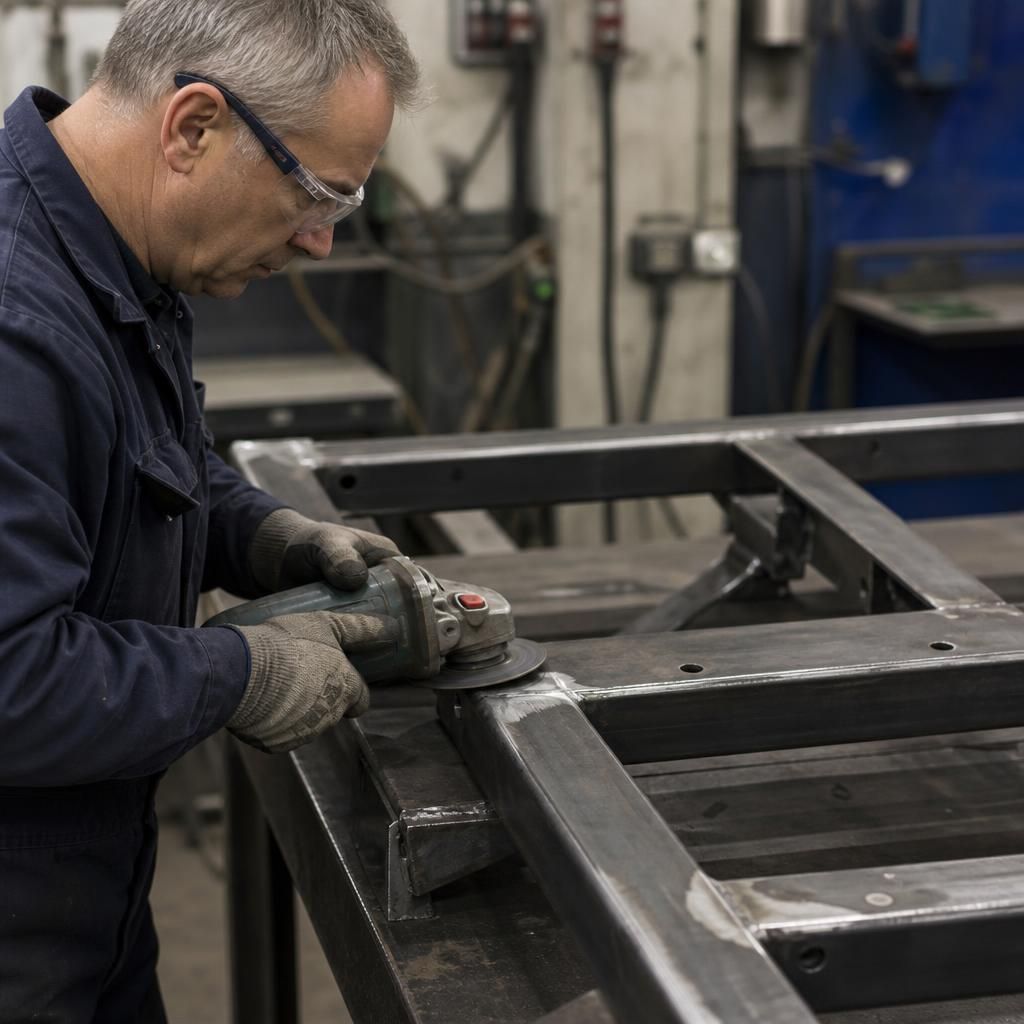
Blasting should not be used to correct fabrication defects. Before choosing sandblasting or shotblasting, check whether the component has sharp burrs, weld spatter, deep scratches, dents or rough edges that could remain visible beneath the powder coating.
These defects may need grinding, dressing or other mechanical correction before abrasive preparation. Blasting can clean and texture the metal, but it will not reliably level a raised weld, remove a deep mark or restore a damaged edge. Treating such areas first helps prevent the blasting method from being selected simply to compensate for an underlying manufacturing issue.
- Remove loose weld spatter and burrs before blasting.
- Confirm that sharp edges are suitable for the specified coating system.
- Separate cosmetic repairs from the cleaning and profiling stage.
- Inspect repaired areas so they receive the same preparation as the surrounding metal.
Discuss the Right Blasting Method for Your Powder Coating Project
Discuss your component drawing, substrate and coating specification with the powder-coating team to identify the most suitable blasting approach. A representative part or preparation requirement can then be reviewed before the full batch is processed.