

What considerations should be made when choosing an abrasive blasting service to ensure alignment with environmental standards and sustainability practices?
Choose an abrasive blasting service that can demonstrate responsible media selection, effective dust and containment controls, efficient equipment use, and compliant handling, reuse or disposal of spent abrasive. Also assess how clearly it records waste streams and environmental procedures, and whether its preparation methods minimise material use while still achieving the surface profile required for coating.
Choosing an environmentally responsible abrasive blasting service requires more than checking which media it uses. The assessment should cover legal compliance, control of dust and contamination, protection of soil and water, energy and resource consumption, waste documentation, transport, and the service’s ability to provide evidence for the work carried out.
Check the environmental controls for the whole process. A responsible provider should be able to explain how blasting is contained, how airborne particles are controlled, and how the work area is protected from escaping debris. Enclosures, extraction systems, suitable filtration and controlled access can reduce the release of dust beyond the treatment area. Ask how the provider checks that these controls remain effective rather than relying only on general statements about environmental responsibility.
Confirm how contaminants are identified before blasting. Old coatings, oils, corrosion products and residues can alter the classification of the waste produced. Some existing finishes may contain substances requiring additional precautions or specialist disposal. Before work begins, the service should establish what is present on the component, identify any relevant safety information and define how contaminated abrasive and removed coating will be handled. This is particularly important when preparing older fabricated parts or components with several previous coatings.
Assess compliance with waste requirements. The provider should understand its responsibilities for storing, transferring and documenting spent abrasive and removed contaminants under applicable UK waste legislation. Ask whether waste is segregated where necessary, kept in suitable labelled containers, protected from rain and leakage, and transferred using an appropriately authorised waste route. Waste transfer notes or other relevant records can help demonstrate where material went and support a company’s own environmental audit trail.
Look for protection of drains, ground and surface water. Abrasive residues and stripped coatings should not be allowed to enter drainage systems or escape into surrounding ground. Enquire about sealed work areas, collection points, spill procedures and the inspection of storage areas. Wet blasting and wash-down processes also require careful control because the resulting water may contain suspended solids, oils or coating residues. A suitable service should explain how such water is collected, treated or disposed of lawfully.
Examine resource use, not just waste disposal. Sustainability includes the electricity, compressed air and water used to complete the preparation. Relevant questions include:
- How is blasting equipment maintained to prevent unnecessary air or energy consumption?
- Are blast pressures and operating settings matched to the substrate and required surface profile?
- Is water used only where the selected process requires it, and is process water controlled?
- Are lighting, extraction and air systems operated and maintained efficiently?
- Can components be processed in suitable batches to avoid avoidable handling, packaging or transport?
Efficient operation should not be confused with simply using less abrasive. The process still needs to achieve a clean, correctly profiled surface suitable for the specified coating. An inadequate preparation method can lead to repeat treatment, additional material use and unnecessary environmental impact.
Ask how the surface preparation is specified and verified. A clear job specification should identify the substrate, existing finish, required cleanliness, surface profile and any areas that must be protected. Verification may include visual inspection, profile checks, cleanliness assessment and records of deviations. This matters environmentally because controlled preparation reduces the risk of over-blasting, rework or premature coating failure caused by an unsuitable surface.
Review the service’s environmental management evidence. Useful evidence can include documented procedures, staff training records, inspection schedules, incident reporting, waste records and internal reviews. Third-party certification may be relevant, but it should not replace questions about the actual blasting process. A provider should be able to describe what it measures, who is responsible for environmental controls and how corrective action is taken when a control fails.
Consider transport and packaging as part of the assessment. Collection and delivery can add to the environmental impact of a project, particularly when components are moved separately or require extensive protective packaging. Ask whether logistics can be coordinated with the production schedule, whether loads can be consolidated and how packaging is managed after delivery. Packaging should protect the prepared metal from moisture, contamination and impact without creating avoidable waste.
Request proportionate documentation before appointing a provider. For a straightforward project, this may be a written explanation of the media, containment, waste route and inspection method. More complex work may require a method statement, risk assessment, waste classification information, records of collection and delivery, and evidence that relevant legal duties have been considered. The level of documentation should reflect the type of coating being removed, the condition of the component and the potential hazards involved.
Finally, compare services on the quality and traceability of their environmental controls rather than on a single claim such as using recyclable abrasive. The strongest assessment considers the complete chain: identifying contaminants, selecting a suitable process, containing the work, limiting resource use, preventing pollution, documenting waste and delivering a surface that will support the intended coating without repeat preparation.
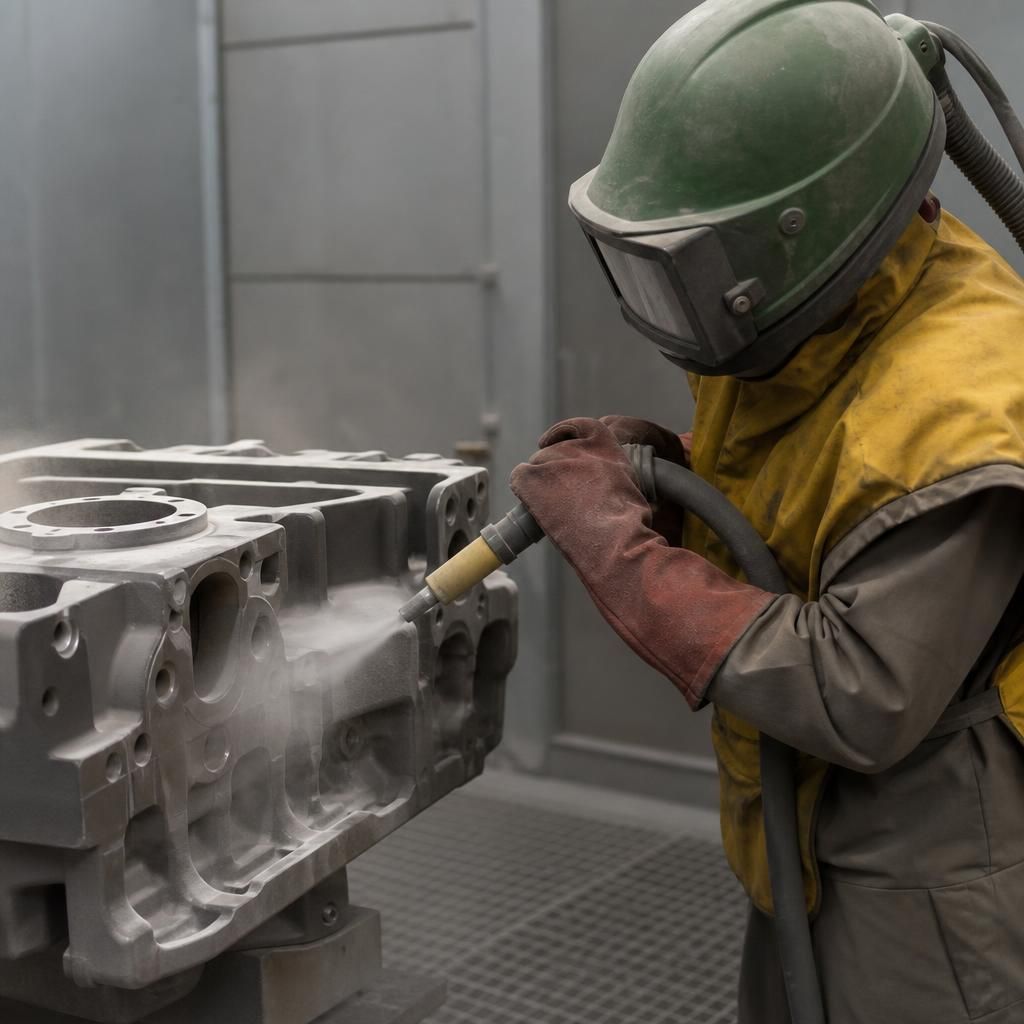
The environmental impact of abrasive blasting can vary with the component’s design and condition, because complex parts may require additional masking, handling and cleaning before they are suitable for coating. Recesses, threaded holes, narrow cavities and assembled sections can retain abrasive or removed coating if the process is not planned around the part geometry.
Ask the service how it manages these areas without introducing unnecessary repeat work. The answer should cover protection of surfaces that must not be blasted, removal of residual media, inspection of difficult-to-reach sections and confirmation that the component is ready for the next treatment. This helps limit avoidable handling, material use and waste while maintaining the preparation standard required for the specified coating.