

What are the most common issues and challenges in aluminium powder coating, and how can they be mitigated?
The most common aluminium powder-coating problems are poor adhesion, surface contamination, outgassing, uneven coverage, colour variation and incomplete curing. They are mitigated through suitable cleaning and pretreatment, correct masking and racking, controlled powder application and oven curing, plus checks on the aluminium grade, coating specification and finished parts.
Aluminium powder coating challenges are usually linked to the alloy, the component’s design, the condition of the surface and the way the part responds to heat. Reliable results depend on selecting an appropriate coating system, preparing the metal for that system, controlling the application environment and checking the finished component against an agreed specification.
Alloy and manufacturing differences
Aluminium is not a single uniform material. Extrusions, castings, sheet, machined parts and welded assemblies can behave differently during preparation and curing. Alloying elements, lubricants from fabrication, casting porosity and heat-affected areas may all influence the final finish. Welds can also retain residues or have a different surface structure from the surrounding aluminium.
The coating specification should therefore identify the aluminium grade or product type wherever possible, together with the intended service conditions. Trial pieces or representative samples can help establish whether the selected pretreatment and powder are suitable before a full production batch is processed. Welded and cast components deserve particular attention because their surfaces may require different preparation from clean, uniform extrusions.
Oxide layers and chemical compatibility
Aluminium rapidly forms a natural oxide layer. This layer is useful for the bare metal, but it must be managed carefully because a coating system needs a stable, chemically compatible surface beneath it. Aggressive or unsuitable preparation can damage the substrate, leave residues or create a surface that does not respond consistently to subsequent treatment.
Mitigation involves choosing a pretreatment sequence appropriate to the alloy and the required level of corrosion protection. Cleaning, controlled abrasion or blasting, rinsing and conversion treatment must be compatible with one another. Water quality, chemical concentration, contact time and rinsing are process controls rather than minor details. Parts should also be thoroughly dried before coating, particularly where water can remain in joints, recesses or hollow sections.
Design features that make coating difficult
Sharp internal corners, deep recesses, narrow slots, overlapping joints and enclosed sections can restrict both pretreatment and powder access. They can also hold moisture or create areas that are difficult to inspect. Thin edges may receive a different film build from broad faces, while threaded holes and close-tolerance mating surfaces can become unusable if they are not protected.
Good design-for-coating practice includes providing suitable drainage and venting, avoiding unnecessary crevices and allowing access for cleaning and spraying. Where the component is being designed or modified, coating allowances should be considered around bores, threads, sliding faces and assembly interfaces. Masking plans should be agreed before production, with plugs, caps or other protection selected for the curing temperature and the required dimensional accuracy.
Racking, electrical contact and Faraday areas
Powder application relies on an electrical relationship between the spray equipment, the powder and the grounded workpiece. Poor contact caused by oxide, previous coating or an unsuitable hanging point can affect transfer efficiency and finish consistency. Recesses, internal corners and boxed sections may also be difficult to coat because the electrostatic field does not reach them evenly. This is commonly described as the Faraday cage effect.
These risks can be reduced by selecting robust contact points, keeping hanging fixtures clean and checking that the parts are properly supported. Racking should expose the surfaces that need coating without allowing movement, contact marks or excessive shadowing. For difficult geometries, the application method, gun settings and spray sequence may need adjustment rather than simply increasing powder output.
Dimensional change and heat-related movement
Powder coating adds a measurable film to the surface, which can matter on precision components, sliding assemblies and parts with tight clearances. Aluminium also conducts heat quickly, so thin and thick sections within the same assembly may reach process temperature at different rates. Delicate fabrications can move or distort if they are inadequately supported.
Critical dimensions should be identified before processing. Masking, racking and loading arrangements can then be designed around those requirements. For thin or complex parts, representative samples can be used to confirm that the chosen cure schedule does not affect flatness or fit. Post-coating inspection should include relevant holes, threads, mating faces and overall geometry, not only the visible colour and gloss.
Moisture, drainage and enclosed sections
Hollow aluminium profiles and fabricated assemblies can trap water, cleaning solution or condensation. If liquid remains inside, it may escape during heating, contaminate the finish or contribute to corrosion at joints. Poorly sealed overlaps can create similar problems in service by allowing moisture to enter and remain trapped.
Components should be designed or prepared with appropriate drain and vent points where practical. Assemblies need enough access for cleaning and drying, and the coater should know which areas are enclosed. Any sealants, inserts or non-metallic components must be checked for compatibility with the preparation and curing conditions.
Choosing the coating for the environment
A finish that is suitable for an internal component may not be suitable for prolonged exterior exposure, industrial pollution, frequent cleaning or contact with chemicals. Colour and gloss are only part of the specification. The required resistance to ultraviolet exposure, corrosion, abrasion, impact and chemicals should be established before the powder is selected.
The specification should state the intended environment, required appearance, substrate, pretreatment level, film-build requirements and any performance tests that matter to the application. This prevents a decorative powder from being selected where a more protective system is needed. Compatibility between the powder, pretreatment and any existing material should also be confirmed, especially when recoating or processing assemblies containing different metals.
Inspection and process control
Visual inspection alone cannot identify every relevant defect. A practical quality plan may include checks on surface preparation, racking, masking, film thickness, colour, gloss, adhesion and cure, using methods appropriate to the agreed specification. Measurements should be taken from representative areas because complex shapes can produce different results at edges, faces and recesses.
Records of the substrate, preparation route, powder identification, batch details, application settings and oven conditions make it easier to trace variation and prevent its recurrence. Non-conforming parts should be assessed before rework, since stripping and recoating aluminium can affect dimensions or the substrate if carried out too aggressively.
How businesses can reduce risk before production
- Provide drawings, alloy information, service-environment details and critical dimensions.
- Identify surfaces that must remain uncoated, electrically conductive, threaded or dimensionally controlled.
- Show drainage, venting, welds, joints and enclosed sections on the job information.
- Agree the required colour, gloss, texture, protective performance and inspection criteria in advance.
- Use representative samples for unfamiliar alloys, complex fabrications or demanding environments.
- Discuss packaging and handling after coating so that finished surfaces are not damaged before assembly.
For larger or specialist aluminium components, a coating provider should review the part geometry and specification before processing rather than treating every item as a standard flat surface. Clear technical information at that stage allows the preparation, masking, racking, powder selection and inspection approach to be matched to the actual risks.
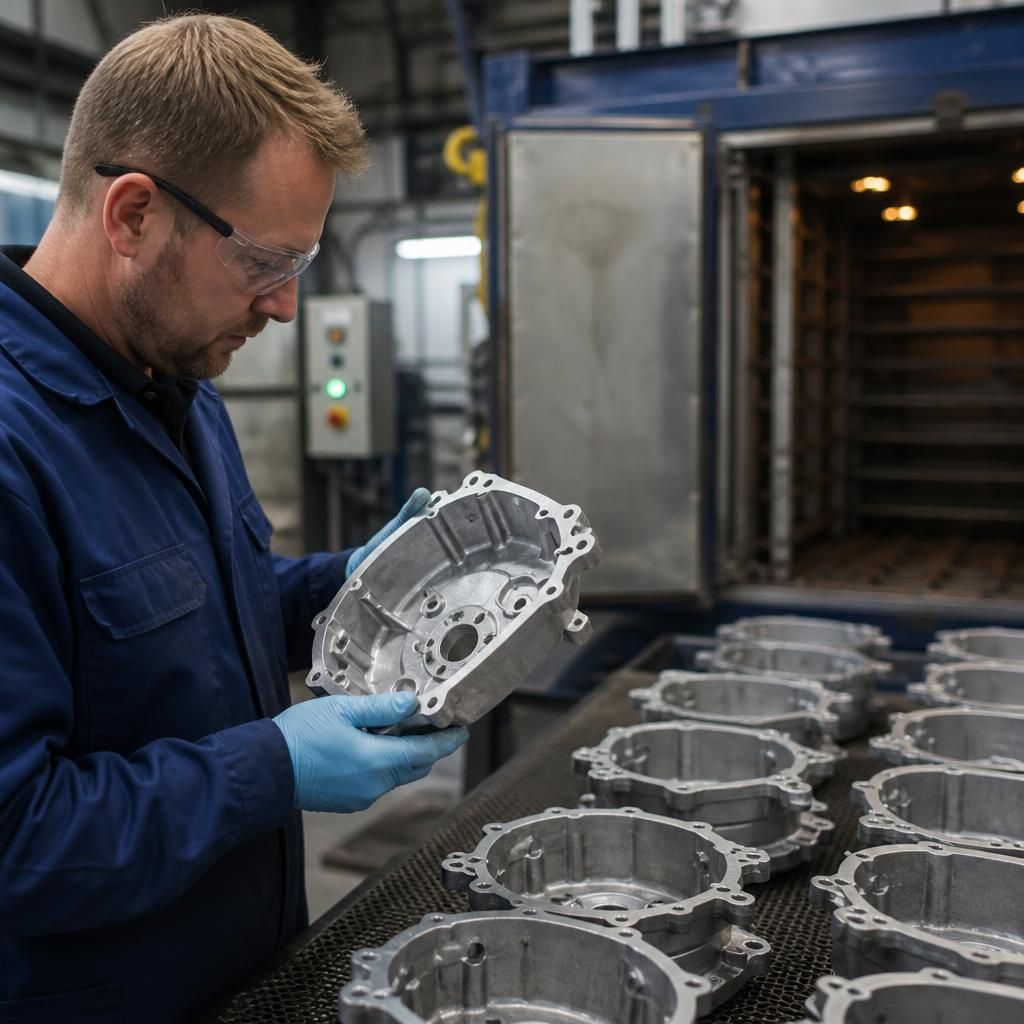
Outgassing is the release of trapped air or moisture from porous aluminium, particularly castings, when the component is heated during curing. The escaping gas can create pinholes, blisters or small craters in the powder film, even when the surface appeared sound before coating.
Risk is reduced by identifying porous castings and contaminated cavities before processing, allowing adequate drying, and selecting a preparation and curing approach suited to the component. In some cases, a controlled preheating or degassing stage can release trapped material before powder application, although this must be assessed alongside the coating manufacturer’s cure requirements. A sample component is useful where porosity is suspected, as it can show whether the proposed process produces an acceptable finish before a production batch is coated.