

How do the curing and baking temperatures impact the performance of high temp and heat resistant powder coatings?
Curing and baking temperatures determine whether a high temperature powder coating develops the correct film structure, adhesion and resistance to heat, chemicals and wear. Insufficient heat or time can leave the coating under-cured and weak, while excessive heat can damage the finish, discolour it or affect the metal component, so the specified curing schedule must be matched to the coating and the part’s actual metal temperature.
Curing and baking temperatures control the chemical reaction that turns powder into a continuous, bonded coating film. The correct result depends on the metal part reaching the coating manufacturer’s specified metal temperature for the required time; the oven air temperature alone does not confirm that the coating has cured correctly.
During curing, the resin and curing agent react and the powder particles flow together. This develops the coating’s hardness, flexibility, adhesion and resistance to chemicals, moisture and heat. A coating that reaches the correct cure schedule can form a consistent film around the component, whereas a schedule that does not provide enough thermal energy may leave the reaction incomplete.
- Under-curing: the film may remain softer or less chemically resistant than intended. Adhesion can be reduced, and the finish may be more vulnerable to marking, abrasion, moisture or cleaning chemicals.
- Correct curing: the coating develops the balance of hardness, flexibility and adhesion specified for the system, helping it withstand the temperatures and service conditions for which it was selected.
- Over-curing: prolonged or excessive heat can alter the coating’s colour, gloss and surface appearance. Some formulations may become less flexible, while heat-sensitive substrates, inserts or adjacent components can also be affected.
High temperature and heat resistant coatings still have a defined curing window. Their ability to tolerate elevated service temperatures is not created simply by putting the coated part into a hotter oven. The coating must be formulated for the intended operating environment and cured according to its technical requirements. Excessive oven heat can damage the finish without increasing its service temperature capability.
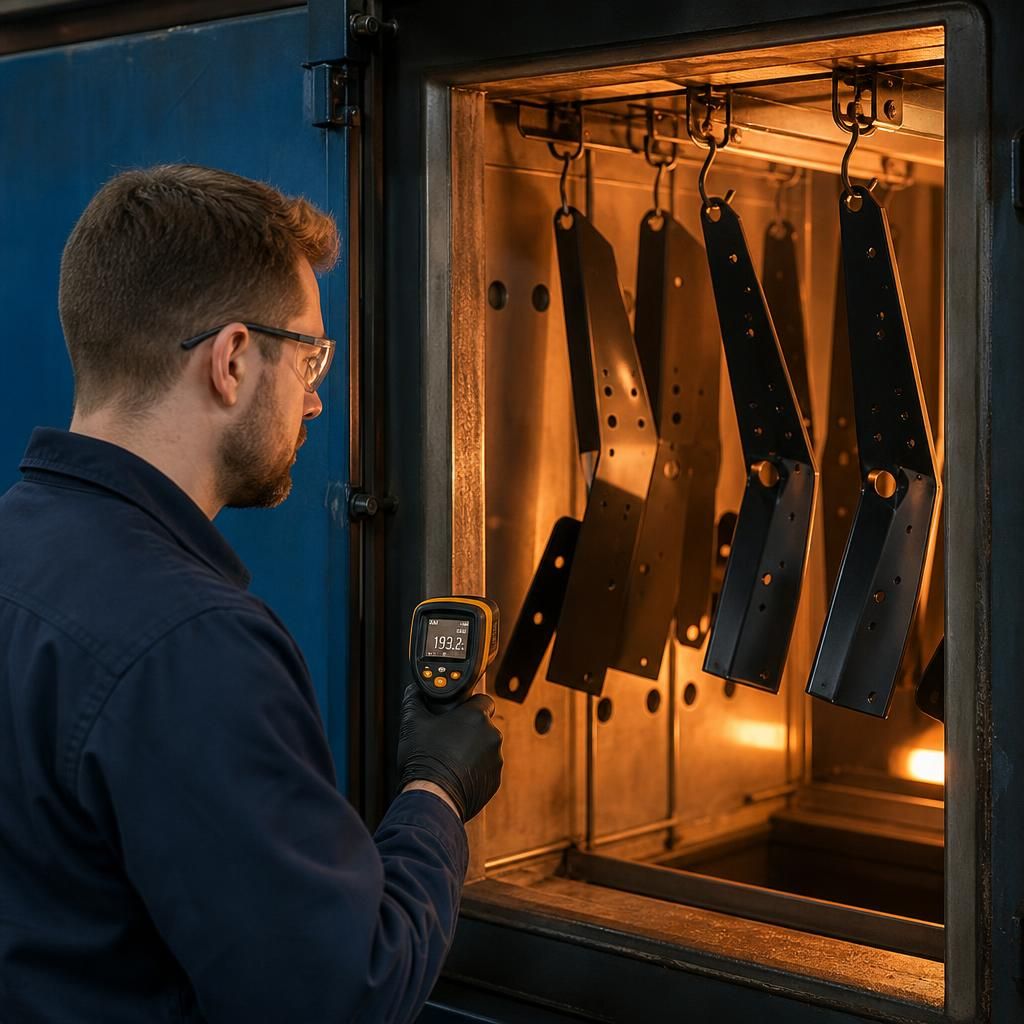
A key distinction is the difference between oven temperature and part temperature. Air in the oven may reach the set point before a heavy steel fabrication, thick bracket or densely loaded batch has absorbed enough heat. Thin sections may heat rapidly, while welds, corners, boxed sections and areas with greater thermal mass take longer. If the process is controlled only by the oven display, some areas may receive a different cure history from others.
Part temperature is affected by several factors:
- the thickness, mass and shape of the metal;
- the number and arrangement of components in the oven;
- the way parts are hung and the amount of exposed surface;
- the oven’s air circulation and temperature uniformity;
- the powder film thickness; and
- the thermal behaviour of welded, fabricated or mixed-material assemblies.
These variables are particularly important for batch work and large components. A schedule suitable for a small, thin component may not produce the same result on a substantial fabricated frame. Conversely, increasing the oven setting to compensate for a slow-heating part can expose already hot areas to unnecessary heat. The appropriate response is to assess the thermal profile and adjust the process rather than relying on a higher set point alone.
Film thickness also influences performance. A heavier deposit may need more time to flow and cure consistently, while an uneven film can create differences in appearance and local mechanical behaviour. Excessive thickness may contribute to runs, loss of definition or trapped defects; insufficient thickness may reduce the protective barrier. Surface preparation, application technique and cure conditions therefore need to be considered together.
Correct curing supports more than visual quality. It affects the coating’s resistance to impact, abrasion, solvents, oils, moisture and repeated temperature changes. In a high-temperature application, the coating may also experience thermal cycling: repeated heating and cooling can place stress on the film and its bond with the metal. A properly selected and correctly cured system is better placed to retain its integrity, but the expected service temperature and exposure conditions must still remain within the coating specification.
Process verification normally involves measuring the temperature reached by the component, not just recording the oven’s programmed temperature. Temperature probes or data-logging equipment can be attached to representative locations, including heavier sections and areas that are slow to heat. The resulting profile helps establish when the metal enters the required cure range and how long it remains there. Oven checks can then identify cold spots, uneven airflow or loading patterns that may affect repeatability.
Visual inspection can identify problems such as colour variation, gloss changes, pinholes, blistering, poor flow or surface damage, but appearance alone cannot confirm the complete cure. Where the application is demanding, practical checks may include adhesion, hardness, solvent resistance and examination of film thickness, selected according to the coating system and the service requirement.
For metal components intended for high-temperature service, the process should therefore be defined in this order: select a coating with a suitable heat and chemical resistance range, prepare the substrate correctly, apply a controlled film, establish the actual part-temperature profile, and verify that the finished film meets the required checks. Powder coating specialists serving manufacturers and fabricators can use this information to assess the component’s mass, geometry and intended environment before setting the curing process.
The same baking temperature can produce different results with different powder coating formulations because resin and curing-agent chemistry determine how the film flows and cross-links. A schedule suitable for one high temperature coating should not automatically be applied to another, even when both are intended for similar operating conditions.
This is important when a coating system is changed, a component is recoated or a production process is transferred to another oven. The technical specification for the selected powder should be used to confirm:
- the required metal temperature range;
- the minimum and maximum time at that temperature;
- whether the stated schedule relates to part temperature rather than oven air temperature; and
- any limits affecting colour, gloss, flexibility or the substrate.
Following the specified schedule helps ensure that the coating’s heat resistance is supported by the intended film properties, rather than relying on a higher oven setting as a substitute for the correct formulation and process.
Discuss Your High Temperature Coating Cure Requirements
If you are assessing a high temperature powder coating for a specific metal component, discuss the required cure schedule alongside its operating temperature, geometry and substrate. Powder-coating.co.uk can help review the coating and baking requirements for your application.