

How does the thickness of the powder coating affect the durability and finish of metal components?
Powder coating thickness affects both protection and appearance: a coating that is too thin may provide insufficient coverage and corrosion resistance, while one that is too thick can affect colour, texture, edge coverage and curing. The correct thickness depends on the powder type, metal component, service environment and specified finish, so it should be controlled consistently during application.
Coating thickness is one of the main variables controlling how well a powder-coated metal component performs. The target is not simply the greatest possible build; it is a consistent, specified dry-film thickness that suits the powder system, substrate, component geometry and service conditions. Correct thickness helps the coating form a continuous protective layer while allowing the intended colour, gloss and texture to develop properly during curing.
How thickness affects durability
A powder coating must cover the metal sufficiently to act as a barrier against moisture, chemicals, abrasion and general handling. If the applied film is below the appropriate specification, thin areas may offer less protection and can be more vulnerable to premature wear, exposed edges or corrosion where the substrate is not fully covered. This is particularly important on corners, folds, welds, recesses and other areas where powder may not deposit evenly.
Increasing thickness does not automatically produce a tougher coating. Excessive build can create problems such as brittleness, poor edge definition, trapped air, uneven texture and incomplete or inconsistent curing. A heavy film may also be more likely to chip or show visible defects if the powder system is not designed for that application. Durability therefore depends on the complete coating system rather than thickness in isolation.
The required build also varies with the intended use. An internal component protected from direct weathering may have different requirements from an external structural part, automotive component or item exposed to chemicals, impact or repeated abrasion. Nylon and other specialist thermoplastic coatings, for example, are selected for particular combinations of wear resistance, impact performance and chemical protection; their suitable thickness and application method must be established from the relevant specification rather than assumed from a standard decorative finish.
How thickness affects appearance
Film build influences how light reflects from the surface, so it can alter perceived gloss, colour uniformity and texture. An insufficient or uneven coating can leave visible variation, thin-looking coverage, poor hiding of the substrate or differences between adjacent parts. Excessive build may soften sharp details, make textured finishes appear heavier and increase the risk of runs, ridges or an uneven surface profile.
Thickness is especially important where components are assembled together or have close dimensional tolerances. The coating adds material to the surface, including around holes, threads, mating faces and edges. If build is not considered during design and preparation, coated parts may no longer fit correctly or may require masking of areas that must remain free from powder.
Why uniformity matters
Average thickness alone does not describe the quality of a coating. A component can have an acceptable average while still containing thin patches and heavy deposits. Variation may result from the shape of the part, the position of the gun, powder charge, grounding, line speed or the way the component is hung. Recesses and internal corners can receive less powder, whereas external corners and edges may attract more or lose coverage during curing.
Consistent application is therefore important for both performance and appearance. The coater needs to assess the whole component, identify critical surfaces and account for areas that require masking, additional attention or a different application approach. Batch work also benefits from repeatable racking and process settings so that parts receive comparable coverage from one run to the next.
Thickness and curing must be considered together
Powder coating is not fully defined by its dry-film build. The powder must also reach the correct metal temperature for the required time so that the resin and curing agent form the intended film. A coating that appears thick enough may still perform poorly if the component has not been heated consistently. Conversely, excessive heat or an unsuitable cure can affect colour, gloss, texture and mechanical properties.
Component mass, shape and metal thickness influence how quickly the work reaches curing temperature. The oven setting alone does not establish the cure received by the coating. Large fabrications, thin sections and assemblies with different thermal masses may need careful process control to achieve an even result throughout the batch.
How thickness is specified and checked
Thickness should be agreed as part of the coating specification, alongside the powder type, colour, gloss level, texture, pretreatment and performance requirements. The specification should identify critical surfaces and any areas where coating is not permitted. This avoids treating a decorative target as suitable for every part or service environment.
After application, dry-film thickness can be checked with suitable coating thickness equipment selected for the substrate. Measurements should be taken at representative locations rather than relying on a single reading. Visual inspection remains important as well, because measurement cannot by itself identify poor curing, contamination, pinholes, inclusions, edge defects or an unsuitable texture.
For B2B orders, providing drawings, component dimensions, substrate details, end-use conditions and any existing coating specification helps the applicator set an appropriate target. It is also useful to identify whether the priority is corrosion protection, wear resistance, dimensional control, a particular RAL colour or a specific matt, satin, gloss or textured appearance. These requirements can affect the choice of powder system and the acceptable thickness range.
For manufacturers and fabricators across the Midlands, a specialist powder coater can review the component design and intended use before processing, then apply and check the coating against the agreed requirements. Collection and delivery options can also be considered for batches of parts, but the coating specification remains the key control: the best result comes from matching film build, powder chemistry, preparation, application and curing to the component’s actual service demands.
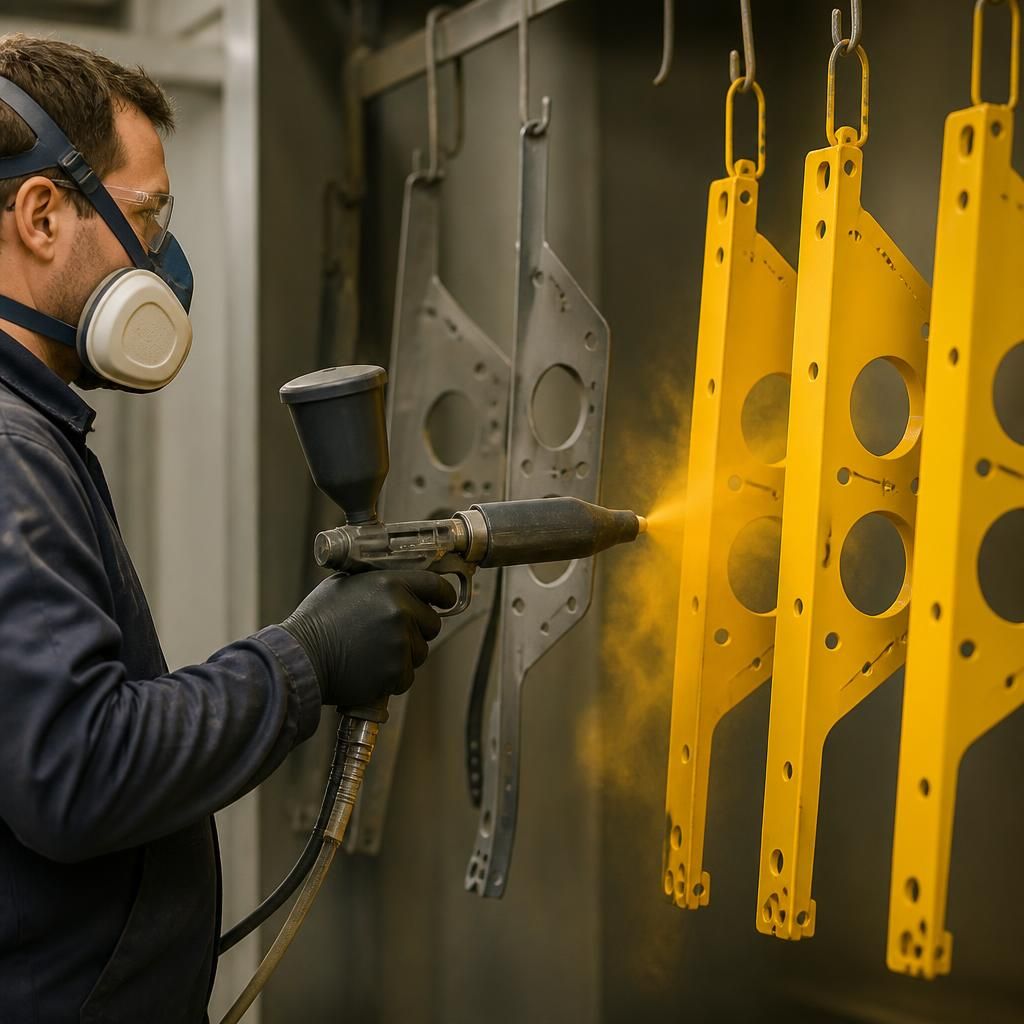
On refurbished or previously coated components, the existing film must be considered before applying new powder. Adding another layer can increase the total build beyond the intended range, obscure surface defects and affect the fit of threads, holes or mating faces. Where the old coating is damaged, poorly bonded or unsuitable for overcoating, it may need to be removed so the new system can be applied to a properly prepared surface. This helps maintain both the specified thickness and a consistent finish.