

How do automated powder coating systems compare with manual processes in terms of efficiency, consistency, and cost-effectiveness for industrial applications?
Automated powder coating systems generally deliver higher throughput and more consistent coverage for repeatable, high-volume industrial work, while manual coating offers greater flexibility for varied parts, small batches and complex geometries. Automation can be more cost-effective when production volume justifies the equipment and setup, whereas manual processing may be more economical for lower volumes or frequently changing requirements.
Automated powder coating systems are generally the more efficient choice where parts, finishes and production volumes are sufficiently repeatable, while manual powder coating remains more cost-effective for variable work, short runs and components that require frequent operator adjustment. The comparison depends on the complete process rather than the spray equipment alone: loading, masking, coating, colour changes, curing, inspection, rework, maintenance and capital costs all affect the result.
How automation improves process efficiency
An automated line can combine a conveyor, spray guns, reciprocators or robotic equipment, a booth, powder recovery equipment and a curing oven into one controlled workflow. Once the system has been set up and the correct programme selected, parts can move through the stages with less manual intervention. This can reduce handling between operations and make production planning more predictable.
Automation is particularly suited to components that have consistent dimensions and can be presented in the same orientation each time. Gun position, spray distance, traverse speed and powder output can be controlled more consistently than when each part is coated entirely by hand. A conveyorised system may also allow coating and curing to operate as a continuous sequence rather than as separate manual stages.
However, automation does not remove the need for process control. Incorrect hanging, poor earthing, unsuitable gun settings or an inappropriate curing schedule can affect every part in a run. Automated equipment therefore needs properly developed programmes, routine checks and competent operators who can identify deviations before they lead to a larger batch of non-conforming components.
Where manual coating can be more efficient
Manual application can avoid the programming, tooling and line setup required for automated equipment. An operator can adjust the gun angle and spray pattern as the component changes, which is useful for unusual shapes, isolated recesses, awkward weldments and parts that cannot be presented consistently to fixed guns. For a small order, this reduced preparation can outweigh the potential output advantage of an automated line.
Manual processing can also make sense where a manufacturer frequently changes colours, coating specifications or component designs. Each change may require cleaning, masking changes, programme adjustments or trial pieces on an automated line. A manual booth can be more straightforward to adapt, although it still requires controlled preparation and skilled application to produce a dependable finish.
Consistency and coating quality
Automation can reduce variation caused by differences in operator movement, gun distance and spray speed. This is valuable where appearance, film build and repeatability must be controlled across a batch. Automated settings can be recorded and reproduced, providing a more consistent starting point for future production runs.
Consistency is not determined by application equipment alone. The outcome also depends on substrate condition, pretreatment, cleanliness, powder storage, earthing, part temperature and oven performance. A well-operated manual process may produce an excellent finish, while a poorly controlled automated line can produce inconsistent coverage. Inspection should therefore consider film thickness, adhesion, visual defects and cure, rather than assuming that automation automatically means higher quality.
Manual coating introduces greater dependence on individual technique. The operator must maintain a suitable spray distance, overlap passes correctly and reach edges, corners and recesses without creating excessive build-up. This does not make manual coating unsuitable for industrial work, but it makes training, work instructions and inspection especially important where repeatability is critical.
Cost-effectiveness over the equipment life
The main financial distinction is between operating cost and investment cost. Automated systems normally require greater initial expenditure for equipment, installation, extraction, curing capacity, controls and maintenance. They may also require dedicated space and suitable handling infrastructure. These costs need to be assessed against the expected workload and the number of years over which the system will be used.
Automation can reduce the labour required for repetitive application and may lower the amount of rework when settings and part presentation are well controlled. Powder recovery can also improve material utilisation where the system is designed and operated for compatible powders and colours. These advantages are most relevant when the line is used consistently rather than left under-utilised.
Manual coating generally has lower equipment entry costs, but labour remains closely tied to the number and complexity of parts. Material use can vary with operator technique, part geometry and the need for touch-up. Rework, additional inspection and handling should be included in any comparison, as the purchase price of the spray equipment does not represent the full cost of manual processing.
Automated systems have their own ongoing costs, including servicing, gun and filter maintenance, cleaning, calibration, control-system support and potential downtime during faults or colour changes. A cost model should include these items, together with energy use for the booth and curing oven. Comparing only the cost of powder or direct labour can give a misleading result.
Changeovers, part presentation and line utilisation
The practical value of automation depends heavily on how often the work changes. Repeated production of similar components allows a programme, hanging method and inspection routine to be refined. Mixed work creates more preparation, including rack changes, masking, gun adjustments and booth cleaning. Colour changes can be particularly significant because residual powder may contaminate the next finish and require cleaning before production continues.
Part presentation is another important consideration. Components need to be loaded so that all required surfaces are accessible and so that electrical contact is reliable. If parts vary substantially in size or orientation, automated guns may not reach every area effectively without additional equipment or manual finishing. In some industrial applications, a combined approach is appropriate: automation covers the repeatable surfaces and an operator completes areas that need targeted attention.
How to select the appropriate process
A useful assessment should examine:
- the number of parts and expected production pattern;
- the similarity of component geometry and hanging requirements;
- the range of colours, powders and coating specifications;
- the required finish, film build and inspection standard;
- the proportion of parts needing masking, touch-up or manual attention;
- available floor space, curing capacity, extraction and material-handling arrangements;
- labour, maintenance, energy, powder, rework and downtime costs; and
- whether demand is sufficient to keep automated equipment productively occupied.
For a business comparing external coating routes, the relevant question is not simply whether a coater owns automated equipment. It is whether the chosen process matches the component mix and controls the risks that matter for the application. Batch size, part dimensions, substrate, required pretreatment, finish specification and delivery requirements should be discussed before deciding how the work should be processed.
In practice, automated and manual methods are not always alternatives. Industrial powder coating operations may use automation for repeatable production and manual equipment for small batches, complex components, colour changes or finishing work. The most cost-effective arrangement is the one that provides the necessary quality and throughput without imposing an unsuitable level of equipment, setup or handling cost on the job.
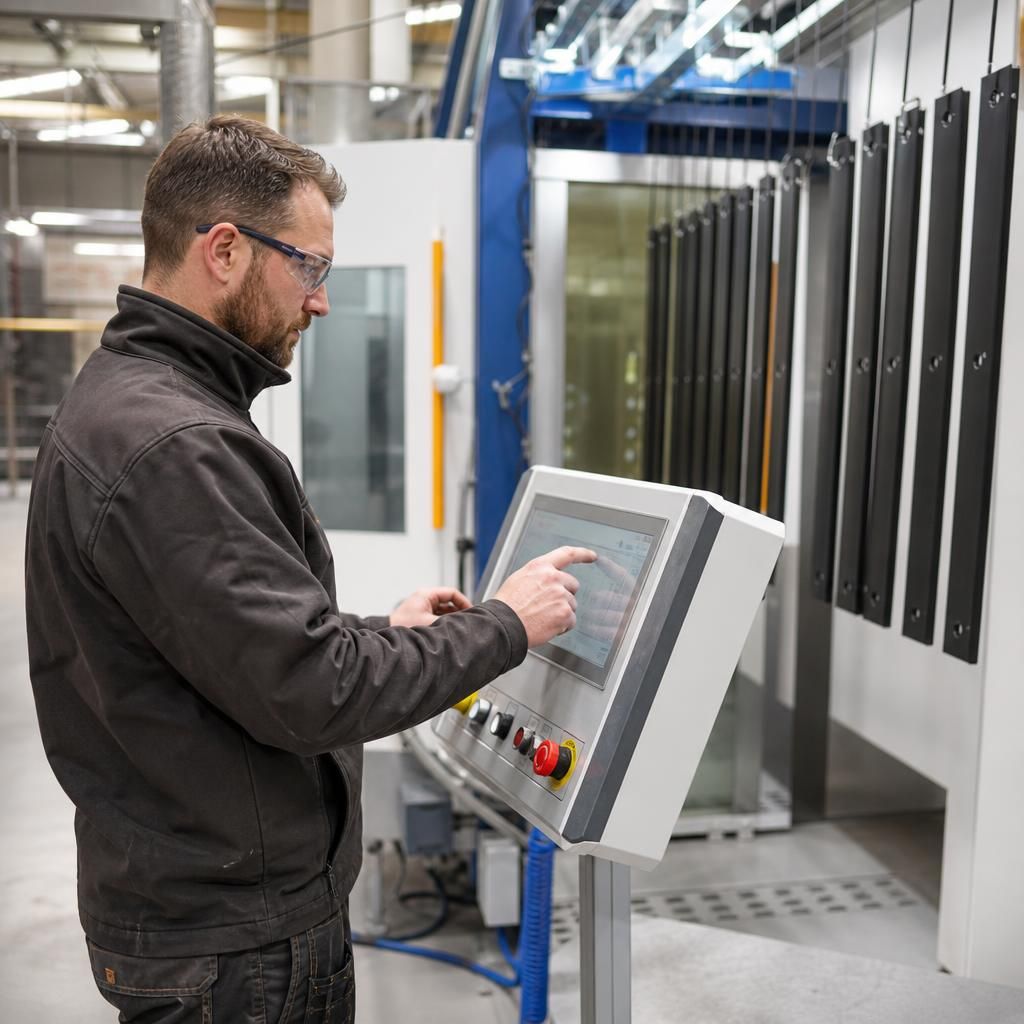
Automation changes the type of labour required rather than removing operator involvement. Instead of controlling every spray pass, trained staff prepare programmes, check earthing and part presentation, manage powder and colour changes, monitor the line and carry out quality checks. This can make labour use more predictable on repeat production, but it also means that setup errors or inadequate process knowledge can affect an entire run.
Manual coating places more emphasis on the operator’s application skill, whereas an automated line places greater emphasis on system setup and supervision. The most suitable option therefore depends not only on equipment capacity, but also on whether the business has the technical resources to programme, maintain and verify the process. This operational requirement should be included when comparing the long-term cost and practical efficiency of each method.