

How does surface texture influence the adhesion and durability of nylon powder coatings?
Surface texture affects how securely nylon powder coating keys to the metal and how evenly the finished film covers it. A clean, consistent profile provides effective mechanical anchoring, while an overly smooth, rough or uneven surface can reduce adhesion, create thin spots and shorten the coating’s service life.
Surface texture influences nylon powder coating by determining how the molten coating wets, flows across and mechanically engages with the metal. The most durable result usually comes from a controlled, uniform surface profile that suits the nylon system and the required film build. Texture that is too shallow may provide limited anchoring, while an irregular profile with sharp peaks, deep valleys or inconsistent areas can leave defects and create points where wear or corrosion protection is weakened.
Surface profile is more than visual roughness. A blasted or mechanically prepared surface contains peaks and valleys. When nylon powder melts, it must flow around this profile and fill it sufficiently to produce continuous coverage. A moderate, even profile increases the available contact area and allows the coating to lock into the substrate. However, a very deep profile may not be completely covered by the applied film, particularly on recessed areas, internal corners or complex fabrications. These locations can become locally thin even when the average coating appearance seems acceptable.
Sharp peaks create a different problem. They can remain close to the surface of the cured film, making the coating more vulnerable to impact, rubbing and premature wear. They may also produce a visibly uneven finish because powder tends to redistribute as it melts. Rounded, regularly spaced features are generally more favourable than isolated high points or torn, jagged metal.
Texture also affects wetting and flow. Nylon powder must soften and spread across the prepared metal before it solidifies. A surface with widely varying heights can cause differences in local film thickness: raised areas may receive less effective coverage, while recesses may retain more material or trap air. This can contribute to pinholes, voids, roughness and incomplete encapsulation. Such defects are particularly significant where the coated component will face moisture, abrasion, chemicals or repeated contact.
The correct texture depends partly on the component and its service conditions. A flat, accessible panel can usually be prepared more uniformly than a welded frame, tube assembly or part with blind sections. Welds, edges, drilled holes and transitions between different metal sections may naturally produce variations in profile. If these areas are not considered during preparation and application, the coating may perform differently from the main surface even though the same powder has been used.
- A shallow profile: may provide insufficient physical engagement and can make the coating more dependent on chemical cleanliness and other preparation controls.
- A deep profile: can demand greater coating coverage and may leave the base of valleys inadequately protected.
- An irregular profile: can cause variable appearance, uneven film distribution and localised weak points.
- A controlled profile: gives the nylon a more predictable surface over which to melt, flow and solidify.
Surface texture should not be assessed by touch or appearance alone. A surface can look evenly prepared while containing isolated peaks, embedded abrasive, smeared metal or areas that have been polished rather than profiled. Conversely, a visibly matt surface is not automatically suitable if the profile is excessively deep or inconsistent. Where the specification is critical, profile comparators or suitable measurement equipment can provide more useful information than visual inspection alone. A single roughness value may not describe the full condition, because two surfaces can have a similar average reading but very different peak shapes and valley depths.
The preparation method affects the resulting texture. Abrasive blasting commonly produces a more open profile, whereas grinding, wire brushing or other mechanical methods may create directional marks, flattened areas or smeared edges. The abrasive type, condition, working angle and consistency of application all influence the result. Preparation should therefore be selected according to the substrate, component geometry and nylon coating specification rather than simply aiming for the roughest possible finish.
Texture is also important at edges. A coating film naturally tends to become less substantial over a sharp external edge because material flows away from the apex during melting. If the edge is left excessively sharp, the prepared profile can amplify this reduction in coverage. Edge conditioning, suitable component preparation and an appropriate application process help create a more gradual transition for the nylon film. Internal corners require equal attention because they may restrict access for preparation and make it harder for powder to reach the required coverage.
For durability, texture must be considered alongside contamination removal, substrate condition, pre-heating, powder selection and curing control. A well-profiled surface cannot compensate for oil, salts, oxide residue or abrasive dust left behind. Similarly, excessive texture cannot be used as a substitute for an appropriate nylon grade or sufficient film coverage. These factors work together: the profile provides the physical foundation, while cleaning and thermal control determine whether the powder can develop its intended bond and structure.
In practical terms, the preparation target should be a uniform, service-appropriate profile rather than maximum roughness. Before coating, inspect representative areas, welds, edges, recesses and any sections treated by a different method. After application, check for variations in appearance, exposed high points, pinholes and areas where the film has failed to reach the base of the profile. This approach links surface texture to the finished component’s actual risks, including abrasion, impact, moisture ingress and repeated handling.
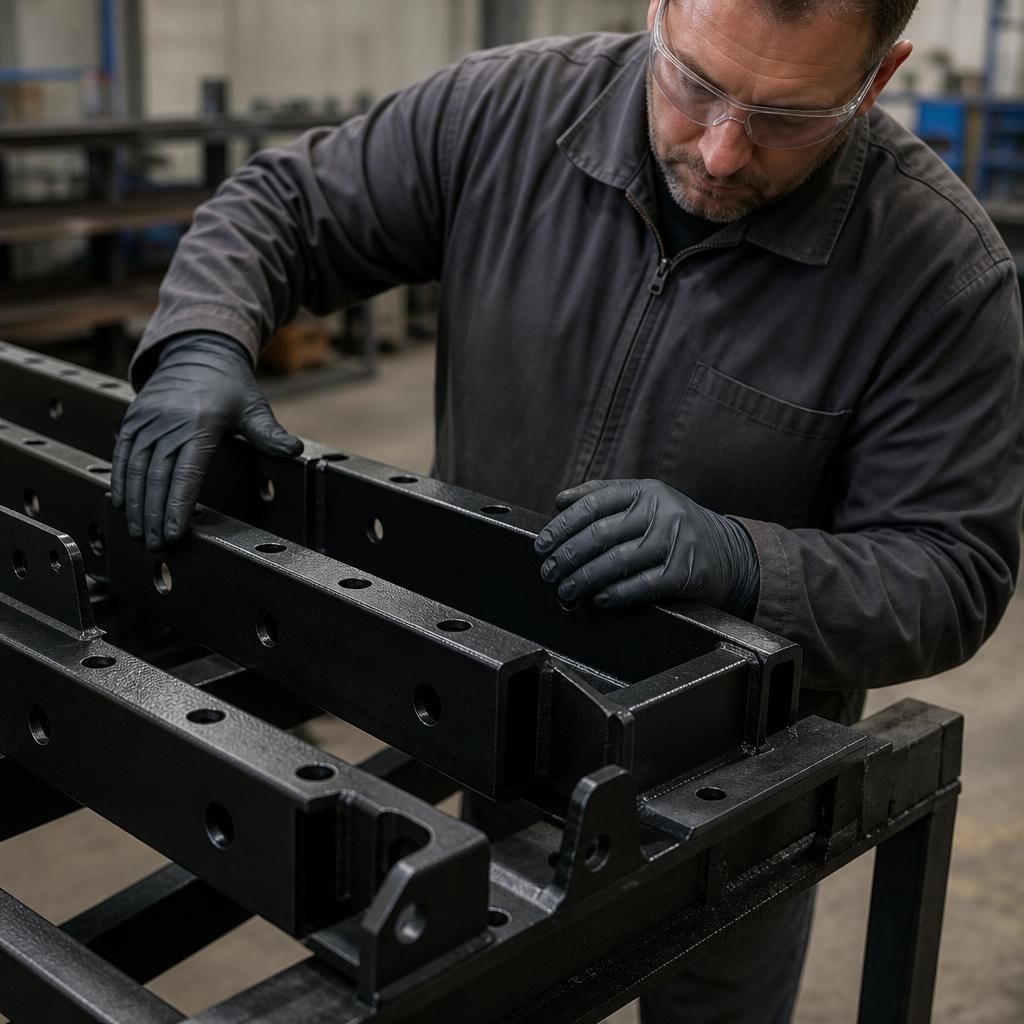
Surface texture only contributes to nylon coating adhesion while the prepared metal remains clean and unchanged. After profiling, handling can transfer oil from hands, while dust, moisture or flash corrosion can settle into the valleys and reduce contact between the nylon and the substrate. These contaminants may be difficult to identify once the powder has been applied.
Prepared components should therefore be handled with clean gloves, kept on clean supports and protected from contamination before coating. Inspecting the surface again before application is particularly important around welds, edges and recessed areas, where residue can remain despite an apparently consistent profile. This preserves the intended texture as a sound foundation for the nylon coating.