

What are the key factors to consider when choosing between epoxy and nylon coatings for industrial applications?
Choose between epoxy and nylon by assessing the component’s exposure to chemicals, moisture, abrasion, impact, temperature and outdoor conditions, together with the required finish and application method. Epoxy is generally suited to strong adhesion and chemical resistance, while nylon is often preferable where low friction, impact resistance and high wear protection are the priority.
Epoxy is usually selected when adhesion, chemical protection and a hard, thermoset finish are the main requirements, whereas nylon is chosen when the component needs a tougher, lower-friction and more wear-tolerant surface. The decision should also account for the metal substrate, part geometry, coating thickness, dimensional tolerances, appearance, production method and the consequences of damage or future maintenance.
1. Define the function of the coating
Start by identifying what the coating must do beyond providing colour. An epoxy system is commonly used as a protective barrier or as part of a primer and topcoat specification. Once cured, it forms a hard film with strong bonding to a correctly prepared metal surface. This makes it suitable for many fabricated components, housings, frames and assemblies where surface protection and a stable finish are more important than sliding performance.
Nylon is a thermoplastic coating. It is often specified where the surface itself will experience repeated contact, rubbing or mechanical handling. Its comparatively tough surface can help components tolerate wear and reduce friction between mating parts. This makes it relevant to items such as guides, rollers, chutes, guards and handling components, provided the particular nylon grade is suitable for the operating conditions.
2. Consider the substrate and preparation requirements
Neither material can compensate for inadequate preparation. Oil, mill scale, rust, weld spatter, sharp edges and embedded contamination can reduce adhesion or create weak points in the finished film. The preparation process should therefore be matched to the metal and the level of protection required. Degreasing, abrasive cleaning, suitable profiling and the removal of residues may all be relevant before coating.
Epoxy is generally more forgiving of complex fabricated shapes when it is applied as a conventional powder film, but the surface still needs to be clean and properly keyed. Nylon may require greater attention to edge condition and surface profile because its performance depends on forming a consistent, mechanically sound layer over the component. The specification should state how welds, corners, holes and inaccessible areas are to be treated rather than considering only the broad flat surfaces.
3. Check the application method against the component design
Application method is a practical selection factor, not just a production detail. Epoxy powder is commonly electrostatically applied and then heated until it flows and cures. The part must be able to withstand the curing cycle, and its mass and geometry can affect how evenly it reaches the required temperature.
Nylon powder may be applied by electrostatic spray or by a fluidised-bed process, depending on the product, component and required film build. Fluidised-bed coating can be useful where a substantial, continuous layer is needed, but it may be less suitable for very tight tolerances or intricate internal features. Electrostatic application can offer more control on suitable shapes, although recesses and Faraday areas still need to be considered. The chosen process should be agreed with reference to drawings, masking requirements and any areas that must remain uncoated.
4. Protect dimensional accuracy and moving interfaces
Coating adds material to the part. This matters where components locate against one another, pass through apertures, fit into bearings or operate with a defined clearance. A thicker nylon layer may be beneficial for wear protection but could affect a close-fitting assembly if allowances have not been made. Epoxy is often suitable where a thinner, controlled film is required, although the achievable thickness depends on the system and application process.
Before choosing a finish, identify threads, mating faces, bearing seats, drain holes, electrical contact points and other critical features. Masking or post-coating finishing may be required. The coating specification should include acceptable thickness ranges and tolerances rather than simply naming epoxy or nylon.
5. Separate resistance to chemicals from resistance to solvents
Chemical compatibility should be assessed using the actual substances, concentration, temperature and contact duration involved. An epoxy film can provide a strong barrier against many industrial contaminants, but its resistance varies between formulations. Some solvents or aggressive chemicals can soften, swell or attack an epoxy surface.
Nylon can perform well in contact with selected oils, greases and other substances, but it is not universally resistant. Certain chemicals, moisture conditions or elevated temperatures can affect its properties. Product data should be checked against the specific cleaning agents, process fluids and contaminants present rather than relying on the generic label “chemical resistant”. Where exposure is uncertain, a representative sample or compatibility test is more reliable than a broad material comparison.
6. Assess temperature and curing constraints together
The operating temperature of the finished component and the temperature needed to apply the coating are separate considerations. The part must tolerate the curing process without distortion, loss of temper or damage to existing components. The finished coating must then remain stable across the full service cycle, including start-up, shutdown and any short-term peaks.
Epoxy and nylon have different thermal behaviours. Epoxy cures into a rigid network, while nylon softens and processes as a thermoplastic. This distinction can affect hardness, flexibility, dimensional stability and performance under repeated heating and cooling. Obtain the coating manufacturer’s application and service limits for the selected grade, particularly where the part will be used near heat sources.
7. Weigh surface appearance against functional performance
Epoxy can provide a smooth, uniform decorative or functional finish in a broad range of colours and gloss levels. Nylon is more often chosen for its engineering properties, although its appearance and texture can also be specified. The required finish should be considered alongside the function of the component: a visually smooth surface may be less important than controlled friction, while a visible enclosure may require colour consistency and a particular gloss.
Coating appearance can be influenced by substrate condition, film thickness, cure, edge coverage and handling. If parts will be assembled together or installed alongside existing coated items, define the acceptable visual standard before production. This reduces the risk of selecting a technically suitable coating that does not meet the project’s finish requirements.
8. Consider damage, repair and the complete service life
A coating should be judged by how the component will be used, inspected and maintained, not only by its initial appearance. Scratches, impact points, cut edges and areas of repeated contact can become routes for corrosion if they expose the substrate. The selected system should therefore be compatible with the planned inspection regime and any repair procedure.
Epoxy damage may be repaired locally in some applications after suitable cleaning and preparation, but a patch may not match the original finish or provide the same continuity as a factory-applied film. Nylon repairs can be more dependent on the coating grade, access and the ability to reproduce the required bond and thickness. If the component is difficult to remove from service, specify how coating damage will be identified and dealt with before choosing the material.
9. Use a written performance specification
The final choice should be recorded as a complete coating specification rather than a material name alone. Include the metal type, preparation standard, coating system, intended film thickness, curing or application requirements, critical masked areas, appearance, test method and service environment. State whether the priority is barrier protection, wear life, low friction, dimensional control or a combination of these requirements.
For a straightforward fabricated part, epoxy may offer the more appropriate balance of adhesion, finish and protective performance. For a component whose main duty involves repeated sliding, rubbing or impact, nylon may be the better starting point. Where the duties overlap, a qualified coating specialist can review the drawings and operating conditions, then compare a suitable epoxy system with the relevant nylon grade rather than treating either material as universally suitable.
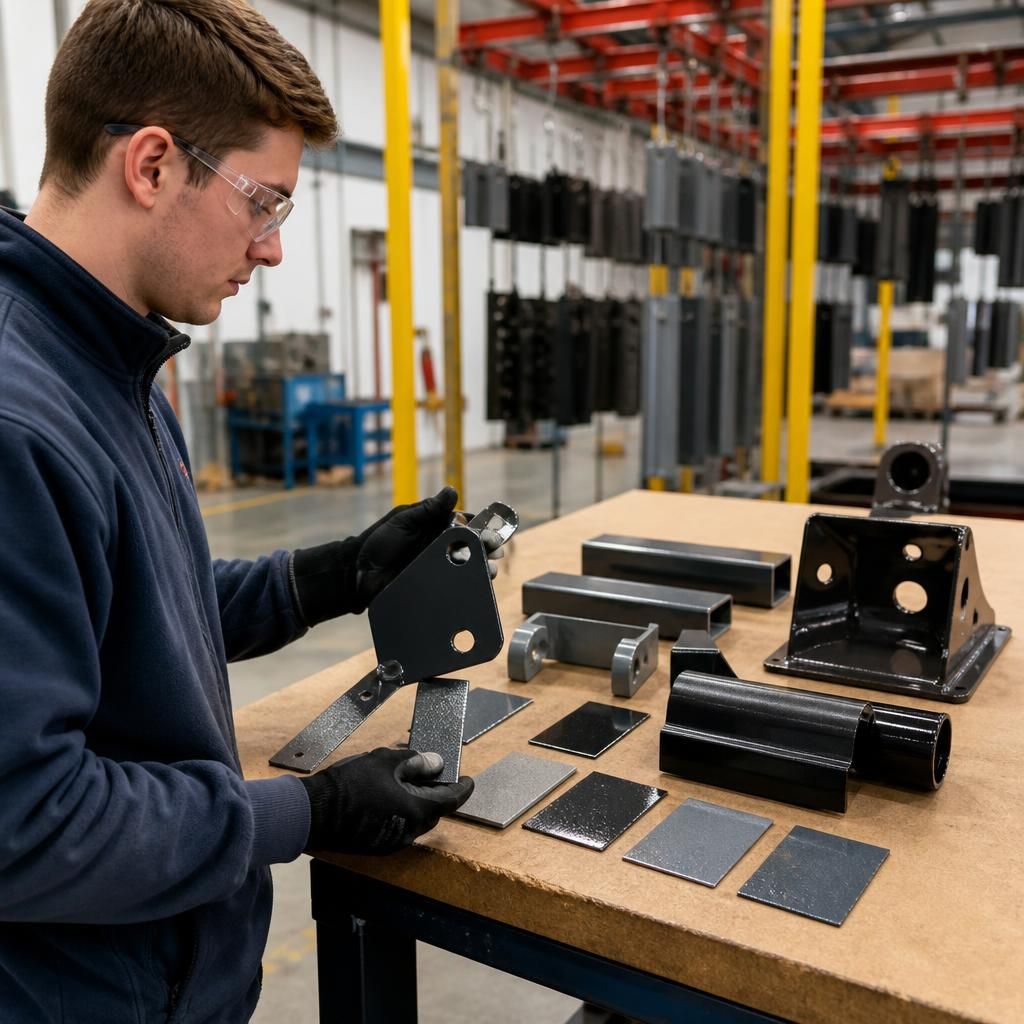
Choosing between epoxy and nylon coatings should be validated against the component’s actual operating conditions, rather than based on a single material property. A coating that performs well for chemical resistance may still be unsuitable if the part also experiences repeated impact, sliding contact, heat or dimensional movement.
Where the application involves several forms of exposure, assess representative coated samples or trial components under comparable conditions. Examine adhesion, surface wear, changes in appearance, dimensional fit and any softening or cracking after exposure. This is particularly useful when the component will encounter a combination of cleaning chemicals, moisture and mechanical contact.
Record the results against clear acceptance criteria before finalising the specification. This evidence-based approach helps distinguish a coating that is technically suitable in isolation from one that is appropriate for the complete service environment.
Discuss Your Epoxy or Nylon Coating Requirements
Discuss your component’s operating conditions, critical dimensions and required finish with the powder-coating specialist before selecting epoxy or nylon. Sharing drawings and service details can help identify the most suitable coating specification for your application.