

How does powder coating compare to other finishes for aluminium in terms of long-term durability and environmental impact?
Powder coating generally provides aluminium with a durable, abrasion-, corrosion- and weather-resistant finish; anodising can offer greater surface hardness, while liquid paint is more dependent on preparation, film thickness and maintenance. In environmental terms, powder coating avoids the solvent emissions associated with many liquid paints and unused powder may be recoverable, although curing energy and end-of-life treatment still need to be considered.
For aluminium, powder coating usually offers the best overall balance of long-term durability and environmental performance, while anodising can be preferable where maximum surface hardness and a metallic appearance are priorities. Liquid paint remains useful for colour matching, on-site repairs and applications requiring a very specific coating system, but its long-term performance depends more heavily on preparation, application conditions and ongoing maintenance.
Durability depends on the type of exposure. Powder coating forms a bonded film over the prepared aluminium, protecting the surface from routine handling, moisture, atmospheric pollutants and general industrial use. Its performance is influenced by the coating specification, film coverage, edge treatment, curing and the environment in which the component will be installed. A coating selected for an indoor component may not be suitable for coastal, chemical or high-temperature service.
Anodising is not a separate layer in the same sense as paint or powder coating. It modifies the aluminium surface to create a hard oxide layer. This gives it strong resistance to scratching and wear, making it suitable for architectural trims, equipment housings and components that receive frequent contact. The finish is relatively thin and retains the appearance of aluminium, but colour range and opacity are more limited than with powder coating. Damage can also be difficult to blend because the treated surface cannot simply be touched in with an equivalent wet film.
Liquid paint provides a broad choice of colours and can be practical where a finish needs to be applied on site or repaired locally. However, the result is more sensitive to surface cleanliness, primer compatibility, application technique, drying conditions and film build. Poor adhesion, under-film corrosion, chalking or flaking can develop if the system is not correctly specified. Powder coating can also be damaged by impact or unsuitable cleaning chemicals, so neither finish should be treated as maintenance-free or immune to site conditions.
The aluminium itself remains an important part of the comparison. Correct preparation removes contamination and supports adhesion, while suitable pretreatment helps manage the risk of corrosion beneath the coating. Designers and fabricators should also consider sharp edges, recesses, joints, fixings and areas where water or debris may collect. These details can affect service life more than the nominal finish selected. For assemblies, compatibility between the coating, sealants, fasteners and adjacent metals should be checked to reduce staining, galvanic effects or premature deterioration.
From an environmental perspective, powder coating can have advantages over many solvent-borne liquid paint systems because it is applied as a dry material and does not require the same solvent evaporation during application. Its environmental profile is not automatically low, however. The parts must be heated during curing, and energy use depends on the equipment, load, curing requirements and production method. Preparation chemicals, rejected work, cleaning materials and the management of powder residues should also be included in a realistic assessment.
Anodising avoids a separate polymer film and can provide a long-lasting surface with limited visual change over its service life. Its environmental impact still includes electricity, process chemicals, water use and wastewater treatment. Liquid paint may have a higher impact where solvent emissions, primers, thinners and repeated recoating are involved, although water-based or otherwise lower-emission systems can reduce some of these effects. The correct comparison therefore requires assessment of the complete coating system rather than judging one material in isolation.
End-of-life considerations favour finishes that do not prevent aluminium recovery. Aluminium can be recycled, but coatings, attached materials and contamination may affect sorting and remelting processes. A durable finish can reduce the need for replacement or recoating during service, which may offset some of the impacts associated with initial application. For projects with documented sustainability targets, the assessment should cover preparation, coating, curing, transport, maintenance, expected service conditions and eventual recycling.
- Choose powder coating where consistent colour, an opaque decorative finish and robust protection are required across batches of aluminium components.
- Consider anodising where surface hardness, a natural metallic appearance or resistance to frequent handling is more important than a wide colour range.
- Consider liquid paint where on-site application, local repair, specialist primers or unusual colour and texture requirements outweigh the benefits of factory-applied powder.
The most durable and environmentally responsible option is the one matched to the operating conditions and applied through a controlled specification. For aluminium parts, the decision should take account of exposure, expected handling, appearance, repair requirements, coating chemistry, curing energy and end-of-life treatment rather than comparing finish names alone.
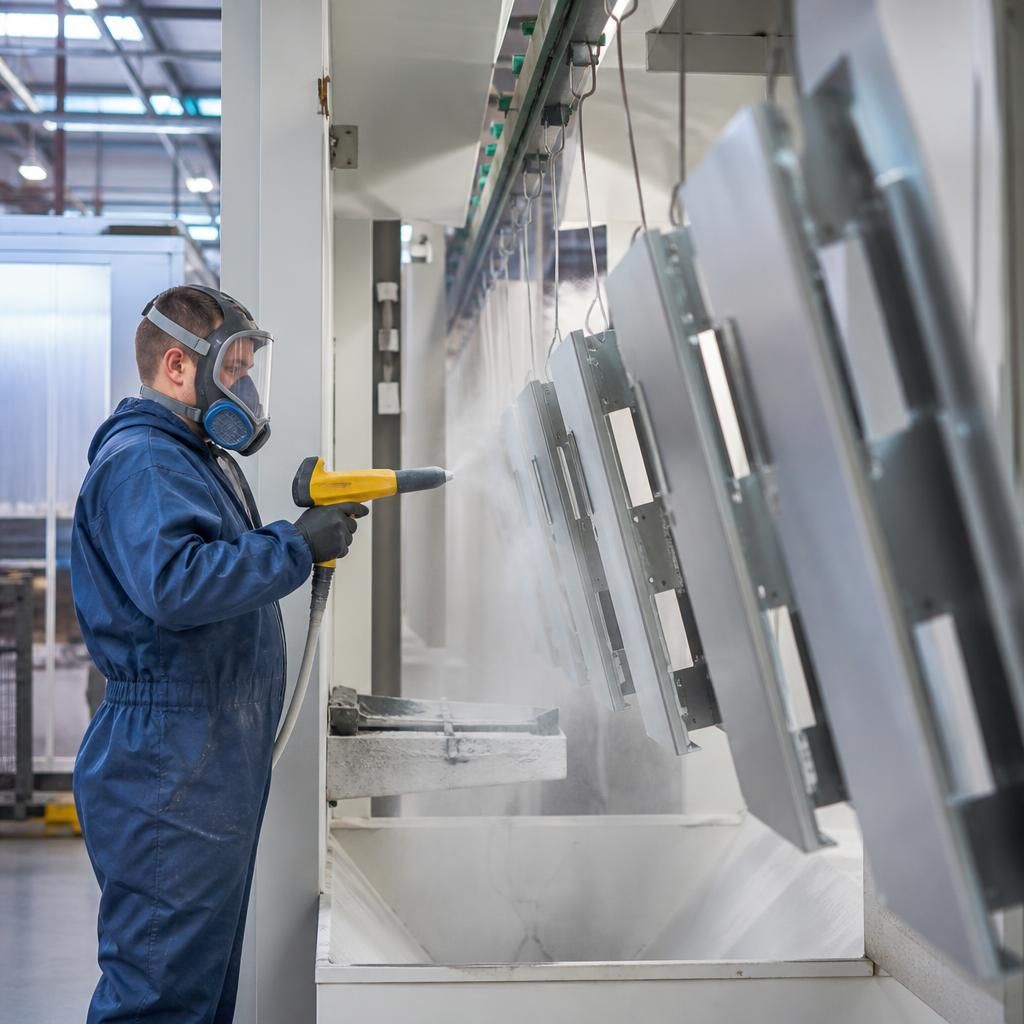
A less obvious environmental consideration is how powder overspray is managed. Unused powder can sometimes be collected and reused, but recovery depends on keeping the material clean and separating incompatible colours or coating types. Contaminated or mixed powder may not be suitable for a consistent aluminium finish and must instead be handled as process waste. A realistic comparison should therefore examine the coating line’s powder recovery arrangements, colour changes, rejected components and waste controls, rather than assuming that all unused powder is automatically reusable.
This also links environmental performance with quality control. Preventing contamination and maintaining an even coating specification reduces avoidable rejects, while correct curing helps the finished aluminium retain its protective properties in service. The most meaningful assessment considers both the material sent to waste during production and the durability achieved by the accepted components.
Discuss the right aluminium finish for your application
If you are comparing finishes for a specific aluminium component, contact Powder-coatings.co.uk to discuss its exposure, handling, appearance and coating requirements. This can help establish whether powder coating is the appropriate specification for your application.