

What specific resins and additives are most effective in high temperature and heat resistant powder coatings for your industry?
Silicone-based and silicone-modified polyester resins are commonly the most effective choices for high-temperature powder coatings, while polyimide-based systems may suit more demanding heat exposure. Heat-stable pigments, inorganic fillers and stabilising additives can further improve resistance to thermal degradation, colour change and loss of coating integrity, but the formulation must be matched to the metal substrate, operating temperature and exposure conditions.
The most effective high-temperature powder coating formulation depends on the combination of continuous operating temperature, peak temperature, thermal cycling, chemical exposure and required surface performance. Silicone-modified systems are widely used for elevated-temperature metalwork, while polyimide, polyphenylene sulphide, polyether ether ketone and fluoropolymer-based powders may be considered for more specialised conditions. The resin is only part of the specification: pigments, fillers, stabilisers, curing agents and flow-control additives determine how well the finished film retains adhesion, hardness and appearance.
Silicone-modified polyester and silicone resin systems
Silicone modification improves the thermal stability of a polyester powder coating by reducing the tendency of the organic resin structure to break down at elevated temperature. These systems are often selected where a balance is needed between heat resistance, weathering performance, appearance and practical application on fabricated metal components. The proportion and type of silicone affect flexibility, gloss retention, adhesion and resistance to repeated heating and cooling, so a higher silicone content is not automatically the best option.
Pure or predominantly silicone-based binders can provide stronger resistance to prolonged heat exposure, but they may have different requirements for film formation, curing and substrate preparation. They can also be less suitable where the specification places greater emphasis on mechanical toughness, abrasion resistance or decorative appearance. The formulation therefore needs to reflect the component’s duty rather than relying on a resin name alone.
Polyimide and other high-performance thermoplastics
Polyimide-based powders are used where sustained heat and dimensional stability are more important than a conventional decorative finish. They are specialist materials and may require carefully controlled application conditions. Their use is generally justified by the operating environment, such as severe thermal exposure combined with demanding chemical or mechanical conditions.
Thermoplastic high-performance resins, including polyphenylene sulphide and polyether ether ketone, can offer strong resistance to heat, chemicals and wear. They are not interchangeable with ordinary thermoset powder coatings. Their processing temperature, equipment requirements, melt behaviour and adhesion methods must be assessed against the metal substrate and the component design. Fluoropolymer powders may also be relevant where heat is combined with aggressive chemicals, low friction or non-stick requirements, although the required surface properties can limit their suitability for general structural metalwork.
Heat-stable pigments
Pigments influence both appearance and thermal durability. Inorganic pigments are generally preferred for severe heat exposure because they are less prone to decomposition, fading and colour shift than many organic pigments. Selection should consider the exact colour, the peak temperature, the duration of exposure and whether the part is heated in air or in a chemically aggressive atmosphere.
Dark colours can show heat-related changes differently from light colours, while metallic and special-effect finishes may be more sensitive to changes in orientation, film thickness and surface texture. A coating that remains structurally sound may still show visible colour or gloss change, so visual stability should be specified separately from basic heat resistance.
Inorganic fillers and reinforcing materials
Mineral fillers can improve dimensional stability, hardness and resistance to thermal movement. Materials such as silica, alumina, mica and other engineered mineral additions may be used to control shrinkage, reduce permeability or improve resistance to wear. Mica and platelet-shaped fillers can create a more tortuous path for moisture and corrosive contaminants, although their effect depends on dispersion, orientation and the quality of the cured film.
Fillers also affect viscosity, flow, surface smoothness and impact resistance. Excessive loading can make a coating brittle or impair adhesion, while poorly dispersed particles can create weak points. The best formulation uses the minimum level needed to provide the required property without compromising application or film integrity.
Stabilisers and protective additives
- Thermal stabilisers can slow resin degradation and reduce loss of mechanical properties during repeated or prolonged heating.
- Antioxidants can reduce oxidation of vulnerable organic components when the coating operates in hot air.
- UV stabilisers may be relevant where the coated part is exposed outdoors as well as to heat, but they do not replace a heat-resistant binder.
- Adhesion promoters can improve bonding to difficult substrates or support retention of adhesion during thermal cycling.
- Flow and levelling additives help produce a continuous film, reducing pinholes and surface defects that could allow corrosion to begin at the substrate.
- Degassing additives can help release trapped air or volatile material, particularly where the substrate is porous, blasted or zinc-coated.
- Matting agents can reduce gloss, but their thermal stability must be checked because some can affect surface durability or appearance after heating.
Additives must be compatible with the resin and curing chemistry. A stabiliser that improves heat ageing may alter cure response, gloss, flexibility or intercoat adhesion. Similarly, a flow modifier may improve appearance but reduce the surface texture required for grip or wear resistance. Formulation changes should therefore be assessed as a complete system rather than as isolated ingredients.
How the industry application affects resin selection
- Industrial ovens, heaters and exhaust-related components: prioritise resistance to continuous heat, oxidation and thermal cycling. Colour change may be acceptable where function is more important than appearance.
- Automotive and transport components: require consideration of vibration, stone impact, road salts, oils and rapid temperature changes as well as heat.
- Fabricated construction and plant equipment: often require a balance of heat resistance, corrosion protection, impact strength and a consistent finish across batches.
- Food, chemical and process equipment: may need resistance to cleaning agents, solvents, acids or alkalis in addition to temperature stability. Any contact-related requirement must be addressed through the relevant specification rather than assumed from the resin type.
- Wear-prone components: may benefit from a harder resin or reinforcing filler, but hardness should not be increased at the expense of flexibility where the part is subject to vibration or thermal expansion.
Check the complete temperature profile
The relevant temperature is the temperature of the metal and coating in service, not simply the temperature inside a curing oven. A component may experience a lower continuous temperature, short-term peaks, repeated heat-up and cool-down cycles, or a combination of heat and moisture. These conditions can produce different failure modes, including blistering, embrittlement, cracking, delamination, chalking, gloss loss and colour change.
Substrate preparation is equally important. Oils, oxides, salts and poorly prepared galvanised surfaces can undermine adhesion before heat is applied. The coating specification should define the preparation method, film thickness, cure schedule, acceptable appearance and the tests needed to confirm performance. Test panels or representative components can be used to assess adhesion after thermal cycling, flexibility, impact resistance, chemical exposure and visual change.
For most industrial requirements, the practical choice is a resin and additive package selected around the full service environment rather than the highest quoted temperature. A silicone-modified system may be appropriate for general elevated-temperature metalwork; a specialist polyimide, high-performance thermoplastic or fluoropolymer may be justified where heat is combined with severe chemical, wear or dimensional-stability demands. The final selection should be based on technical data for the exact formulation, substrate and exposure profile.
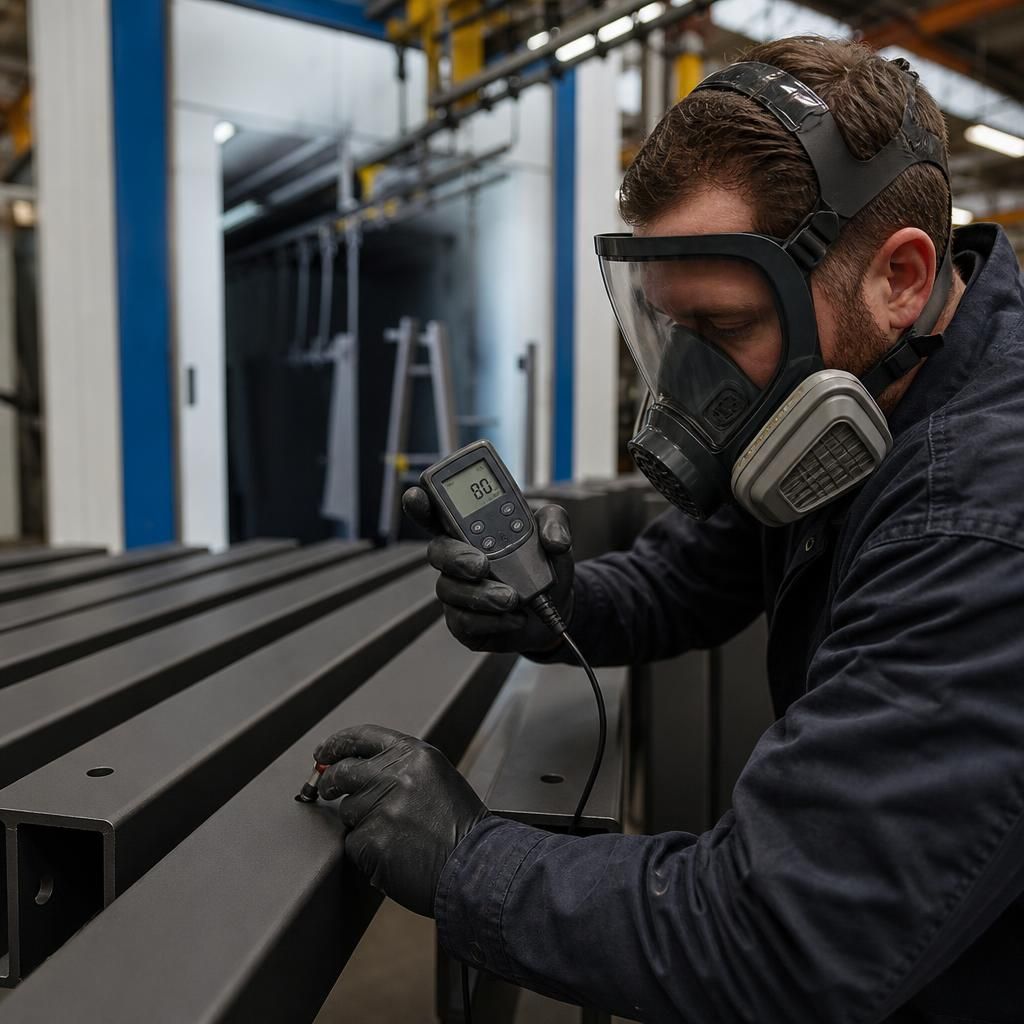
Film thickness is part of the formulation decision. A resin and additive package may perform differently when applied too thinly or too heavily. The specified film build affects cure, flexibility, edge coverage, heat transfer and the risk of defects such as pinholes or cracking during thermal cycling.
For this reason, a quoted temperature capability should be assessed alongside the manufacturer’s recommended film thickness and cure conditions. The coating system should then be applied consistently to representative metal samples so its adhesion, appearance and physical condition can be checked after exposure to the intended heat profile.
Discuss Your High Temperature Powder Coating Requirements
Discuss your component’s resin and additive requirements with the powder-coating.co.uk team to identify a formulation suited to its operating conditions. Provide the metal type, service temperature and exposure environment so the coating specification can be assessed accurately.