

Which pretreatment chemicals are most effective for different environmental conditions and why?
The most effective pretreatment chemicals depend on the metal substrate and the exposure it will face: alkaline cleaners remove oil and contamination, while zinc phosphate or chromate systems provide a conversion layer that improves powder-coating adhesion and corrosion resistance. For humid or corrosive environments, the chosen system should be matched to the required protection level, substrate compatibility and any environmental restrictions.
The most effective pretreatment chemical is the one that matches the substrate, the severity of exposure and the powder coating system. A relatively mild iron phosphate process may be suitable for clean, dry indoor conditions, whereas zinc phosphate, chromate conversion or a modern chrome-free system may be required where moisture, salt or industrial pollutants could accelerate corrosion.
Dry internal environments
For components used indoors with limited condensation and little contact with chemicals, the main objective is to remove oil, grease, mill scale and handling contamination while creating a surface that accepts the powder coating. Alkaline cleaning followed by an iron phosphate treatment is commonly considered for this type of service. Iron phosphate can improve coating adhesion and provide a basic level of corrosion protection without the heavier coating associated with some zinc phosphate systems.
This approach still depends on the part remaining genuinely clean and dry in service. Areas exposed to repeated condensation, wash-down operations or temperature changes may need a more robust process than the building location alone suggests.
Humid and condensation-prone conditions
Humidity creates a greater risk of corrosion beneath a damaged or poorly bonded coating. For ferrous steel, zinc phosphate is often preferred because it forms a more substantial crystalline conversion layer than iron phosphate. It provides a stronger barrier between the metal and the coating and can help limit corrosion spreading from scratches or exposed edges.
Performance depends on more than the phosphate bath. Thorough rinsing, controlled drying and consistent chemical concentration are essential. Residues left on the surface can interfere with adhesion, while incomplete cleaning can leave corrosion cells beneath the powder. Zinc phosphate should therefore be viewed as part of a controlled multi-stage process rather than a standalone chemical solution.
Coastal, salt-exposed and heavily polluted environments
Salt spray, de-icing salts and airborne industrial contaminants are more aggressive than ordinary atmospheric moisture. Components intended for these conditions generally require a conversion treatment selected for enhanced corrosion resistance, together with careful attention to welds, crevices, sharp edges and drainage points where contaminants can collect.
Zinc phosphate is commonly considered for carbon steel in these circumstances. For aluminium, a suitable chromate or chrome-free conversion treatment may be more appropriate because aluminium requires different surface chemistry. The powder specification, coating thickness, edge coverage and part design must also be assessed; no pretreatment can compensate fully for water traps, unsealed joints or exposed cut edges.
Aluminium in humid or corrosive service
Aluminium naturally forms an oxide layer, but that layer is not always an adequate foundation for powder coating. Cleaning and deoxidising remove contaminants and unstable oxides before a conversion treatment is applied. Chromate conversion has historically provided strong adhesion and corrosion performance on aluminium, but systems containing hexavalent chromium are subject to significant health, safety and environmental controls.
Chrome-free alternatives, including modern zirconium-, titanium- or silane-based systems, may be selected where regulatory, waste-treatment or site-management requirements make chromate unsuitable. Their performance depends particularly on correct surface preparation, bath control and the powder system used afterwards. The appropriate alternative should be validated on the actual aluminium alloy and component geometry rather than selected solely by name.
Galvanised and zinc-coated steel
Galvanised steel needs a process that cleans the zinc surface without attacking it unnecessarily. A suitable alkaline cleaner, controlled activation stage and compatible conversion treatment can help produce a stable surface for powder application. Overly aggressive acids or poorly controlled cleaning can damage the zinc layer, create an uneven appearance or reduce the protection that galvanising is intended to provide.
Gas release from galvanised parts can also cause pinholes or other coating defects during curing. This is not solved by choosing a stronger pretreatment chemical alone. Surface condition, storage, outgassing behaviour, powder selection and curing practice all need to be considered together.
Immersion, wash-down and chemical exposure
Parts exposed to regular immersion, pressure washing or process chemicals require a more demanding specification than parts exposed only to the atmosphere. The pretreatment must provide reliable adhesion and corrosion resistance, but the powder coating itself must also be chemically compatible with the service environment. A conversion layer cannot prevent failure if the powder film is softened, permeated or mechanically damaged by the substance it contacts.
For severe service, the specification may include a higher-performance conversion process, additional sealing, a suitable primer or another protective coating arrangement. These choices should be based on the actual liquid, temperature, exposure cycle and substrate rather than on the environment label alone.
Factors that determine the final choice
- Metal type: steel, aluminium, galvanised steel and mixed-metal assemblies respond differently to cleaning and conversion chemistry.
- Exposure: condensation, salt, chemicals, abrasion, immersion and temperature cycling each create different failure risks.
- Required durability: a basic indoor finish may not justify the same process as an externally exposed structural component.
- Environmental and handling controls: chromate systems require strict management, while chrome-free alternatives may simplify waste and operator-control requirements.
- Plant capability: chemical stages must be compatible with the available spray or immersion equipment, rinsing arrangements and wastewater treatment.
- Powder compatibility: the conversion layer, drying conditions and curing process must work with the selected powder formulation.
Effective pretreatment is verified through process checks rather than inferred from the chemical name. Cleaning quality, bath condition, contact time, rinse quality, drying and surface uniformity should be controlled, with adhesion and corrosion testing used where the service risk warrants it. The best selection is therefore the least aggressive system that provides the required protection for the actual metal and exposure, supported by a process capable of applying it consistently.
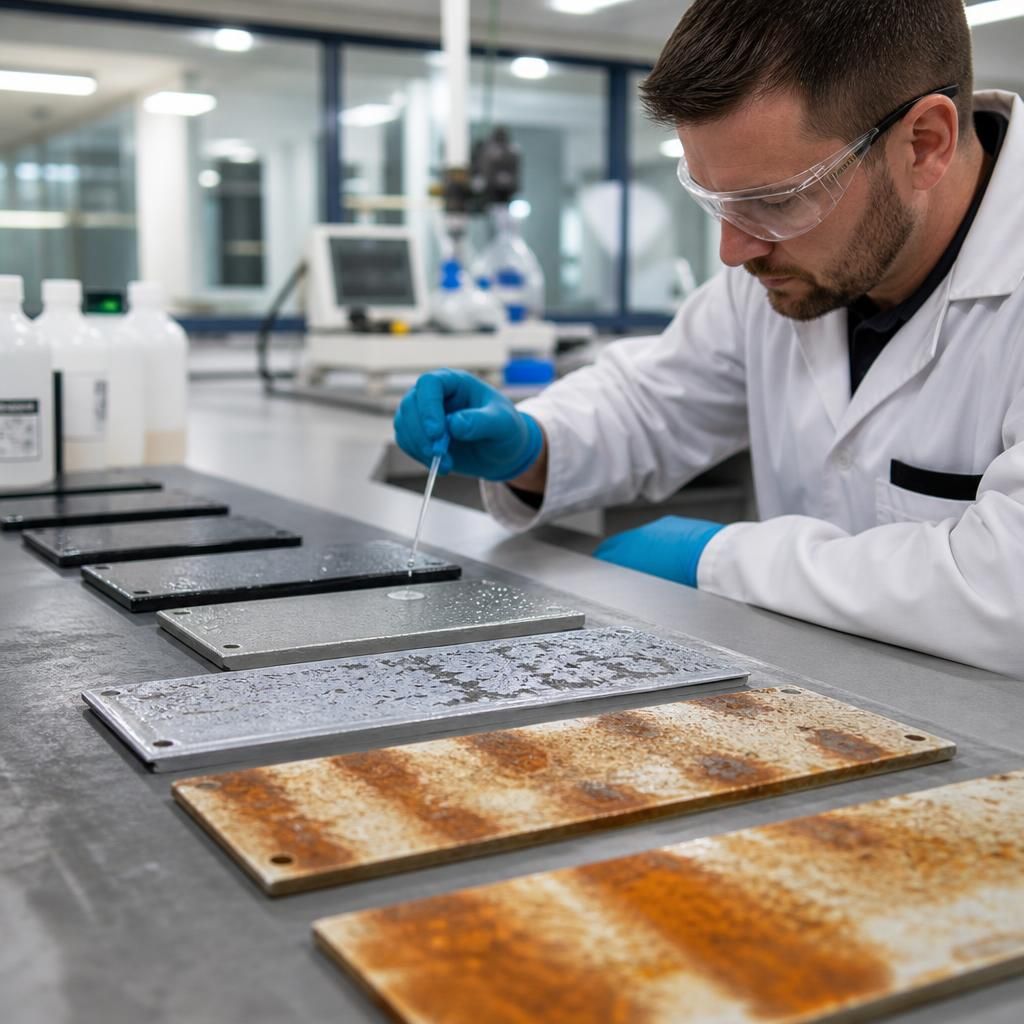
Pretreatment chemicals should be validated as part of the complete coating system, rather than ranked in isolation. A corrosion test is most informative when it uses the actual substrate, conversion treatment, powder coating, film thickness and cure cycle intended for production. Test panels should also include representative edges, welds or joints, since these areas may behave differently from a flat, uniform surface. Where components face a defined service environment, testing should reproduce its principal stresses—such as condensation, salt contamination or chemical contact—so the selected pretreatment reflects the conditions the finished part will actually encounter.
Discuss the Right Pretreatment for Your Environment
Share your component material, intended environment and coating requirements with our powder-coating specialists to discuss a suitable pretreatment specification. We can then advise on the appropriate process for your parts and collection or delivery requirements.