

What factors should be considered when choosing the best sandblasting media for your specific project requirements?
The best sandblasting media depends on the metal substrate, its condition, the contaminants to remove, the surface profile required for coating adhesion, and the component’s size and geometry. Also consider media hardness, grit size, whether the abrasive can be recycled, and the finish and dimensional tolerances the project requires.
The best sandblasting media is the one that prepares the surface for its intended coating without causing unacceptable damage, contamination, health risks or waste. Selection should therefore be based on the complete process: the coating system, the blasting equipment, the required surface condition, how the component will be handled afterwards and the controls needed to carry out the work safely.
Consider the coating system first. Powder coating requires a clean, suitably keyed surface, but different powder systems and service environments may require different preparation standards. A media that produces an aggressive anchor pattern may be appropriate for a demanding protective application, while a less aggressive abrasive may be preferable where the coating is thinner or the finished appearance is closely specified. The media should support the coating manufacturer’s preparation requirements rather than being selected solely because it removes material quickly.
Match the abrasive to the metal. Ferrous components can generally tolerate harder, more aggressive media than softer aluminium or thin-gauge parts. Aluminium, zinc-coated steel and other softer surfaces can be marked, distorted or excessively roughened if the abrasive energy is too high. Stainless steel and other corrosion-sensitive alloys also require careful control of contamination. Using media that has previously contacted carbon steel can introduce ferrous particles, which may later appear as staining or corrosion points. Separate media streams, suitable equipment and effective cleaning are important where different metals are processed.
Choose a media type suited to the required action.
- Aluminium oxide is hard and durable, making it suitable where efficient cutting and a pronounced profile are required.
- Glass bead is generally used where a smoother, more uniform finish is wanted rather than a deeply etched surface. It is often associated with cleaning and cosmetic finishing, so its suitability for powder-coating preparation depends on the specified profile.
- Steel shot or grit can provide a strong impact-cleaning action on suitable ferrous work, but it needs careful control to avoid excessive peening or distortion.
- Garnet and other mineral abrasives can offer a useful balance of cutting action and recyclable use, subject to the equipment and recovery arrangements.
- Plastic or organic abrasives are gentler options for selected applications where preserving the underlying material is more important than creating a highly aggressive profile.
These categories are not interchangeable. Two abrasives with a similar nominal particle size can behave differently because of their shape, density, friability and hardness. Angular particles cut into the surface, while rounded particles tend to peen or clean with less pronounced cutting. Friable media break down during use, creating finer particles and changing the blasting behaviour as the work progresses.
Assess the risk of embedded or transferred material. Residual abrasive can interfere with powder adhesion, create visible defects or contribute to corrosion beneath the coating. Media must be clean and appropriate for the component, particularly where the finished part will be exposed to moisture, chemicals or elevated temperatures. After blasting, remove loose dust and abrasive residue using a controlled method that does not introduce oil, moisture or other contaminants. The prepared surface should not be handled with bare, contaminated gloves before coating.
Include safety and legal controls in the decision. Respirable dust, noise, ricochet and spent abrasive all affect the suitability of a media. Ordinary silica sand is generally avoided for blasting because respirable crystalline silica presents a serious respiratory hazard and its use is subject to stringent UK controls. Alternative abrasives may reduce particular risks, but they do not remove the need for suitable enclosure, extraction, respiratory protection, eye and hearing protection, operator training and safe waste handling. The safety data for the chosen media should be reviewed before work begins.
Check compatibility with the blasting equipment. The abrasive must work with the available blast pot, cabinet, nozzle, pressure range, recovery system and extraction plant. Dense media may need different settings from lightweight alternatives, while fragile media can break down rapidly if operated at excessive pressure. The recovery system must also be capable of separating dust and spent particles so that deteriorated abrasive does not remain in circulation. A theoretically suitable media may be impractical if the equipment cannot deliver consistent control.
Use a test area for critical work. For unfamiliar components or tightly specified finishes, a trial on a representative piece can reveal whether the abrasive produces the required visual condition without damaging edges, threads, welds or formed sections. Inspect the trial surface for embedded particles, excessive roughness, distortion and areas that remain insufficiently prepared. Where appropriate, verify the result with surface-profile and cleanliness checks rather than relying on appearance alone.
Plan the interval between blasting and coating. A freshly prepared surface can be affected by humidity, handling, flash rusting or airborne contamination before powder is applied. Media selection should therefore be considered alongside the planned transfer, storage and coating sequence. Parts that cannot be coated promptly may require additional protection or re-preparation, depending on the metal and the surrounding conditions.
For a production or specialist project, the practical choice is the media that meets the preparation specification consistently while controlling contamination, substrate damage, operator exposure, equipment wear and waste. A coating specialist can compare these factors with the component drawings, finish requirements and planned powder-coating process before full-scale blasting begins.
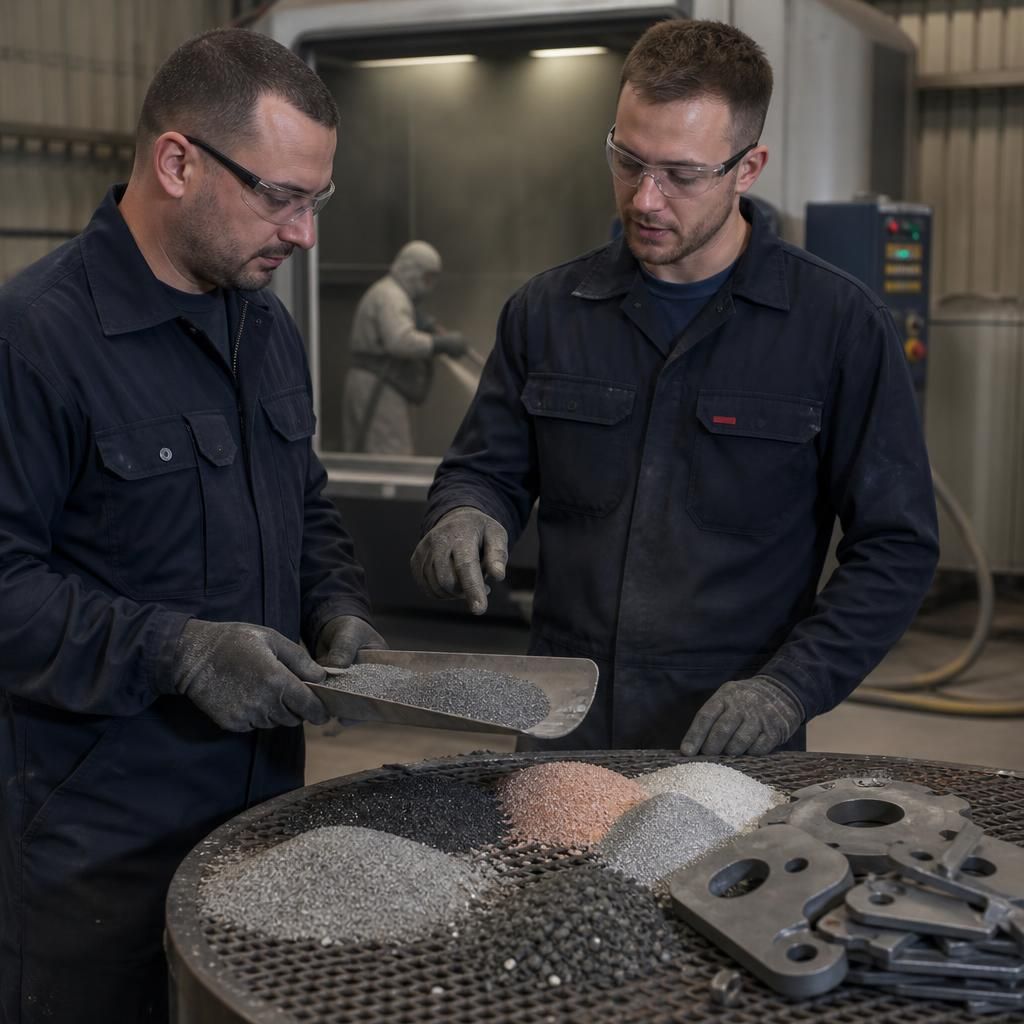
Compare sandblasting media against the project’s acceptance criteria rather than choosing solely by abrasive name or grit grade. Define what the prepared surface must achieve, such as removal of mill scale, coating residue or oxidation, together with limits for roughness, edge condition and visible marking. This gives the blasting operator a clear basis for judging whether a media is suitable.
For components with specified tolerances or a visible finish, record the approved media and operating conditions after the trial. Consistency matters because changes in abrasive condition, pressure or working distance can alter the surface even when the nominal media grade remains the same. A documented preparation standard helps ensure that different batches receive comparable treatment before powder coating.