

What specific environmental factors should influence the choice of an anti-corrosion coating for steel in my industry?
The choice of anti-corrosion coating for steel should reflect exposure to moisture, salt, chemicals, temperature changes, ultraviolet light, abrasion and the severity of the operating environment. Consider how these factors combine, along with the steel’s preparation and intended use, to select a coating system with suitable chemical, thermal and mechanical resistance.
The most suitable anti-corrosion coating for steel is determined by the complete exposure profile: how the component is exposed, how often that exposure occurs, what contaminants are present, how the steel is designed and joined, and what performance or environmental requirements apply. A coating that performs well in a sheltered factory may be unsuitable for a component exposed to condensation, chemical splash, standing water or repeated handling.
Assess the type and duration of exposure
Location alone is not enough to select a coating. Establish whether the steel will remain dry, experience intermittent wetting, be subject to splash, or face partial or complete immersion. The duration of each exposure is important because a short-lived event has a different effect from contamination that remains trapped against the surface.
Pay particular attention to areas where water or residues can collect, including folded sections, lap joints, hollow profiles, threaded connections and poorly drained fabrications. The coating specification should account for the component’s actual geometry rather than only the general conditions around it. Where drainage is poor, even a coating with strong general resistance may be challenged at seams, edges and crevices.
Consider the atmosphere and contaminants
Industrial atmospheres may contain more than visible dirt. Process fumes, airborne pollutants, acidic deposits, alkaline residues, oils and cleaning chemicals can alter the coating’s performance. In manufacturing environments, the relevant question is not simply whether chemicals are present, but whether they can reach the steel, at what concentration, and for how long.
Identify the substances used near the component and check the coating manufacturer’s chemical-resistance information for the actual operating conditions. A finish intended for general atmospheric service should not automatically be treated as suitable for solvent contact, chemical storage areas, wash-down zones or process equipment. Chemical compatibility also needs to be checked at the expected operating temperature, since resistance can change as the coating becomes hotter.
Account for contact with other materials
Steel may be connected to aluminium, stainless steel, zinc-coated components or other dissimilar metals. If an electrolyte reaches the joint, galvanic corrosion can occur, with one metal becoming preferentially affected. The risk depends on the metals involved, the size and design of the contact area, the quality of electrical separation and the likelihood of contamination or water retention.
Fasteners, hinges, brackets and interfaces should therefore be considered as part of the coating decision. A coating system may protect the exposed steel while corrosion begins at an uncoated joint or damaged interface. Sealing, suitable component design and compatible ancillary materials can be as important as the finish selected for the main surface.
Match the coating to mechanical and operational conditions
The environment includes the way the part is handled and used. Loading, impact, vibration, flexing and repeated contact can damage a coating without visible exposure to aggressive chemicals. Coating selection should therefore consider adhesion, flexibility, hardness and resistance to chipping, as well as resistance to the surrounding atmosphere.
Edges, welds, drilled holes and cut-outs are common points of weakness. These areas require careful specification and inspection because a defect or thin area can become the starting point for corrosion beneath an otherwise sound finish. If the component will be assembled after coating, the design should allow for protected contact points, controlled fastening and repair of any damage caused during installation.
Check thermal and dimensional conditions in service
Some steel components experience repeated heating and cooling, localised heat from machinery, or temperature differences between the steel and attached materials. These conditions can place stress on the coating system, particularly where the substrate expands and contracts differently from the coating.
Determine the normal operating condition as well as foreseeable peaks, cold starts and process interruptions. The specified system must be suitable for the full service range and for the method used to cure it. A coating that is chemically resistant at ordinary temperatures may not retain the same properties under sustained heat, while a finish designed for high-temperature service may not provide the best protection in other conditions.
Evaluate the consequences of failure
The required protection level should reflect what corrosion would affect if it occurred. Cosmetic rust on a decorative enclosure has different implications from section loss on a structural support, contamination of a manufactured product, seizure of a moving part or failure of a safety-related guard.
For critical components, define acceptance criteria before coating begins. These may cover coating continuity, adhesion, film thickness, edge coverage, repair procedures and inspection records. The more serious the consequence of corrosion, the less appropriate it is to rely on a generic coating description without documenting the exposure and verification requirements.
Include cleaning, maintenance and repair conditions
Routine maintenance can change the environment experienced by the coating. Pressure washing, steam cleaning, detergents, disinfectants and occasional chemical spills may impose more demanding conditions than the surrounding air. Ask whether the finished component can be cleaned without damaging the coating and whether local repairs will be practical if the surface is chipped during service.
Inspection should focus on coating breakdown, staining, blistering, cracking, loss of adhesion and corrosion around joints or damage points. Finding deterioration early usually gives more repair options than allowing corrosion to develop beneath an apparently intact film.
Balance protection with environmental and process requirements
The coating choice may also be influenced by restrictions on solvent emissions, waste handling, overspray, cleaning products and end-of-life treatment. Powder coating can be relevant where a dry application process and a durable finish suit the component, but the complete process still requires suitable preparation, curing, handling and quality control.
For each steel item, record the exposure conditions, contaminants, contact materials, service temperature, mechanical demands, cleaning regime, failure consequences and inspection requirements. This information allows a coating specialist to compare single-coat and multi-coat systems, confirm compatibility with the substrate and identify where additional design protection or sealing is needed. For industrial fabricators and manufacturers, providing this exposure information at quotation or specification stage is one of the most effective ways to avoid selecting a finish based on appearance alone.
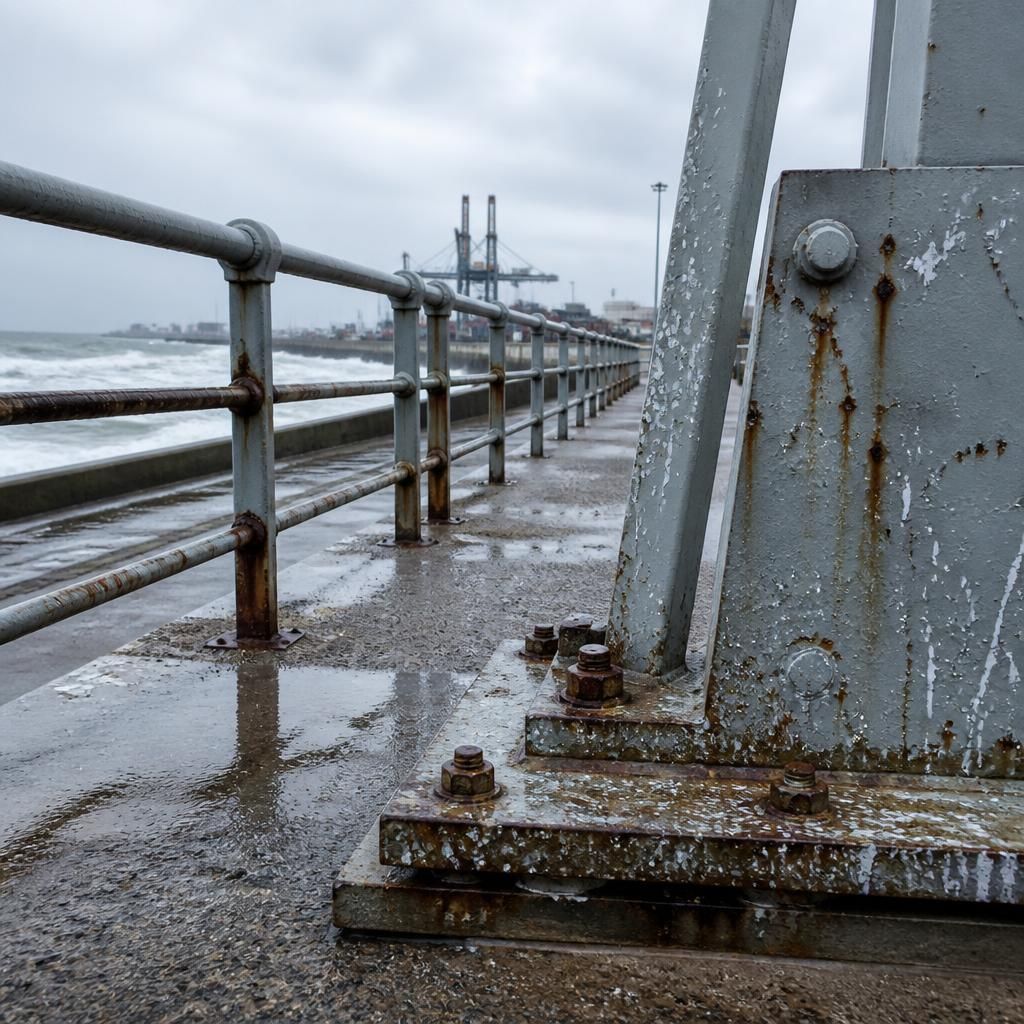
Salt and chloride contamination should be treated as a distinct environmental risk when selecting an anti-corrosion coating for steel. Coastal air, road de-icing residues, industrial deposits and salt-containing process materials can leave conductive deposits on the surface, particularly where moisture remains after wetting.
The exposure is often more demanding when the steel repeatedly becomes wet and then dries. As water evaporates, dissolved salts can become concentrated at edges, joints, fixings and other areas where residues collect. Specify the likely source of chloride contamination, how often it occurs and whether the component can be washed down or inspected. The coating system and surface preparation should then be assessed for the actual salt exposure rather than being selected solely for general outdoor use.
Discuss your steel’s environmental exposure
Discuss your steel’s environmental exposure with our coating specialists, including chemical contact, temperature, moisture and mechanical demands. This information helps identify a suitable anti-corrosion coating system and preparation requirements for your application.