

How do different powder coat finishes impact the durability of aluminium components in harsh environments?
Different powder coat finishes affect aluminium durability by changing its resistance to UV exposure, moisture, corrosion, abrasion and chemicals. In harsh environments, the most suitable finish depends on the coating chemistry, surface pretreatment, film thickness and the specific conditions the component will face.
Powder coat durability on aluminium is determined by the complete coating system, not by colour or sheen alone. In harsh environments, the most important variables are the resin chemistry, pretreatment, coating thickness, cure, edge coverage and the way the component is designed and maintained. A finish selected for indoor plant equipment may therefore be unsuitable for exposed architectural, coastal or chemically demanding applications.
Coating chemistry affects the main failure mechanisms.
- Exterior-grade polyester systems are commonly selected for exposed aluminium because they provide a balanced combination of weathering performance, colour retention and resistance to general atmospheric conditions.
- Epoxy-based systems can provide strong adhesion and resistance to many chemicals, but they are not normally the first choice where the component receives prolonged direct sunlight. Ultraviolet exposure can cause chalking and loss of appearance unless the system has been designed for that environment.
- Hybrid systems combine resin types to provide particular balances of hardness, adhesion and chemical resistance. Their suitability depends on the environment and the specification rather than the name of the finish.
- Fluoropolymer and other specialist architectural systems may be considered where long-term exterior appearance and weathering resistance are especially important, subject to the required specification.
- Thermoplastic coatings, including nylon-based finishes, can be useful where abrasion, impact, friction or chemical exposure is more significant than colour retention. They are selected for the service conditions and the geometry of the component, rather than simply for a decorative effect.
Gloss level and texture influence practical performance, but they should not be treated as a substitute for the correct resin. A smooth gloss surface is generally easier to wash because it offers fewer areas for dust, salts and process residue to lodge. Matt and fine-textured surfaces can reduce visible reflections and may suit equipment or architectural parts where a subdued appearance is required, but their surface profile can make contamination more difficult to remove. Coarse textures may also be more vulnerable to retained moisture or deposits if cleaning is neglected. The underlying formulation and the quality of application remain more significant than the visual description alone.
Pretreatment creates the foundation for corrosion resistance. Aluminium naturally forms an oxide layer, but that layer does not by itself provide a complete barrier against every severe service condition. Cleaning and conversion treatment remove contaminants and prepare the surface for adhesion. Poor degreasing, trapped residues, unsuitable conversion treatment or contamination between preparation and coating can create weak points where blistering, filiform corrosion or local loss of adhesion begins.
Particular attention is needed around drilled holes, sharp corners, joints, weld areas, folded edges and recesses. These locations can receive less consistent coverage or retain moisture. Good component design, appropriate masking and controlled application help reduce those risks. Where aluminium is fixed to another metal, the design should also consider galvanic interaction, water traps and the possibility that damaged coating will expose a conductive contact area.
Film thickness affects the barrier provided by the coating, but thicker is not automatically better. Insufficient build can leave the substrate vulnerable at edges and exposed faces. Excessive build may cause runs, poor curing, cracking, loss of texture definition or problems around moving and mating parts. The correct specification should therefore define an appropriate coating build for the selected system and component, with checks made on representative areas rather than relying only on visual inspection.
Curing is equally important. Powder must reach the correct metal temperature for the required time so that the resin cross-links properly. Under-cured coating may have reduced hardness, adhesion and resistance to chemicals, while overheating can affect colour, gloss and the properties of the finish. Aluminium dissipates heat differently according to section thickness and shape, so the oven schedule should be established from the component rather than assumed from a standard setting.
The environment should be assessed in terms of the actual exposure:
- Coastal or salt-laden locations: specify a system and pretreatment intended to limit under-film corrosion, and pay close attention to cut edges, fixings, drainage and salt deposits.
- Industrial atmospheres: identify airborne pollutants, moisture and deposits that may attack the coating or concentrate around joints and recesses.
- Chemical processing areas: identify each chemical, its concentration, temperature, contact time and cleaning method. General statements such as “chemical resistant” are not sufficient for a demanding process environment.
- High-abrasion applications: consider a hard-wearing or thermoplastic system where repeated contact, sliding, impact or handling could damage a conventional decorative coating.
- Outdoor applications: give priority to the required level of weathering and colour stability, while checking that the selected system also meets the mechanical and cleaning requirements.
Where several hazards occur together, the selection must address their combined effect. For example, an aluminium part exposed to salt, repeated washing and abrasion may need a different specification from a sheltered component exposed only to sunlight. Temperature cycling can also cause movement between the aluminium and coating, particularly where the part is thin, highly restrained or subject to rapid changes in temperature.
Colour itself usually has less influence on structural protection than the coating system and application quality. Dark colours can become hotter in direct sunlight, which may increase thermal movement and surface temperature. Light colours may make dirt, staining or chalking more noticeable in some settings. These are practical considerations, but choosing a colour solely on the basis of appearance does not establish that the coating is suitable for the environment.
Maintenance extends the useful performance of a powder-coated aluminium component. Wash deposits away using a method compatible with the coating, avoid abrasive tools and do not allow aggressive chemicals to remain on the surface. Inspect high-risk areas such as edges, fasteners, joints and impact points. Small damage should be assessed promptly because a scratch or chip can allow moisture and contaminants to reach the aluminium beneath. Touch-up methods may improve appearance or provide interim protection, but they do not always reproduce the performance of the original baked finish.
Before specifying a finish, provide the coater with the component’s alloy, dimensions, intended location, exposure to sunlight and moisture, contact with chemicals, cleaning regime, abrasion or impact risk, required appearance and any areas that must remain uncoated. The specification should then identify the coating type, pretreatment, colour and sheen, target film build, curing requirements, masking points and any relevant performance tests. For critical components, test panels or representative samples can help confirm adhesion, appearance and resistance before a production batch is processed.
For industrial aluminium components, the most durable result comes from matching the whole powder coating system to the service environment and controlling every stage from preparation through curing. A decorative matt, gloss or textured description is useful for appearance, but it cannot by itself demonstrate suitability for severe exposure.
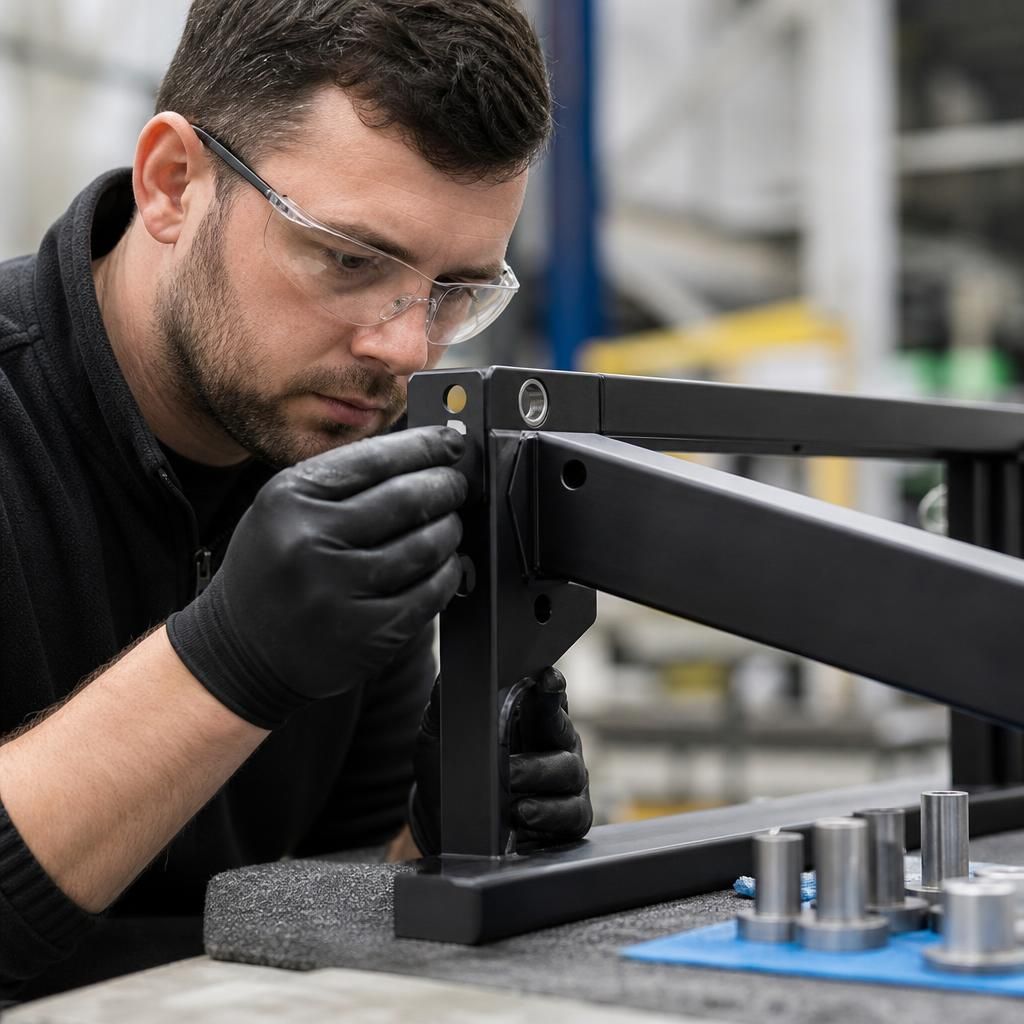
Assembly details can determine whether a powder-coated aluminium component remains protected in service. Threads, bearing seats, electrical earth points and close-fitting joints may need controlled masking because coating build-up can interfere with fit or contact. If coating is damaged during installation, exposed aluminium may become an entry point for moisture and contaminants. The finish specification should therefore identify areas requiring masking, the permitted coating build around interfaces and any handling or assembly steps that could mark the cured surface.
Discuss your aluminium powder coating requirements
Discuss your aluminium powder coating requirements with powder-coatings.co.uk to identify a finish suited to your component’s harsh-environment exposure. Collection and delivery options are available for businesses across the Midlands and surrounding areas.