

What grit size and abrasive materials are recommended for preparing metal surfaces for nylon powder coating?
For most metal surfaces, use a clean, medium-grade abrasive such as aluminium oxide or garnet, commonly around 60–100 grit, to remove contamination and create a consistent key for nylon powder coating. Select the exact abrasive and pressure according to the substrate and required surface profile, avoiding an overly coarse finish that could remain visible through the coating.
The recommended abrasive for nylon powder coating is one that produces a clean, angular and controlled surface profile without embedding contaminants in the metal. The selection should be based on the substrate, the condition of the surface, the required coating thickness and the application method, rather than grit size alone.
Choose the abrasive according to the substrate
- Carbon steel: An angular abrasive is generally appropriate because it removes mill scale, corrosion products and firmly bonded contamination while producing a mechanical key. The abrasive must be clean and free from oil, moisture and previously removed coating residues.
- Stainless steel: Use a dedicated abrasive that has not previously been used on carbon steel. Cross-contamination with ordinary steel particles can introduce ferrous contamination and may contribute to later staining or corrosion.
- Aluminium and other non-ferrous metals: Use a less aggressive approach than may be suitable for steel. Excessive impact can distort edges, leave an unnecessarily deep profile or alter the appearance of the substrate. A softer, non-ferrous abrasive may be preferable where dimensional accuracy and appearance are important.
- Previously coated or delicate components: The abrasive must be capable of removing the existing layer without unnecessarily damaging the underlying metal. Testing a representative area is advisable before processing the complete batch.
Angular and rounded abrasives behave differently
Angular particles cut into the surface and are normally selected where the objective is to remove corrosion, mill scale or an existing coating while creating a pronounced key. Rounded particles tend to peen or smooth the surface rather than cut it. They may be useful for light cleaning or sensitive components, but they are not automatically the best choice where strong mechanical adhesion is required.
Glass bead and similar rounded media can leave a relatively smooth, uniform appearance. That may be suitable for particular substrates or finishing requirements, but the resulting texture should be verified before nylon powder is applied. A visually clean surface is not necessarily sufficiently keyed for the coating system.
Grit size is only one part of the specification
Grit designations can differ between abrasive suppliers and grading systems, so the stated size should be checked against the product specification. The condition of the abrasive also matters: worn particles produce a different profile from new particles, while broken-down media can create excess dust and inconsistent blasting.
- Use a consistent abrasive grade throughout a batch where practical.
- Remove fines from the blasting system when they begin to reduce cutting performance.
- Keep abrasive dry, as damp media can obstruct equipment and transfer moisture to the component.
- Prevent oil from compressors, hoses or handling equipment entering the blast stream.
- Monitor reclaimed abrasive for paint particles, salts, metal fragments and other unwanted residues.
Control the surface profile rather than relying on appearance
The finished profile should be compatible with the nylon coating thickness. A profile that is too shallow may provide insufficient mechanical purchase, while one that is too deep can leave peaks insufficiently covered, increase coating consumption and remain visible through the finish. Surface profile comparators or suitable profile measurement equipment can provide a more reliable assessment than looking at the blasted metal alone.
Blast pressure, nozzle distance, nozzle angle and dwell time all affect the result. Holding the nozzle too close, moving too slowly or repeatedly working the same area can produce an unnecessarily rough surface. Conversely, low impact energy or rapid movement may leave mill scale and contamination behind. Settings should therefore be established on a test piece made from the same metal and with a similar starting condition.
Silica and contamination risks
Free crystalline silica abrasives should not be selected casually because respirable silica dust presents a serious occupational health hazard. The blasting process requires suitable risk controls, ventilation, personal protective equipment and dust management, regardless of the abrasive used. Abrasive choice must also comply with the site’s health and safety assessment and equipment requirements.
After blasting, do not touch the prepared surface with bare hands. Finger oils, workshop dust and moisture can compromise adhesion before nylon powder is applied. Use clean gloves and appropriate handling methods, and protect the component from condensation. If the blasted metal develops flash rust, visible dust or other contamination, it should be reassessed and cleaned or reprocessed before coating.
Confirm suitability before full production
For an unfamiliar metal, unusual geometry or critical component, compare abrasives on a representative sample. Assess coating adhesion after the complete preparation and application cycle, not just the appearance immediately after blasting. The final decision should consider the substrate, profile, coating thickness, service environment and any preparation requirements specified for the selected nylon powder system.
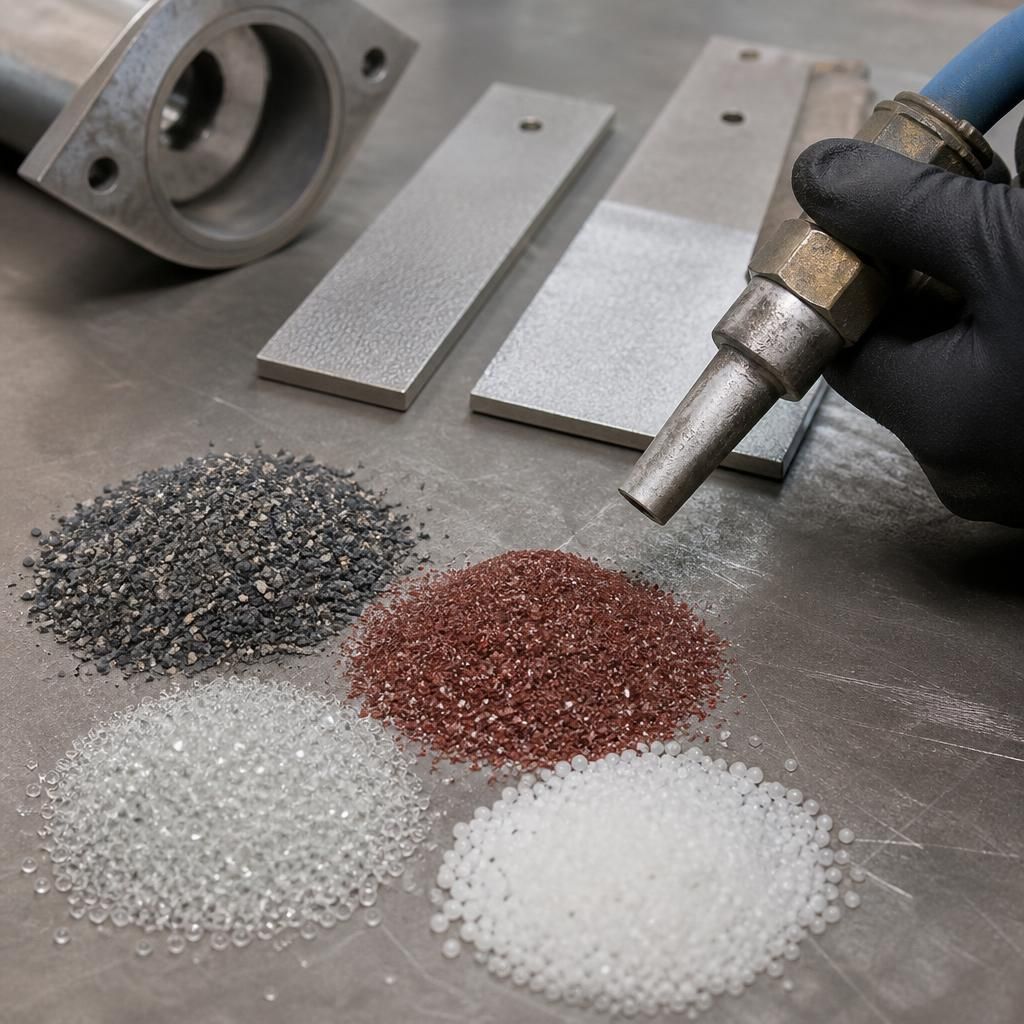
Aluminium oxide and garnet are commonly considered for nylon powder coating preparation because both can produce an angular profile when correctly controlled. Aluminium oxide is a hard, sharp-cutting medium suited to removing firmly bonded scale, corrosion and old coating. Garnet can provide effective cleaning with a more moderate cutting action, which may be preferable where the substrate or component geometry needs careful control.
The abrasive should be matched to the metal and the required finish rather than selected by material name alone. Metallic media may introduce unwanted particles, particularly where the prepared surface must remain free from ferrous contamination. Glass bead and other rounded media can clean and peen a surface, but may produce less mechanical key than an angular abrasive. Whichever material is chosen, confirm the resulting profile and coating adhesion on a representative piece before processing a complete batch.
Discuss Grit Size and Abrasive Materials for Nylon Powder Coating
Discuss your substrate, component geometry and required nylon coating specification with our Midlands powder-coating specialists before preparing a full batch. We can help assess the appropriate abrasive approach and arrange collection or delivery for your metal components.