

What are the advantages and limitations of using chromate pretreatment on aluminium surfaces before powder coating?
Chromate pretreatment converts the aluminium surface into a thin chemical layer that can improve powder coating adhesion and provide additional corrosion protection, particularly where the coating is damaged. Its limitations include environmental and health controls, waste-treatment requirements, process sensitivity and the need to select compliant, suitable chemistry; it is not a substitute for thorough cleaning or correct powder curing.
Chromate pretreatment can be highly effective on aluminium before powder coating when a thin conversion layer is required without materially changing the component’s dimensions or surface profile. Its main advantages are consistent coating adhesion, retention of aluminium’s detail and a degree of protection at areas where the powder film is locally breached. The main limitations are regulatory control, process management, waste handling and the need to match the chemistry and application method to the aluminium alloy and end-use conditions.
Unlike a conventional primer, chromate conversion does not create a substantial film thickness. The treatment chemically modifies the outermost aluminium surface, allowing the powder coating to form a more reliable bond than it would on untreated or inadequately prepared metal. This is useful for close-tolerance components, folded sections, extrusions, housings and parts with machined features where a thicker preparatory coating could affect fit, assembly or appearance.
The treatment can also help maintain continuity of protection around small scratches, pores and exposed edges. This does not make the powder coating immune to damage, but it can reduce the speed at which corrosion develops beneath a local defect. Chromate conversion can be particularly useful where aluminium parts face outdoor exposure, moisture or salts and where the powder coating is expected to provide the principal decorative and protective finish.
Another advantage is that the process can be adapted to different aluminium alloys and component designs, provided the pretreatment line is properly controlled. It is suitable for many fabricated and extruded parts, including components with recesses or irregular profiles that may be difficult to protect with a uniform liquid primer. The conversion layer is also far thinner than most primers, so it normally preserves sharp edges, markings and fine surface detail.
There are important limitations. Hexavalent chromium compounds present significant health, environmental and regulatory concerns and require tightly controlled handling, storage and waste management. Trivalent chromium systems may offer a more suitable compliance route, but they are not automatically interchangeable with older chemistries: concentration, pH, contact time, rinsing and drying conditions can differ. The applicable restrictions depend on the substance, process and end market, so the chosen system should be verified against current UK requirements and any customer or sector specifications.
Chromate performance is sensitive to the condition of the aluminium before treatment. Oils, drawing compounds, fingerprints, oxides and residues can prevent an even conversion layer from forming. Aluminium alloys also respond differently because their alloying elements and surface condition influence cleaning and conversion. Excessive etching may alter the appearance or dimensions of the part, while insufficient preparation can leave an uneven or poorly receptive surface. The process therefore needs controlled cleaning, rinsing and activation stages rather than simply applying chromate to visibly clean metal.
Visual appearance can be another consideration. Some chromate systems produce a yellow, iridescent or lightly coloured film, whereas other systems are designed to leave a clear or less visible finish. Colour variation may result from alloy composition, treatment time, bath condition and drainage. Where the powder coating is translucent, very light, or specified to a particularly consistent appearance, sample panels or representative test pieces can help establish whether the pretreatment affects the final finish.
Chromate conversion is not always the best choice for every aluminium component. The decision should consider:
- the aluminium alloy, temper and existing surface condition;
- the intended indoor, outdoor, marine or industrial exposure;
- required corrosion performance and the consequences of coating damage;
- dimensional tolerances, surface appearance and electrical contact requirements;
- whether the chosen chromium chemistry is acceptable for the customer, sector and waste-treatment arrangements;
- the geometry of the component and whether all surfaces can be cleaned, rinsed and treated consistently; and
- compatibility between the conversion coating, powder formulation and curing process.
Application controls are especially important on aluminium because inadequate rinsing can leave residues, while poor drying can interfere with powder application. Excessive treatment can produce an unnecessarily heavy or uneven conversion layer, and insufficient treatment can reduce the consistency of the finished system. Records of bath condition, process stages and inspection results are valuable when coating batches of parts or investigating adhesion and appearance differences.
For many industrial aluminium applications, chromate pretreatment remains a technically capable option where a thin conversion layer and strong interface with the powder coating are required. Its suitability depends less on the name of the treatment than on the complete process: alloy identification, preparation, compliant chemistry, controlled application, thorough rinsing, drying, powder application and correct curing. A coating specification should therefore state the required pretreatment system and performance expectations rather than relying on the general term “chromated aluminium”.
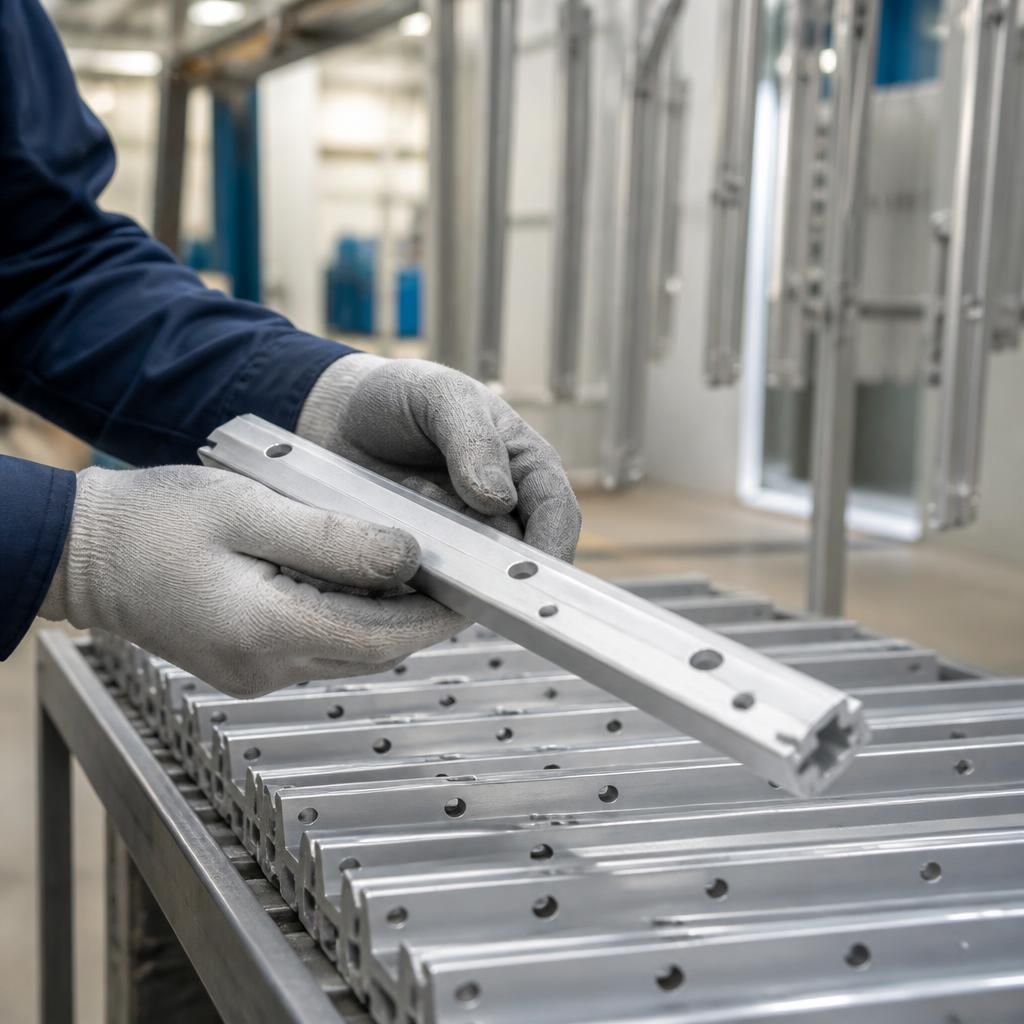
A chromate conversion layer is thin and relatively delicate before the powder is applied, so post-treatment handling is an important limitation. Contact with bare hands, dirty supports, workshop dust or abrasive packaging can contaminate or disturb the treated surface, even when the aluminium still appears clean. Components should therefore be handled with suitable clean protection, supported without damaging critical faces and kept separate from untreated work.
This is particularly relevant for batches containing exposed edges, recesses or contact points. Any area that is rubbed after conversion may no longer have the same surface condition as the rest of the component, creating a potential source of inconsistent powder adhesion. Inspection should take place before coating, with attention to visible residues, water marks, handling damage and incomplete coverage. This practical control helps ensure that the benefit of the chromate treatment is retained through powder application and curing.