

How does the curing process affect the performance of high temperature and heat resistant powder coatings in industrial environments?
Curing determines how fully a high temperature and heat resistant powder coating cross-links, directly affecting its hardness, adhesion, flexibility and resistance to heat, chemicals and corrosion. Insufficient or excessive heat exposure can leave the film under-cured or degrade the resin, so the specified metal temperature and bake time must be controlled for consistent industrial performance.
Curing affects the performance of a high temperature powder coating by establishing the final structure of the film and making its properties consistent across the component. The specified cure must be achieved at the metal surface, not simply indicated by the oven’s air temperature. Correct control of part temperature, dwell time and heating uniformity is therefore essential in industrial production.
Metal temperature is more important than the oven temperature
Powder coating technical data normally specifies a metal-temperature and time combination. The part must reach the required temperature before the effective dwell period begins. An oven displaying the correct air temperature does not prove that a heavy steel section, boxed assembly or densely loaded component has received the required thermal exposure.
Different parts heat at different rates. Thin sheet, small brackets and exposed edges may reach temperature quickly, while thick plate, folded sections and components with a high thermal mass take longer. If the process is judged only by the oven controller, parts within the same batch can receive different levels of cure.
How the cure schedule affects high temperature performance
- Correctly cured film: the coating reaches the properties designed into the powder system, allowing it to operate reliably within its stated service conditions.
- Insufficient thermal exposure: the surface may appear acceptable while the film has not fully developed its intended resistance to handling, solvents or repeated heat cycles.
- Excessive thermal exposure: prolonged or unnecessarily high heating can alter appearance and may reduce the coating’s useful performance, particularly where the formulation is not designed for that schedule.
- Uneven heating: local differences across a component can create inconsistent finish quality and make some areas more vulnerable during service.
High temperature resistance is not created by curing alone. The resin chemistry, pigments, additives, film thickness and preparation of the metal all contribute to the finished coating’s behaviour. Curing allows those formulation characteristics to develop; it cannot compensate for a powder selected for a service temperature or chemical environment beyond its design range.
Service temperature and curing temperature are different
A coating’s bake temperature should not be confused with the temperature it can withstand during operation. The bake is a controlled manufacturing stage used to form the finished film. The service rating describes the conditions the coating is intended to tolerate after processing. A powder that requires a relatively high bake temperature may not necessarily be the best choice for the highest operating temperature, and a coating intended for elevated service temperatures still needs to be cured according to its own specification.
Repeated heating and cooling can place additional stress on the coating and the metal beneath it. A suitable cure helps provide a stable film for these cycles, but selection must also consider thermal expansion, exposure duration, atmosphere and any contaminants present in the application.
Process factors that influence the result
- Part loading: tightly packed components can restrict airflow and extend the time needed for the centre of the load to reach temperature.
- Component geometry: enclosed sections, overlaps and deep recesses may heat differently from open surfaces.
- Oven airflow: uneven circulation can produce hot and cold zones, even where the average oven temperature appears correct.
- Line speed: on a continuous system, changing conveyor speed alters the time available for heating and dwell.
- Film build: an unusually heavy or uneven deposit can affect appearance, heating behaviour and the way the finished film performs.
- Oven condition: inaccurate sensors, blocked airflow routes or poor insulation can make a previously established schedule unreliable.
Infrared and convection systems can also deliver heat differently. Infrared energy may heat exposed surfaces rapidly, while shaded areas and complex shapes may receive less direct energy. Convection relies on heated air and may provide a more even result for some geometries, but the appropriate process depends on the equipment, component design and powder specification.
Checking whether the cure is suitable
Industrial coating control should verify the temperature reached by representative parts rather than relying solely on the oven display. Temperature-recording equipment can be attached to heavy and lightly built areas to identify the slowest-heating locations. This is particularly useful when a new component, loading pattern or oven setting is introduced.
Finished-part checks can then assess whether the process is producing a consistent result. Depending on the specification, these may include visual inspection, film-thickness measurement, adhesion assessment, solvent resistance checks and tests that reflect the expected heat exposure. The exact test method should be agreed with the coating specification and the intended application rather than selected in isolation.
For repeat production, the validated schedule should be linked to the component type and loading arrangement. Changing the thickness of the metal, the number of parts in a batch or the position of parts in the oven can require the process to be reviewed. Recording these variables helps distinguish a coating-formulation issue from a heating or handling issue.
For industrial components exposed to sustained or cyclic heat, curing is therefore a process-control requirement rather than a final cosmetic step. Correct metal temperature, adequate dwell, even heating and confirmation on representative parts give the selected high temperature powder coating the conditions needed to deliver its specified performance in service.
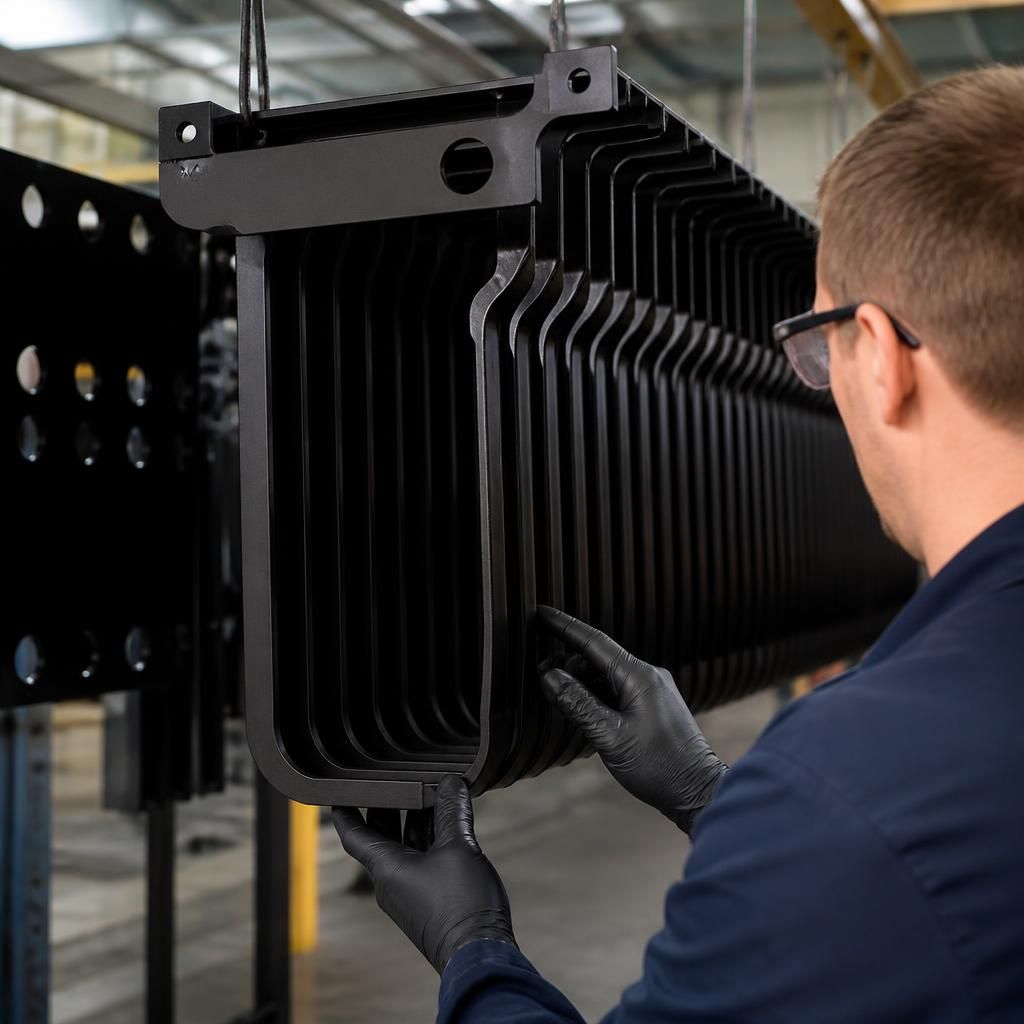
A high temperature powder coating must first melt and flow across the metal before it can fully cross-link. A smooth, continuous appearance therefore confirms that the powder has fused, but it does not by itself prove that the coating has developed its intended chemical and mechanical resistance.
As cross-linking progresses, the film becomes less susceptible to softening, solvent attack and damage during handling. This distinction is important when assessing heavy or complex components: a surface may look finished while the coating beneath has not completed the required cure. Performance should therefore be judged against the powder manufacturer’s cure specification and suitable finished-part testing, rather than appearance alone.