

What specific maintenance practices should be implemented to prolong the lifespan and effectiveness of my powder coating equipment?
Implement a planned maintenance routine covering cleaning, inspection, calibration and replacement of wear parts across the powder delivery, application, curing and extraction systems. Record each check, address contamination or faults promptly, and follow the equipment manufacturer’s servicing guidance to preserve consistent coating performance and extend equipment life.
Effective powder coating equipment maintenance combines safe operation, controlled environmental conditions and subsystem-specific checks. In addition to routine servicing, operators should protect the equipment from moisture, powder contamination, electrical faults, excessive heat and mechanical strain, while verifying that safety controls and process settings continue to work as intended.
Use a safe isolation procedure before maintenance. The booth, gun system, conveyor, extraction equipment and curing oven should be shut down in accordance with the equipment’s operating instructions before work begins. Isolate electrical supplies, release stored pneumatic pressure and allow heated components to cool. Where electrostatic equipment is used, discharge residual electrical energy and confirm that the system is safe before handling guns, cables or electrodes. Appropriate respiratory, eye, hand and hearing protection should be selected for the task, particularly where powder residues or compressed air are involved.
Control compressed air quality. Moisture, oil and particulate contamination in the air supply can affect powder transport, fluidisation and gun operation. Check that the compressor’s filtration and moisture-separation arrangements are suitable for the system, drain condensate from relevant collection points and investigate any sudden change in air pressure. Air leaks at hoses, couplings and regulators should be corrected rather than compensated for by increasing pressure, as excessive pressure can disturb powder flow and create inconsistent application.
Protect the powder feed system. Powder containers should remain sealed when not in use and be stored in a clean, dry area at a stable temperature. Keep different powder types and colours clearly separated to reduce the risk of cross-contamination. Fluidising plates, suction tubes, pumps and feed hoses need to remain correctly fitted and free from hardened or compacted material. Any change in powder flow, surging or loss of fluidisation should be investigated at the source rather than corrected solely through gun settings.
Maintain electrical continuity and earthing. Reliable earthing is essential for electrostatic transfer. Check the earth connection between the equipment, workpieces, hooks, racks and conveyor, and make sure contact points are not obstructed by accumulated coating. Hangers and fixtures should provide repeatable contact with the parts being coated; damaged or poorly aligned fixtures can reduce transfer efficiency and contribute to uneven coverage. Gun cables, connectors, electrode assemblies and control-panel connections should be protected from impact, sharp bends and abrasion.
Keep application components correctly configured. Gun nozzles, deflectors, electrodes and powder hoses should match the intended powder and coating process. Excessive bending of hoses can restrict flow, while unsuitable hose lengths or loose connections can cause powder to settle before reaching the gun. Check that gun mounts and reciprocators, where fitted, move smoothly and remain aligned with the workpiece path. Avoid changing several process variables at once, because this makes it more difficult to identify whether a fault originates in the powder feed, electrostatic system or mechanical movement.
Preserve booth and extraction performance. Extraction must maintain the airflow needed to contain powder without pulling material away from the workpiece or disturbing the spray pattern. Monitor changes in airflow, fan noise and filter pressure, and investigate unusual readings rather than continuing to operate with a restricted extraction path. Booth doors, access panels and seals should close properly. Recovery equipment should also be checked for blockages, leaks and incorrect airflow, particularly when reclaimed powder is used as part of the process.
Check the curing oven as a complete system. A sound oven maintenance regime covers the heating source, circulation fans, ducting, insulation, doors, seals and exhaust arrangements. Look for signs of uneven heating, unstable burner or element operation, unusual fan vibration and damaged insulation. Parts should not obstruct air circulation, and the conveyor should carry components through the heated zone at a steady, controlled rate. If coating defects suggest under-curing or over-curing, test the oven and process conditions before altering the powder application settings.
Maintain mechanical movement and load handling. Conveyors, lift mechanisms, reciprocators and rotating fixtures should be kept correctly aligned and lubricated with products suitable for the equipment and operating temperature. Check for abnormal vibration, increased resistance, slipping, loose fasteners or inconsistent movement. Loads should be within the equipment’s intended capacity and positioned so that the conveyor, hooks and fixtures are not subjected to avoidable imbalance. Mechanical faults can affect coating uniformity as well as create a direct safety risk.
Test protective devices and controls. Emergency stops, access-door switches, over-temperature protection, booth interlocks and alarm functions should be function-tested under a defined safe procedure. Control displays should be checked for recurring warnings rather than simply resetting them. A fault that repeatedly returns may indicate a failing sensor, restricted airflow, overheating component or control-system problem and should be diagnosed before normal production continues.
Use condition-based triggers as well as calendar dates. Maintenance should be brought forward when there is a change in powder consumption, airflow, pressure stability, gun response, oven behaviour, conveyor movement or defect patterns. The frequency of specialist attention should reflect operating hours, powder type, colour changes, production volume and the amount of reclaimed powder in use. A maintenance plan that responds to these conditions is more effective than treating every item as though it experiences the same load.
Only suitably competent personnel should work on electrical, pneumatic, combustion, extraction or high-temperature systems. If a fault affects earthing, oven safety, extraction or the integrity of the control system, the equipment should be taken out of service until it has been assessed and made safe. These practices help preserve process control, reduce avoidable equipment stress and support reliable powder coating results over the working life of the installation.
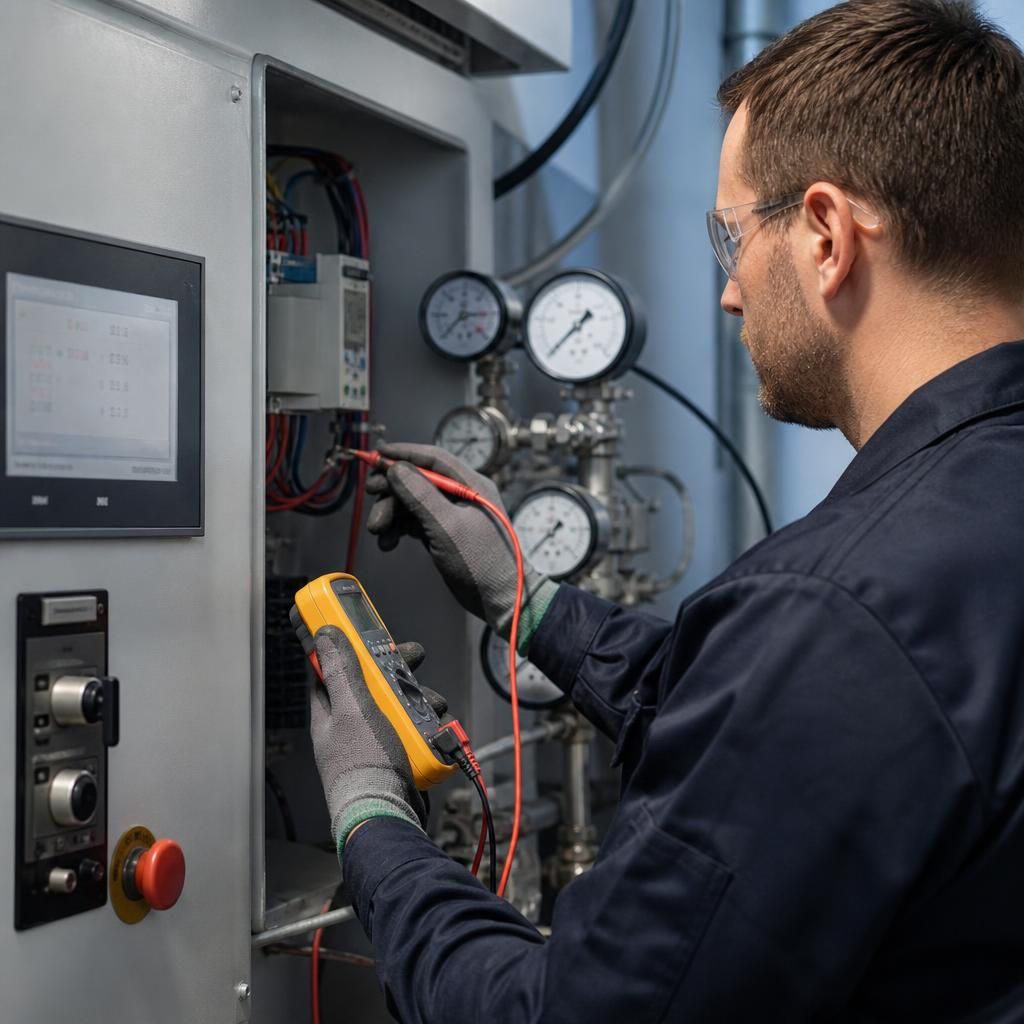
Calibration checks confirm that the readings used to control the coating process reflect actual conditions. Verify oven temperature displays against a suitable reference instrument, compare pressure and airflow readings with known operating conditions, and check powder delivery or weighing equipment where these measurements guide process settings. Record the instrument used, the result and any adjustment made.
Calibration should also be reviewed after a sensor, controller or gauge has been replaced, or when readings conflict with coating results. Keep certificates and comparison records with the equipment maintenance log so recurring drift can be identified. Instruments that cannot be brought back within their required tolerance should be removed from service rather than used to compensate for inaccurate process information.