

What factors should be considered when choosing a primer for powder coating surface preparation?
Choosing a primer for powder coating surface preparation depends on the substrate, the level and type of corrosion risk, the required adhesion, and the powder system being applied. Compatibility with the pre-treatment process, curing conditions, service environment and desired finish must also be confirmed so the primer supports, rather than undermines, the complete coating system.
A suitable primer for powder coating is selected by assessing how it will behave as part of the entire coating build, not by choosing a product solely for its adhesion or colour. The decision should account for film thickness, edge and weld coverage, application method, recoat timing, handling requirements, specification tests and any restrictions affecting the finished component.
Define the required coating build. Decide whether the primer is intended to provide additional corrosion resistance, improve coverage over difficult areas, isolate the substrate, or support a particular performance specification. A primer may be applied beneath a powder topcoat as a separate layer, or the system may use a powder primer designed to be overcoated. These arrangements have different requirements for thickness control, curing and intercoat adhesion. The chosen primer must therefore be approved for the intended number and type of layers rather than treated as a universal undercoat.
Consider film thickness and component geometry. Corners, folded sections, recesses, holes, welds and sharp edges do not receive coating in the same way as broad, accessible faces. A primer that performs well on flat panels may be unsuitable where penetration, edge coverage or wraparound deposition is important. Excessive build in joints and recesses can interfere with assembly, while insufficient coverage at edges can leave vulnerable points in the finished system. Trial application on representative parts is often more informative than relying only on a data sheet.
Check how the primer will be applied. The primer must suit the equipment, line arrangement and part presentation used for the job. Electrostatic application, for example, depends on the component being suitably earthed and on the powder being attracted consistently to the surface. Complex shapes, internal faces and areas shielded from the spray may require a different application strategy. The specified primer should be capable of producing an even layer without creating excessive back-ionisation, pinholing or other application defects under the planned conditions.
Review the overcoating window. Timing between primer application and the topcoat affects the bond between the layers. Some systems require the primer to be fully cured before overcoating, whereas others are designed for an intermediate or partially cured stage. The usable interval may also be affected by contamination, moisture and handling. Confirm whether the primed component can be moved, stored or inspected before the next coat, and establish what cleaning or re-preparation is needed if the planned sequence is interrupted.
Assess handling and assembly conditions. Coated parts can be exposed to lifting, racking, stacking, drilling, fastening or movement before they are installed. The primer should have adequate resistance to marking and damage during these stages, while still allowing the topcoat to bond correctly. On parts that will be cut, bent or assembled after coating, the specification should address the effect of those operations on the primer and on exposed edges. A primer that is technically suitable in service may be impractical if it cannot withstand the manufacturing sequence.
Consider welds, fabrication residues and repairs. Weld spatter, heat-affected zones, grinding marks, sharp edges and residues from fabrication can create local differences in coating behaviour. The primer should not be selected without considering how these areas will be treated and inspected. If repairs are permitted, establish whether the same primer can be used for local correction and whether the repaired area can be blended into the subsequent powder coat. Any repair procedure should be compatible with the original coating system rather than introducing an untested material.
Match the primer to the required inspection regime. Where a project specification includes adhesion, thickness, impact, flexibility, salt spray or other performance testing, the primer must form part of the system used for validation. Results from a primer tested beneath one topcoat cannot automatically be applied to a different powder or preparation method. Keep records of the primer type, batch, application conditions and curing process so that deviations can be investigated and repeat work can be controlled.
Check chemical and environmental resistance. The finished system may encounter cleaning agents, oils, fuels, salts, industrial chemicals, humidity or repeated washing. The primer should be assessed alongside the topcoat because the weakest layer can determine the behaviour of the complete coating. Particular care is needed where a coating is exposed to substances that may permeate the top layer and attack the interface or substrate beneath it.
Confirm storage, safety and compliance requirements. Technical documentation should state the recommended storage conditions, application limits, curing requirements and handling precautions. The selected system should also fit the site’s controls for dust, waste, ventilation and worker protection. These considerations do not replace performance testing, but they can rule out a primer that is difficult to store, apply or manage within the intended production process.
In practice, primer selection is best finalised from the component drawing, substrate condition, coating specification and proposed process sequence. The supplier’s technical data should be checked for application limits and overcoat instructions, then confirmed through a representative trial where the part has complex geometry, welded areas or unusually demanding service conditions. This approach helps establish whether the primer supports the complete powder coating system rather than solving one preparation issue while creating another.
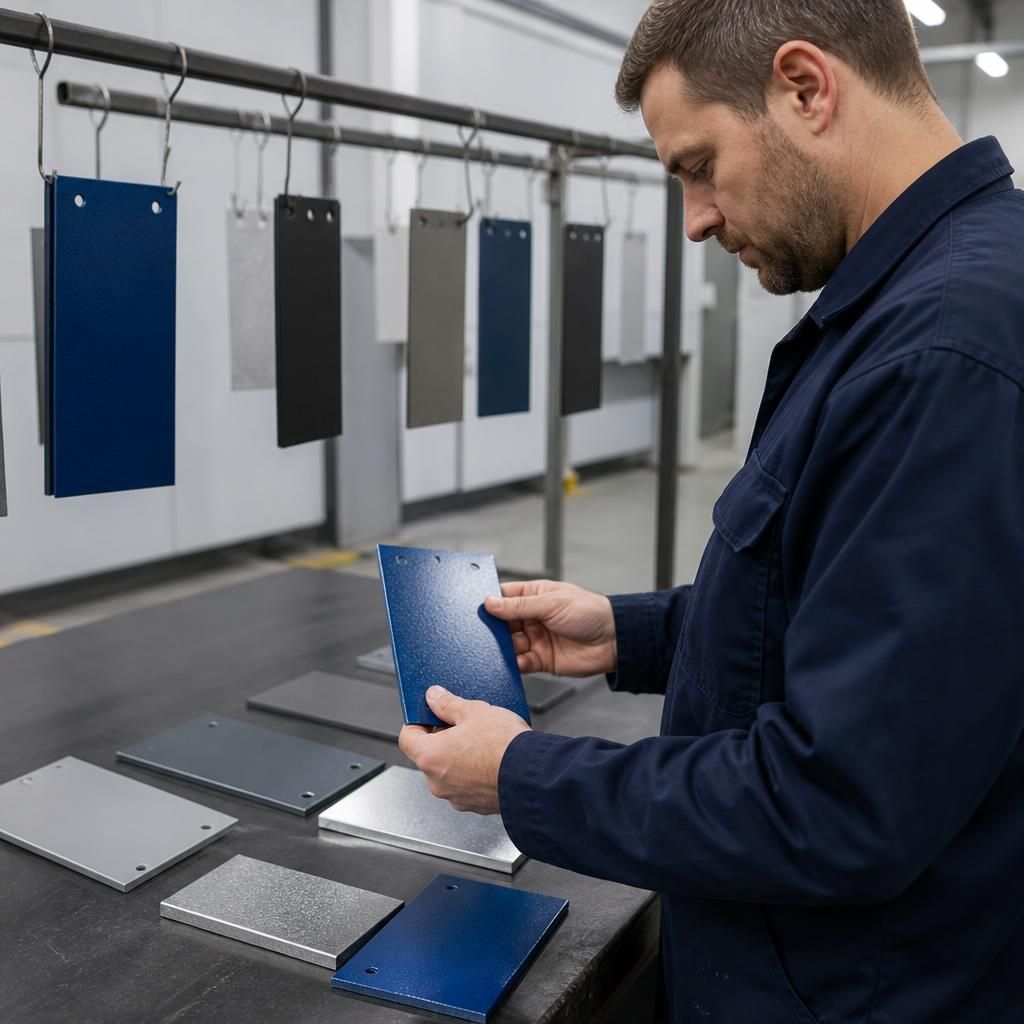
The substrate is a primary factor in primer selection because steel, galvanised metal and aluminium present different adhesion and corrosion challenges. A primer suitable for prepared mild steel may not bond reliably to a zinc-rich surface or an aluminium component, particularly if the metal has a conversion coating, oxide layer or residues from fabrication.
Check that the primer is compatible with the specific pre-treatment and substrate rather than relying on a general-purpose product. The assessment should cover:
- the metal type and any existing coating or conversion layer;
- the expected corrosion mechanism, including exposure at cut edges, welds and joints;
- the risk of reactions between the primer, pre-treatment and powder topcoat; and
- whether representative samples have been tested after the complete preparation and coating sequence.
Where the substrate or its condition is unusual, technical documentation and a trial on representative material can identify incompatibility before production parts are coated.
Discuss Your Powder Coating Primer Requirements
Discuss your powder coating primer requirements with our team, including the component material, service environment and proposed coating specification. We can help identify the information needed to assess a suitable primer and complete coating system.