

How does the application process for nylon and speciality coatings affect their performance and longevity?
The application process directly affects how well nylon and speciality coatings adhere, resist wear and protect metal over time. Thorough surface preparation, an even coating build and correctly controlled curing help produce a consistent finish with reliable performance and longer service life.
The application process affects nylon and speciality coatings by determining the quality of the bond, the continuity of the protective film and the way the coating responds to service conditions. Each stage, from selecting the application method to cooling and inspection, can influence resistance to impact, abrasion, chemicals, moisture and corrosion.
Application method and part geometry: Nylon powder may be applied by electrostatic spraying or by a fluidised-bed process, depending on the component, coating specification and required film characteristics. Electrostatic application can suit complex production work, while a preheated part immersed in fluidised powder can produce a substantial, continuous layer. Recesses, internal corners, holes and sharp edges need particular attention because powder may accumulate, thin out or fail to reach the required areas. The method must therefore be selected around the component rather than treated as a standard operation for every part.
Thermal control: Nylon systems depend on a defined thermal cycle to melt and consolidate the powder. The important variable is the temperature reached by the metal itself, not simply the reading from the oven or surrounding air. Thick sections, thin brackets and assemblies with different materials can heat at different rates. If the substrate does not receive enough heat, the coating may not flow and fuse properly; excessive thermal exposure can affect the finish, colour or properties of the coating. Monitoring the part’s thermal behaviour is particularly important for large or irregular components.
Film continuity and edge coverage: A coating can appear acceptable on broad faces while remaining vulnerable at edges, welds, corners or transitions. These areas experience concentrated impact and may provide a route for moisture or chemicals if coverage is incomplete. Application parameters, part orientation and movement through the process all affect how powder settles and flows. Where a specification requires a particular thickness or multiple coating layers, each layer must be compatible with the next so that the finished system does not contain weak interfaces.
Masking and tolerances: Threads, bearing seats, electrical contact points and close-fitting mating surfaces may need masking before coating. Poorly planned masking can leave unprotected metal where protection is needed or add coating to a surface that must remain within a tight tolerance. The design of masking also affects the boundary between coated and uncoated areas. For manufactured components, coating allowances should be considered alongside dimensional tolerances so that the final part remains suitable for assembly.
Cooling and handling: Once the coating has formed, the component needs to be handled in a way that avoids marking, indentation or contamination while the finish stabilises. Contact with racks, lifting equipment or adjacent parts can damage edges or leave impressions if the support points are unsuitable. Cooling conditions can also affect the appearance of the surface, particularly on large parts where sections may cool unevenly. Components should be inspected before packing or further assembly rather than assuming that a visually smooth finish is defect-free.
Inspection and process control: Performance is assessed against the requirements of the application, not by appearance alone. Relevant checks may include visual inspection, coating thickness, coverage at difficult features, adhesion and, where specified, resistance to impact, abrasion or chemicals. The inspection approach should reflect the intended environment: a coating for outdoor structural hardware may require different acceptance criteria from one used on a component exposed to sliding wear or aggressive cleaning agents.
Matching the coating to service conditions: Nylon is often selected where toughness, low friction, wear resistance or resistance to particular chemicals is important, but no coating is suitable for every combination of load, temperature and exposure. Speciality systems may be chosen for properties such as enhanced chemical resistance, electrical insulation, release characteristics or protection against a specific corrosive environment. The application process must preserve the properties for which the system was selected. For example, a coating intended to reduce friction may perform poorly if its surface is contaminated, while a chemically resistant finish may still be unsuitable if the operating temperature exceeds its design limits.
For batch production, repeatability is as important as the result on an individual part. Consistent racking, part orientation, powder handling, thermal treatment and inspection help limit variation between batches. Records of the coating specification and process conditions can also assist with investigating defects, reproducing an approved finish or deciding whether a component requires repair rather than complete recoating.
In practice, a durable result comes from treating application as a complete system: the coating material, substrate, component design, process settings and intended service environment must be considered together. A coating specialist can use the part drawings, substrate information and expected exposure to identify risks before production and define checks that are relevant to the component’s actual use.
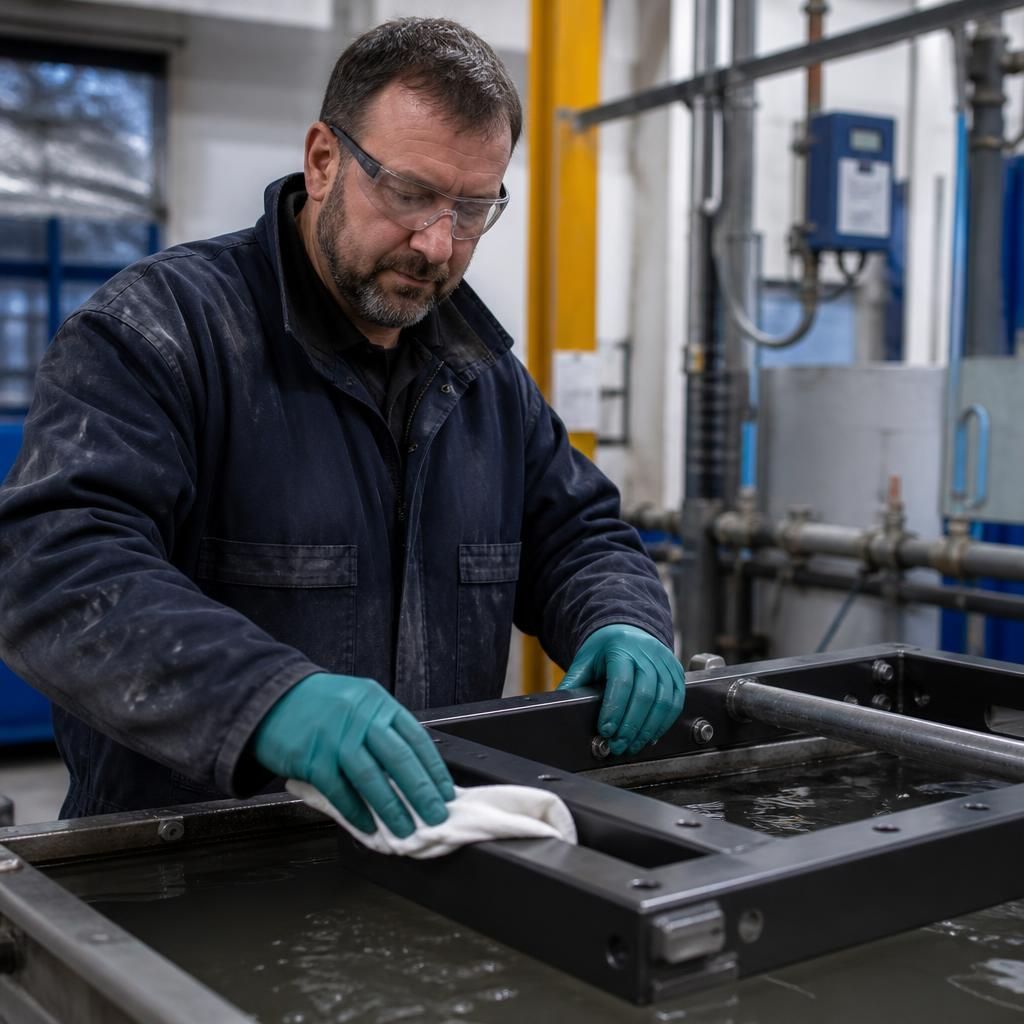
Invisible contamination can shorten the life of a nylon or speciality coating even when the finished surface looks smooth. Oils, salts, dust and light oxidation can remain at the metal–coating interface, reducing adhesion and creating routes for moisture to cause lifting or corrosion beneath the film.
Preparation should therefore be matched to the substrate and service environment. Cleaning, suitable mechanical or chemical treatment and removal of residues help establish a stable interface before powder is applied. This is particularly important for components exposed to moisture, chemicals or repeated handling, where a small adhesion defect can grow into local coating failure.
Discuss your nylon and speciality coating requirements
Discuss your nylon or speciality coating requirements with the team, including the component design, substrate and expected service conditions. Drawings or sample parts can help establish a suitable application approach and inspection requirements.