

What factors influence the choice of sandblasting media for different metal surfaces?
The choice of sandblasting media depends on the metal’s hardness, surface condition, geometry and the profile required for powder coating adhesion. Media hardness, particle shape and grit size must provide effective cleaning without distorting, embedding in or excessively roughening the surface.
The most suitable sandblasting media is determined by the substrate, the material that must be removed, the required cleanliness level, the finished appearance and the risks of contamination or surface damage. A media that is appropriate for structural steel may be unsuitable for aluminium, stainless steel or zinc-coated components, so selection should be based on the complete preparation and powder-coating specification rather than on the abrasive alone.
Substrate composition and contamination risk
Different metals respond differently to abrasive treatment. Carbon steel can generally tolerate more aggressive media when mill scale, corrosion products or old coatings need to be removed. Aluminium and other softer non-ferrous metals require greater care because aggressive blasting can alter the surface more readily and may leave an unsuitable texture for the intended coating.
Stainless steel presents an additional consideration: free iron or residues from previously used abrasive equipment can compromise its corrosion resistance. Dedicated, clean media and separate handling equipment may therefore be required. Zinc-coated or galvanised steel also needs controlled preparation because excessive abrasion can remove protective zinc and expose the underlying steel. Castings may contain sand, mould residue, porosity or embedded contaminants, making media cleanliness and inspection particularly important.
What needs to be removed
The contaminant often dictates the initial media choice. Rust and tightly bonded scale generally require a more cutting abrasive than light oxidation, loose paint or surface deposits. Existing powder coating may need a media capable of breaking through the coating without unnecessarily attacking the metal beneath it. Oil and grease should normally be removed by a suitable degreasing process before blasting; abrasive treatment alone can spread contamination across the component rather than eliminate it.
Where several contaminants are present, preparation may involve more than one stage. A coarse or angular abrasive can remove a durable coating, followed by a finer or less aggressive medium to produce the specified surface for powder coating. The sequence should be agreed with the coating specification, particularly where a high-quality decorative finish is required.
Media type and its typical use
- Aluminium oxide: a hard, angular abrasive used where strong cutting action is required on ferrous metals and some non-ferrous applications. It can provide an effective key but must be controlled carefully on softer substrates.
- Garnet: an angular mineral abrasive that can remove coatings and corrosion products while producing relatively low dust compared with some alternatives. Its suitability still depends on the substrate and the required finish.
- Glass bead: a rounded medium generally associated with a more uniform, satin or peened appearance rather than aggressive coating removal. It may be considered where preserving the visual character of the metal is important.
- Steel shot or steel grit: useful for suitable ferrous components, with shot providing a more peening action and grit offering a sharper cutting action. These media are not suitable for every non-ferrous or contamination-sensitive application.
- Crushed glass: an angular, disposable abrasive used for removing coatings, rust and scale. The grade and operating conditions must be matched to the substrate to avoid unnecessary metal removal.
- Plastic, walnut shell or other softer media: considered where a coating or deposit must be removed with minimal effect on the base metal. They are more specialised and may not provide enough action for heavy corrosion or tightly bonded scale.
Risk of embedded or transferred material
Some abrasive particles can become lodged in softer metals or leave residues that interfere with powder coating. This is particularly relevant to aluminium, stainless steel and components where corrosion resistance or electrical properties matter. Media must be clean, dry and appropriate for the substrate; previously used abrasive should not be introduced where cross-contamination could affect the finished part.
The condition of the blasting equipment also matters. Worn nozzles, contaminated recovery systems or mixed abrasive streams can change the effective action of the media. For critical components, the preparation process should include inspection for residue, dust and visible defects before powder is applied.
Required appearance and coating specification
The desired appearance beneath the powder coating influences whether an angular, cutting medium or a rounded, peening medium is more appropriate. A heavily textured surface may be acceptable for a robust industrial finish but unsuitable for a thin decorative coating. Conversely, a gentle medium may preserve appearance but fail to remove the contamination needed for reliable adhesion.
The powder manufacturer or coating specification may state a target cleanliness category, surface preparation standard or surface roughness range. These requirements should take priority over a general preference for a particular abrasive. Media selection, blasting pressure and pass technique should be validated together, because changing one can alter the result produced by the others.
Component design and process control
Recesses, welds, edges, drilled holes and enclosed sections can respond differently from broad flat areas. Media must reach the areas requiring preparation without causing excessive rounding at edges or collecting in cavities. Parts should also be designed or positioned so abrasive and dust can be removed fully before coating.
For repeat production, the chosen medium should deliver a consistent result across batches. Important controls include abrasive condition, nozzle distance, blasting angle, pressure, exposure time, media flow and recovery practices. These are process variables rather than fixed properties of the abrasive, but they determine whether a theoretically suitable medium produces an acceptable coating surface.
Safety, waste and environmental considerations
Health and environmental requirements also influence media selection. Respirable crystalline silica presents a serious inhalation hazard, so ordinary silica sand should not be treated as a default abrasive. Suitable ventilation, extraction, enclosure, respiratory protection and housekeeping controls are essential, with the exact arrangements depending on the equipment and abrasive used.
Disposable media may simplify recovery but create more waste, while recyclable metallic or mineral media can require collection, classification and monitoring to maintain consistent performance. The abrasive should be assessed for dust generation, hazardous residues from removed coatings and the disposal requirements of the spent material.
How the final choice is confirmed
- Identify the base metal and any coating, corrosion, oil or residue that must be removed.
- Check whether the component is sensitive to transferred iron, abrasive embedding, heat or loss of a protective layer.
- Define the required cleanliness, surface texture and appearance from the powder-coating specification.
- Compare suitable media for cutting action, contamination control, recyclability, dust and waste handling.
- Test the proposed process on a representative area or sample component, then inspect the surface before powder application.
A successful trial should confirm that the contaminant has been removed, the metal has not been adversely altered, residues can be cleared and the resulting surface is compatible with the powder system. For complex or high-value components, documenting the selected abrasive and process settings helps maintain consistency when further batches are prepared.
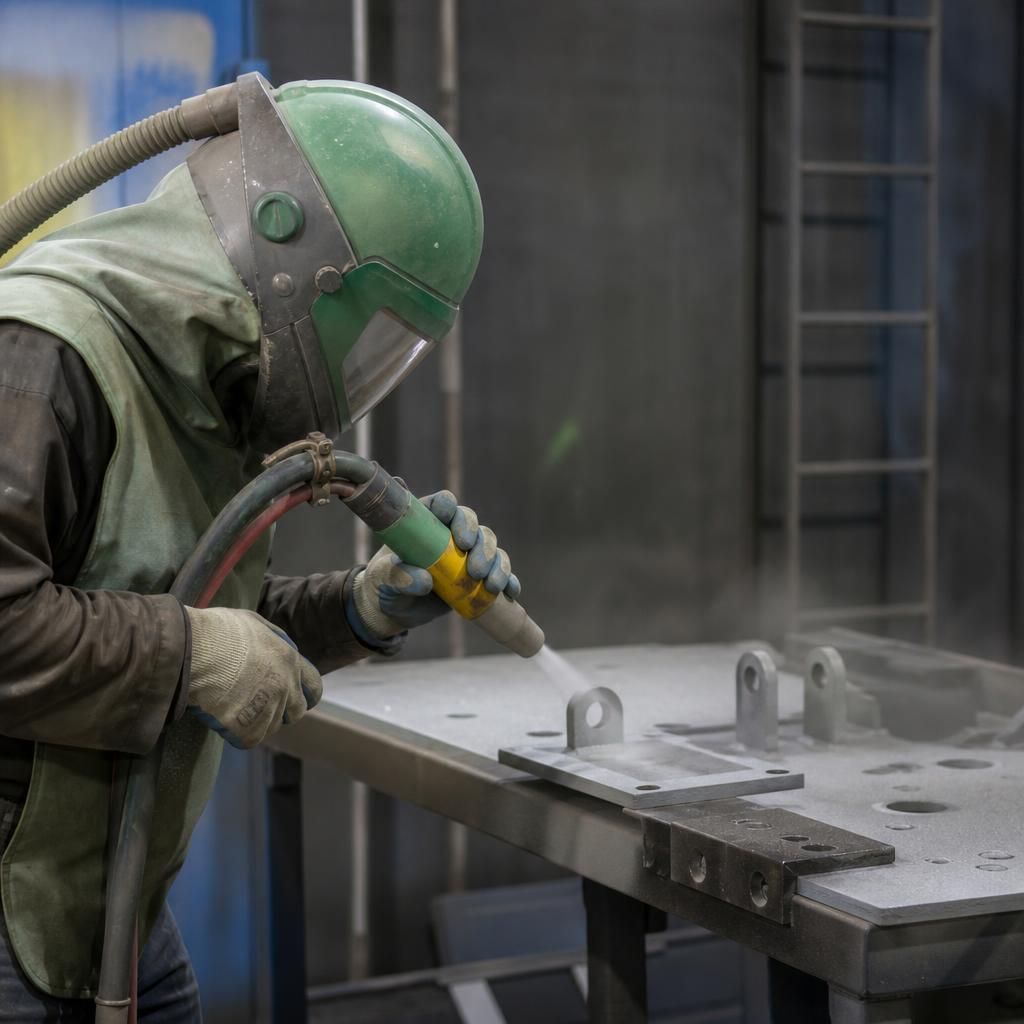
Heat sensitivity is an additional factor when selecting media for thin, lightweight or finely machined components. Blasting energy can raise the surface temperature and, if concentrated in one area, may contribute to distortion or alter the condition of the metal. A less aggressive medium, reduced impact and controlled passes may be more appropriate than using a highly cutting abrasive at maximum force.
Component thickness, rigidity and thermal sensitivity should therefore be assessed alongside contamination and required surface profile. A representative test can show whether the selected media removes the unwanted material without changing dimensions, rounding detail or affecting areas that must remain accurately defined before powder coating.