

What role does cleaning and degreasing play in surface preparation for powder coating?
Cleaning and degreasing remove oils, grease, dirt and other contaminants from the metal surface before powder coating. This gives the coating a clean, consistent substrate, helping it adhere properly and reducing surface defects in the finished coating.
Cleaning and degreasing are essential because powder coating can only perform properly when the metal surface is chemically and physically suitable for treatment. They are not simply cosmetic steps: residues left on the substrate can interfere with pretreatment, prevent consistent contact between the coating and the metal, and create defects that may only become visible after curing.
Metal components commonly arrive with contaminants from manufacture, storage and handling. These may include cutting fluids, forming oils, grease, fingerprints, polishing compounds, dust, workshop debris, adhesive residues and corrosion products. Even a thin film can affect the way a pretreatment solution reacts with the surface. Handling after cleaning can also transfer new contamination, so parts need to be managed carefully before coating.
A typical preparation sequence is selected according to the component, its condition and the required finish:
- Initial assessment: the coater identifies the base metal, existing residues, corrosion, previous coatings, weld spatter and areas that may retain contamination.
- Removal of loose material: dirt, dust and loose corrosion are removed so that cleaning agents can reach the underlying surface.
- Degreasing: a suitable cleaner dissolves or lifts oils, grease and other organic residues. The method may involve immersion, spraying or manual application, depending on the size and geometry of the parts.
- Rinsing or removal of cleaner: remaining cleaning solution and loosened contamination must be removed rather than allowed to dry on the substrate.
- Drying and inspection: the metal is dried and checked for visible residue, staining, water breaks or areas that may need further preparation before coating.
The choice of cleaning method matters. Solvent-based cleaning can be useful for particular oils or localised contamination, while aqueous alkaline cleaners are commonly used for broader industrial cleaning. Mechanical methods may be needed where contamination is baked on or combined with scale and corrosion, but abrasion alone does not necessarily remove oils; it can spread them across the surface or press them into surface irregularities. For this reason, cleaning and abrasion are normally treated as complementary stages rather than interchangeable alternatives.
Part geometry also influences the preparation method. Hollow sections, recesses, threaded holes, folded edges and overlapping joints can retain oil or cleaning fluid. Components should therefore be designed, positioned and drained in a way that allows the cleaning process to reach relevant surfaces and prevents residues collecting in concealed areas. Welded assemblies may require particular attention around welds, heat-affected areas and spatter.
Cleaning is often followed by a chemical pretreatment suited to the metal. This stage can improve the substrate’s readiness for powder application and may provide additional resistance against corrosion, but it cannot compensate for a surface that is still greasy or dirty. If a part is not clean enough for pretreatment, the problem remains beneath the coating even when the final finish initially appears acceptable.
Inspection should take place before powder application, not only after curing. Practical checks include looking for oily patches, water beading, powdery residues, flash rust, trapped moisture and contamination in joints or apertures. A uniform wetting behaviour during rinsing can indicate that the surface is free from some forms of hydrophobic contamination, although inspection requirements depend on the specification and the material being processed.
Insufficient cleaning can lead to poor wetting, cratering, pinholes, blistering, fisheyes, localised adhesion failure and premature corrosion. Some defects originate at the interface and may not be obvious until the component is handled, exposed to moisture or subjected to service conditions. Over-cleaning or using an unsuitable chemical can also cause problems, including staining, attack on sensitive substrates or residues that interfere with later stages.
For manufacturers and fabricators, the most reliable approach is to communicate the component’s material, manufacturing history, oils used, previous coatings, service environment and required appearance before preparation begins. Parts should arrive free from avoidable contamination where possible, while any masking, plugs or temporary protection must be compatible with the cleaning and coating process. The preparation specification should also identify which surfaces require coating and whether internal areas, contact points or concealed faces need treatment.
In practice, cleaning and degreasing form the foundation of a controlled powder coating process. They allow subsequent preparation stages to work as intended and give the applicator a consistent substrate on which to apply and cure the powder. The exact products and sequence should be matched to the metal and contamination present, rather than applying one cleaning method to every component.
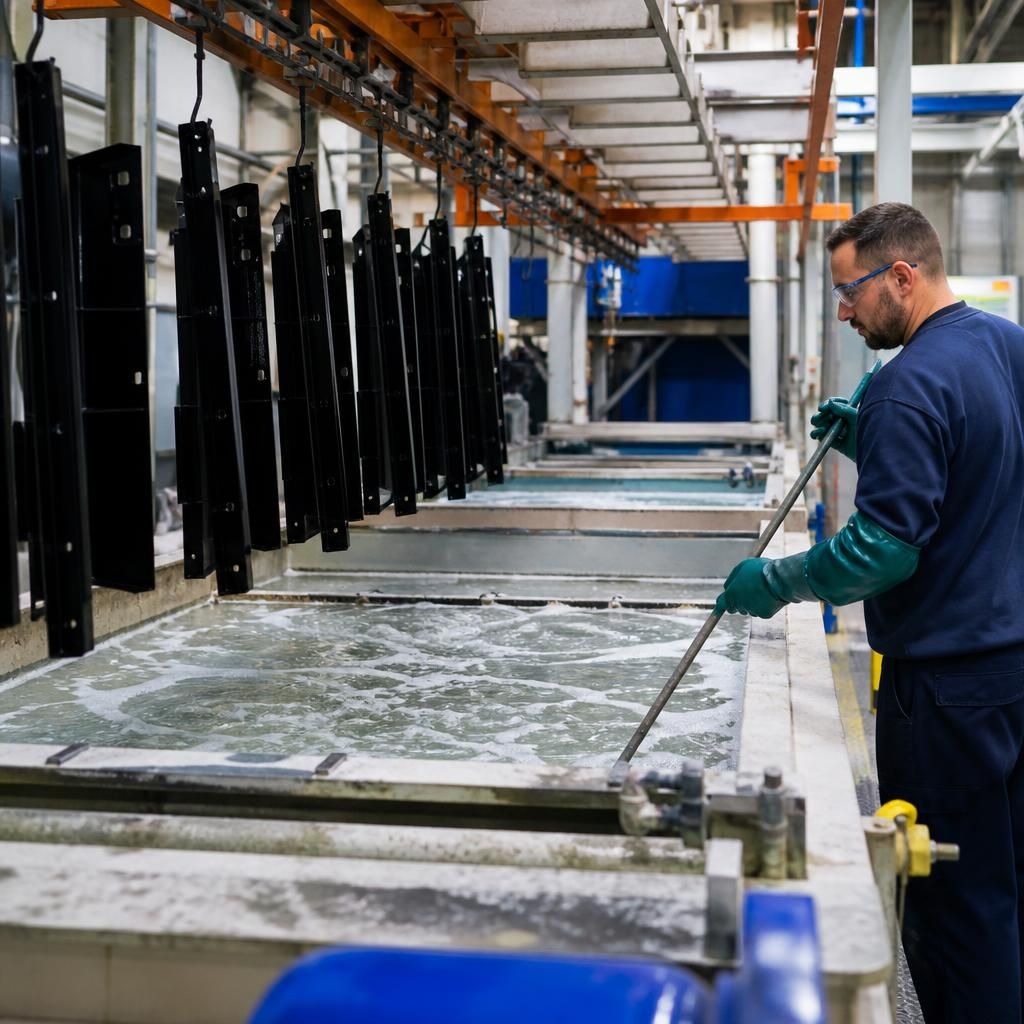
In an industrial powder coating line, degreasing is a controlled process rather than a single application of cleaner. Its effectiveness depends on factors such as the cleaner’s concentration, temperature, contact time, agitation and the level of contamination already held in the solution. If the cleaning stage becomes overloaded, it may transfer contamination between components instead of removing it.
Rinse stages are equally important because cleaner carried forward can leave an alkaline or chemical film on the metal. Good process control therefore includes maintaining cleaning solutions, preventing excessive carry-over between stages and checking that rinse water remains suitable for the required finish. This gives the powder coating process a more repeatable starting condition, particularly when batches contain parts with different shapes or levels of manufacturing residue.
Discuss Your Powder Coating Preparation Requirements
Discuss your component material, manufacturing history, contamination risks and required finish with the powder-coating.co.uk team to help identify suitable preparation requirements. Collection and delivery options are available for businesses across the Midlands and surrounding areas.