

What specific industrial applications benefit the most from electrostatic powder coating?
Electrostatic powder coating benefits industrial applications that require a durable, consistent finish on metal components, particularly automotive parts, chassis and frames, construction steelwork, machinery, panels and fabricated products. It is especially suitable for batch and high-volume production where efficient application, repeatable coverage and resistance to wear and corrosion are important.
Electrostatic powder coating is most beneficial for industrial applications involving conductive metal parts that need a hard-wearing, uniform finish and can withstand the curing process. It is particularly well suited to repeat-manufactured components, exposed fabricated assemblies and products where consistent appearance, edge coverage and resistance to handling are important.
The process applies electrically charged powder to an earthed metal component. The charged particles are attracted to the surface before being heated and cured into a continuous coating. This makes the method useful where a controlled finish is required across multiple parts, provided the component design, substrate and curing temperature are suitable.
Electrical enclosures and control equipment
Switchgear cabinets, control panels, meter boxes and other electrical housings commonly benefit from powder coating. These parts require a finish that resists routine handling, abrasion and general industrial contamination while maintaining a clean, consistent appearance. Powder coating can also be applied in different colours or gloss levels to support product identification, equipment grouping and a consistent enclosure specification.
Care is needed around hinges, threads, contact points and areas where electrical continuity must be maintained. These features may require masking or a coating specification that accounts for dimensional tolerances.
Racking, shelving and material-handling equipment
Warehouse racking, storage frames, trolleys, cages, workbenches and handling equipment are frequently moved, loaded and unloaded. Their coating needs to tolerate knocks, friction and repeated contact with other metal surfaces. Powder coating is well suited to these applications when the components are designed for access during spraying and can be cured without distortion.
For fabricated storage products, coating performance depends on more than the powder itself. Welds, corners, folded sections and enclosed areas need appropriate preparation so that contamination, sharp edges or incomplete cleaning do not undermine the finished coating.
Architectural and building components
Metal doors, balustrades, handrails, window and curtain-wall components, security grilles and other architectural fabrications can benefit from powder coating where a durable decorative finish is required. The method allows related components to be finished to a coordinated colour and appearance, which is important when separate parts are assembled into one visible installation.
For exterior applications, the specification should consider exposure to moisture, sunlight, pollutants and contact wear. The metal substrate, pre-treatment system, powder type, film thickness and required appearance all influence the suitability of the finished coating. Components exposed to particularly demanding conditions may need a specialist protective system rather than a standard decorative grade.
Heating, ventilation and plant equipment
Fan housings, ductwork components, air-handling parts, heater casings, guards and plant-room fabrications may benefit from powder coating where the surface must withstand routine maintenance and industrial surroundings. The finish can protect exposed metal surfaces while providing a uniform appearance across panels and assembled equipment.
Temperature is a key consideration in this sector. The expected operating temperature must be distinguished from the curing temperature used during manufacture. Powder coating is not automatically suitable for components that will experience sustained heat beyond the coating’s specification, so the service environment should be established before selecting the system.
Automotive and transport-related components
Metal brackets, guards, suspension-related parts, battery trays, equipment housings and other transport components can benefit where the coating must withstand handling, road debris, moisture and contact with oils or cleaning products. The most suitable system depends on the component’s location, geometry and exposure rather than simply its use within a vehicle.
Parts with concealed faces, deep recesses or narrow cavities require particular attention during application. The design should allow the charged powder to reach the required surfaces, while masking may be necessary where moving interfaces, press fits or fastener connections must remain free of coating.
Agricultural, plant and outdoor equipment
Frames, guards, brackets, housings and fabricated assemblies used around agricultural or industrial equipment can benefit from a finish that resists mechanical contact and exposure to dirt, moisture and handling. Powder coating is most appropriate when the component can be thoroughly prepared and the chosen coating system matches the level of environmental exposure.
Heavy contamination, corrosion products, weld residues and mill scale must be removed before coating. Where steel has already begun to corrode, preparation is especially important because a sound-looking powder finish cannot compensate for an unstable substrate beneath it.
When electrostatic powder coating is the strongest choice
- The parts are electrically conductive and can be properly earthed during application.
- The component can tolerate the required curing cycle without distortion or damage.
- Several parts need a repeatable finish across a production batch.
- The finished product will experience abrasion, handling, moisture or general industrial exposure.
- The design permits effective cleaning, spraying, curing and inspection.
- Colour, gloss and texture need to remain consistent between related components.
It is less suitable for heat-sensitive materials, assemblies containing components that cannot enter a curing oven, or parts with inaccessible surfaces that cannot be adequately cleaned and coated. It may also be inappropriate where extremely tight tolerances would be affected by the added coating thickness. In these cases, the design may need masking, selective coating or a different finishing approach.
For an industrial specification, the important questions are not only what the component is used for, but also what metal it is made from, how it is prepared, where it will operate, how it will be handled and which surfaces must remain uncoated. These factors determine whether standard, protective, nylon or another specialist powder system is appropriate, and whether the application will deliver the required combination of protection, appearance and dimensional control.
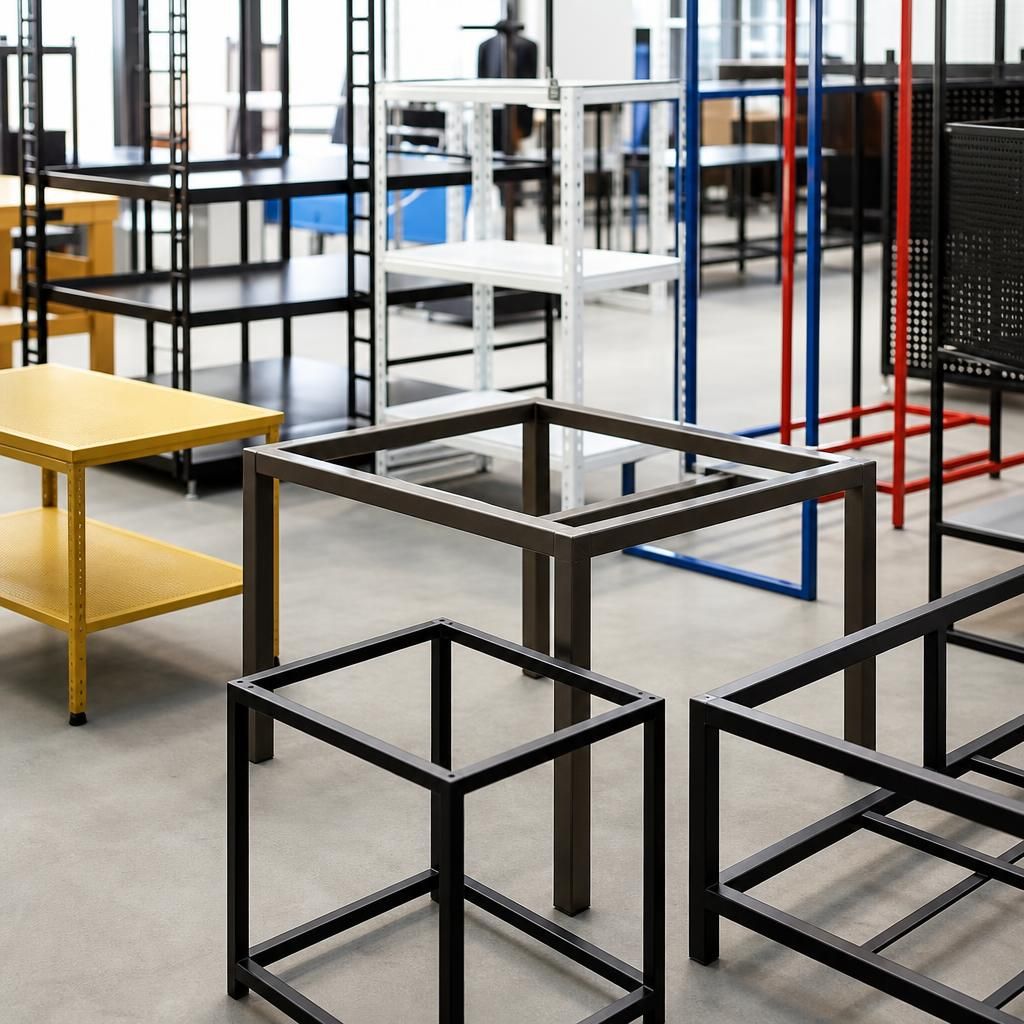
Commercial metal furniture and retail fixtures benefit from electrostatic powder coating when they need a consistent decorative finish as well as resistance to repeated handling. Steel table frames, display stands, shelving supports, seating components and shopfitting structures can be coated in coordinated colours and gloss levels, helping separate parts appear uniform after assembly.
These products are often moved, assembled and cleaned, so the coating specification should reflect expected contact, abrasion and exposure to cleaning materials. The design should also identify areas such as threaded holes, sliding interfaces and fixing points that must remain free from coating. Where multiple components share the same finish, batch processing can help maintain consistency between visible parts.
Discuss your industrial electrostatic coating requirements
Discuss your industrial electrostatic coating requirements with the team, including the component material, dimensions, operating environment and required finish. This information helps establish whether the proposed parts are suitable for the process and identify any preparation or masking considerations.