

Which techniques are most effective for removing powder coating from metal surfaces?
The most effective methods for removing powder coating from metal are chemical stripping, abrasive blasting and controlled thermal removal, with the right choice depending on the metal substrate, coating thickness, part geometry and required finish. Chemical stripping is generally suited to delicate or complex components, while blasting is effective for robust parts and heating can help soften stubborn coatings before mechanical removal.
The most effective removal process is the one that removes the coating without distorting the metal, changing critical dimensions or damaging features that must be retained. In practice, this means matching the method to the substrate, coating build, component geometry, access to all surfaces and the condition required before recoating. A combination of methods is often more controlled than relying on one technique alone.
Chemical stripping is usually the most suitable option for intricate components, thin sections and parts with recesses, threaded areas or awkward internal surfaces. The component is exposed to a coating stripper that softens or breaks down the cured powder film, after which the softened residue is removed by rinsing, brushing or low-impact mechanical action. Chemical systems can reach areas that abrasive media cannot access evenly, but the product must be compatible with the base metal and any inserts, seals or previously applied treatments.
After chemical stripping, the surface must be thoroughly cleaned and, where required, neutralised. Remaining chemical residue can interfere with later coating adhesion or contribute to corrosion beneath the new finish. Rinsing, drying and inspection are therefore part of the removal process rather than optional finishing steps. Aluminium and other sensitive substrates require particular care because aggressive chemicals can etch the surface or alter its appearance.
Abrasive blasting is effective where the component can tolerate controlled impact and a prepared surface is required for subsequent coating. The operator selects the media, pressure, nozzle distance and angle according to the metal and coating condition. Coarser, harder media can remove a tough or thick film efficiently, while finer media can provide greater control on less robust parts. Excessive blasting can round edges, erode thin sections, mark machined faces and alter dimensions, so critical areas may need masking or a lower-impact treatment.
Blasting also needs to be assessed against the shape of the part. Open, accessible surfaces are relatively straightforward, whereas deep cavities, narrow slots and blind holes can retain coating or abrasive residue. Components should be checked for trapped media and remaining film, particularly around welds, corners and joints. If the part will be recoated, the final blast condition should provide a clean, consistent surface without leaving contamination that could affect adhesion.
Thermal removal can be useful for robust steel components or heavily built-up coatings that are difficult to strip chemically or mechanically. Heat softens or decomposes the coating so that the residue can be removed afterwards. The temperature and exposure must be controlled: overheating may distort the component, affect heat-treated properties, damage attached parts or create oxidation that then requires further cleaning.
Thermal treatment is not appropriate for every metal or assembly. Aluminium can lose dimensional stability, while zinc-coated surfaces, bonded components and parts containing seals or bearings may be damaged. Coating decomposition can also produce fumes and residues, so the process requires suitable extraction, temperature control and subsequent cleaning. Heat should be regarded as a controlled industrial process, not an improvised substitute for stripping or blasting.
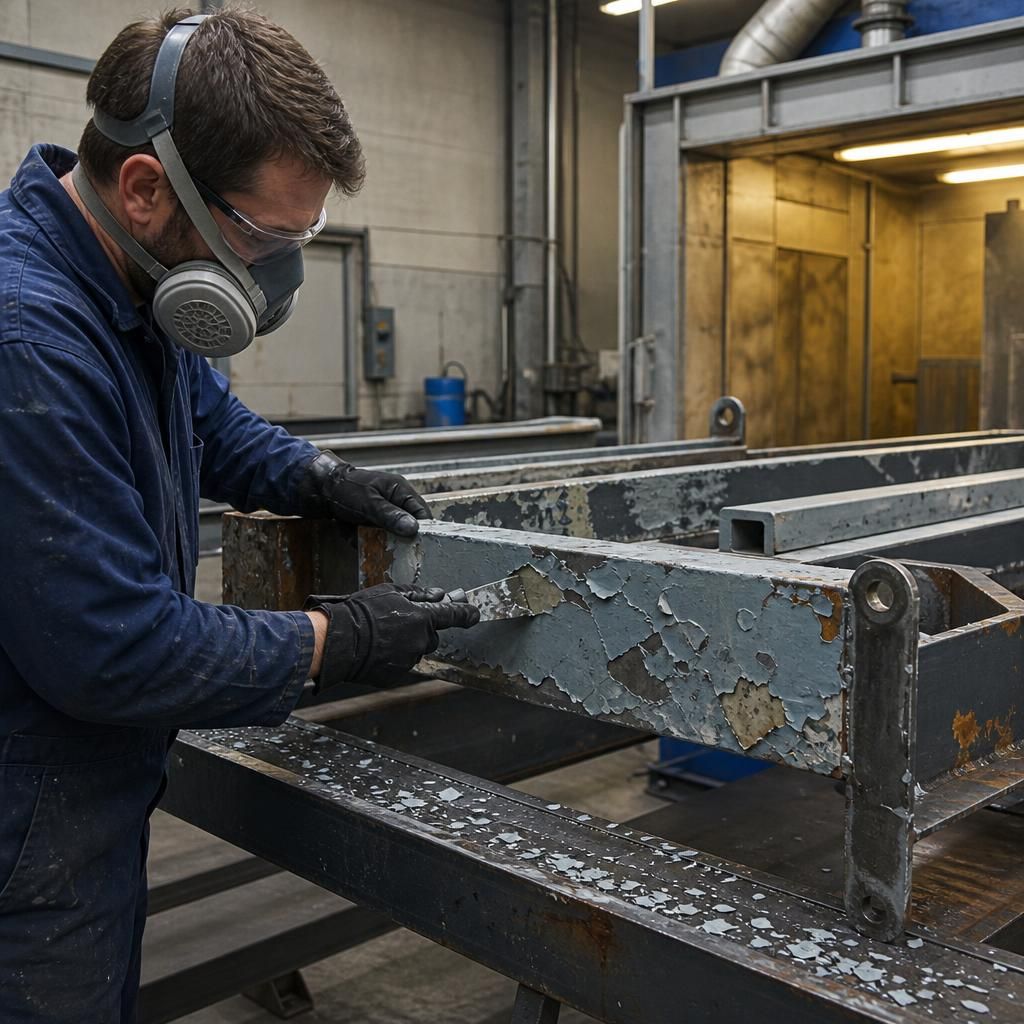
Mechanical removal has a role where only a small area needs to be cleared, such as a local repair, weld preparation or removal of loose coating at a defect boundary. Scrapers, abrasive pads, sanding equipment and rotary tools can remove isolated material with good control. They are generally inefficient for complete removal from large batches and can leave a non-uniform surface if pressure or abrasive grade varies. Mechanical work is most useful as a supplementary step after another method has removed the main coating layer.
For particularly sensitive or high-value parts, precision processes such as laser ablation may be considered. These systems remove the coating by concentrating energy at the surface and can offer fine control around selected areas. Their suitability depends on the coating, substrate, component size and required production rate. They are more commonly justified where selective removal, minimal contact or protection of adjacent surfaces is important than for routine stripping of uncomplicated parts.
Before selecting a technique, assess the following points:
- Substrate: steel, stainless steel, aluminium and zinc-coated metal have different tolerances for chemicals, heat and impact.
- Coating condition: a sound, thick film may need a different approach from a coating that is already lifting, cracked or contaminated.
- Component design: threads, holes, folds, welds, sharp edges and enclosed sections affect access and the risk of retained residue.
- Dimensional requirements: bearing faces, mating surfaces and precision holes may need protection from abrasion or heat.
- Next operation: the removal process should leave the surface suitable for inspection, repair, preparation and recoating.
- Environmental and handling controls: chemical waste, airborne dust, fumes, used abrasive and contaminated rinse water require appropriate management.
A controlled removal sequence commonly begins with identification of the base metal and a visual inspection. A small test area can establish whether the coating responds better to chemical softening, abrasive action or heat, while also revealing whether the substrate is being marked. Sensitive features are masked or protected, the selected process is applied consistently, and the part is inspected for remaining coating, pitting, distortion and exposed corrosion.
Once the film has been removed, the metal should be cleaned and dried promptly. Any corrosion, embedded abrasive, chemical residue or oxidised material must be addressed before the next preparation stage. The required final condition depends on whether the component will be repaired, blasted, primed or directly recoated. Removing the visible powder alone is not enough if contamination or unstable substrate material remains beneath it.
For batches of similar components, the best technique is also influenced by repeatability and handling. A method that works on one complex part may be unsuitable for a large quantity if it produces inconsistent results or requires excessive manual finishing. Process controls should cover media or chemical selection, exposure, masking, cleaning and inspection so that every component reaches the same condition before further work.
Most industrial powder coatings are thermoset films, meaning they cure into a cross-linked layer that does not simply melt back into a liquid when reheated. This is why removal normally requires chemical breakdown, abrasive action or carefully controlled thermal treatment rather than ordinary scraping alone.
The coating’s chemistry affects the most suitable technique. Heating may make some cured films brittle or easier to remove, but excessive heat can degrade the residue and complicate cleaning. Chemical systems work by attacking or weakening the coating, while abrasive methods physically break the bond and carry the film away. Identifying the coating type where possible helps avoid selecting a process that is ineffective or unnecessarily aggressive for the metal beneath.