

What are the key considerations when selecting high temperature and heat resistant powder coatings for specific industrial applications?
Select a high temperature and heat resistant powder coating by matching its continuous operating temperature, peak exposure, substrate, chemical environment and required corrosion protection to the application. Also confirm that the coating’s curing conditions, film thickness and surface preparation are compatible with the component and production process.
Selecting a high temperature and heat resistant powder coating requires more than choosing the highest temperature rating on a product data sheet. The coating must be assessed against the component’s actual service conditions, including the pattern of heating and cooling, mechanical duty, appearance requirements, dimensional limits, production method and inspection needs. A suitable specification is one that remains fit for purpose throughout the expected operating cycle rather than one that simply tolerates a stated maximum temperature.
Define the thermal duty accurately. Distinguish between continuous exposure, intermittent operation and short-duration peaks. A component used in a furnace, exhaust system or industrial heating assembly may experience repeated thermal cycling rather than one constant temperature. Expansion and contraction can place stress on the coating, particularly where the metal is thick, restrained or joined to another material. The frequency of these cycles, the heating and cooling rate and the temperature difference between adjacent areas should be included in the specification.
Consider whether the component will be exposed to hot spots. Localised heat from burners, heating elements, friction or poor ventilation can produce a more demanding condition than the general ambient temperature suggests. Thermal imaging, process records or measurements taken at the part can help establish the real exposure. The coating supplier should then confirm that the quoted performance relates to the same type of exposure and not only to a laboratory test under different conditions.
Assess the complete operating environment. Heat is often accompanied by other stresses that influence coating life. These may include oils, fuels, cleaning chemicals, salt, moisture, combustion residues, abrasive dust and process deposits. A coating that performs well in dry heat may be unsuitable where contaminants remain on the surface at elevated temperature. Chemical resistance should therefore be considered at the expected service temperature, not assessed separately under room-temperature conditions.
Mechanical requirements are equally important. Identify whether the finish will be exposed to impact, vibration, sliding contact, abrasion or repeated handling. Thermal resistance does not automatically indicate good resistance to wear or impact. For parts subject to movement, consider friction, surface hardness and whether a change in coating texture could affect the operation of mating components.
Review the substrate and component design in practical detail. Different metals and surface conditions can affect adhesion, outgassing and the consistency of the finished film. Castings, porous fabrications, welds, folded sections and threaded features may require different preparation or masking arrangements. Holes, bearing seats, electrical contact points and close-fitting faces should be identified before coating so that the finish does not interfere with assembly or function.
Dimensional tolerance is a key consideration on precision parts. Powder coating adds a measurable film to every accessible surface, including edges and internal features. The specification should state where coating is permitted, where it must be excluded and what finished dimensions must be maintained. Masking, plugs or post-coating machining may be required, but these methods need to be agreed before production because they affect cost, handling and repeatability.
Check the finish requirements as well as technical performance. Colour, gloss, texture and visual uniformity can change when a coating is exposed to high heat. Some finishes may darken, chalk or lose gloss even if the film continues to protect the metal. If appearance matters, establish whether colour retention is a functional requirement or simply an initial preference. Parts installed together should also be assessed as a group, since differences in exposure can produce visible variation over time.
Electrical and thermal properties may also influence the choice. A coating can act as an electrical insulator, alter earthing or affect contact points, while its thickness can influence heat transfer from the metal. For components designed to dissipate heat, the coating system should be reviewed alongside the thermal design rather than selected only for appearance or corrosion protection.
Confirm that the application method is suitable for the component. Complex shapes, deep recesses and enclosed sections can affect powder deposition and may produce thin areas or difficult-to-cure locations. Part size and weight can influence racking, handling and oven loading. The production route should allow the coating to be applied consistently without creating contact marks, contamination or uneven heating.
Batch work also needs a defined standard. Agree the acceptable film build, appearance, masked areas, inspection method and sampling approach before coating begins. Consistent racking and oven loading help reduce variation between batches, while records of powder identification, preparation and curing conditions support traceability. For safety-critical or difficult-to-replace components, a trial piece or representative sample can be used to confirm fit, finish and performance before full production.
Use evidence that reflects the intended application. Technical data sheets should be read carefully because temperature ratings may describe different conditions, such as continuous service, short-term exposure or a specific test method. Ask which properties were measured, how the test panels were prepared and whether the result relates to adhesion, colour retention, corrosion resistance or general film integrity. No single rating describes every aspect of coating performance.
Where the consequences of failure are significant, validation should include the actual substrate, film thickness and thermal cycle. Depending on the component, this may involve adhesion checks, visual inspection after heating, dimensional checks, heat cycling or exposure to the relevant chemicals. Testing is most useful when it reproduces the service condition rather than relying only on a generic coupon test.
Consider maintenance and the full service life. A high-temperature finish should be compatible with the way the part will be cleaned, inspected and repaired. Determine whether deposits can be removed without damaging the film, whether damaged areas can be touched up and how a future recoating process would be managed. If the component is exposed to corrosion beneath deposits or at damaged edges, inspection access and planned maintenance may be as important as the initial coating selection.
For industrial buyers, the final specification should bring together the service temperature profile, exposure to chemicals and wear, substrate condition, permitted dimensions, appearance, masking, testing and documentation. A specialist powder coating provider can review these requirements with the part drawings and production process, helping establish whether the proposed system is technically suitable before a full batch is committed to coating.
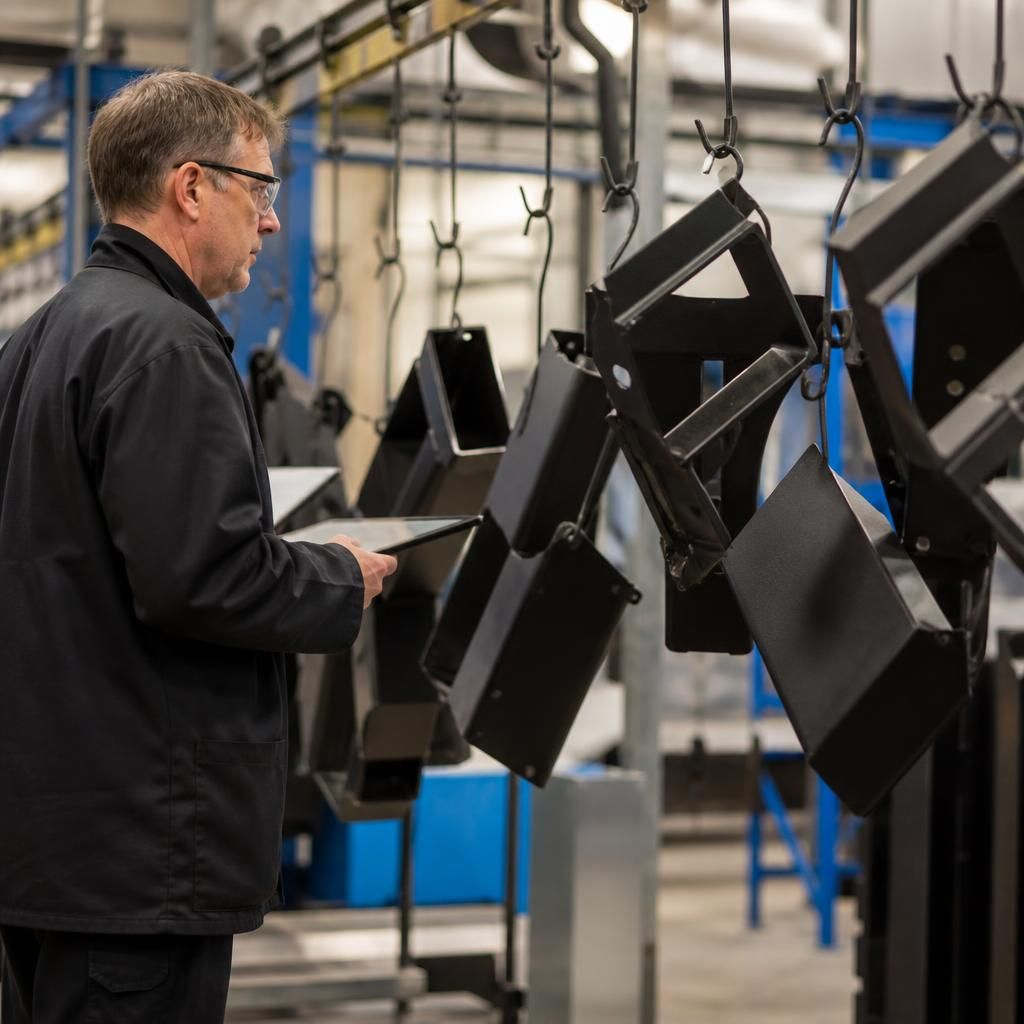
Decide whether the application requires a single high-temperature powder coat or a compatible primer-and-topcoat system. A primer may be relevant where additional corrosion protection is needed, but the complete system must be assessed rather than selecting each layer independently. The primer, topcoat and substrate need compatible curing requirements, adhesion characteristics and thermal expansion behaviour.
Ask for confirmation that the proposed layers have been tested together under the intended heating and cooling cycle. A coating system that performs well as an individual film may not provide the same result when combined with another product. The specification should identify each layer, its permitted film build, curing conditions and the performance evidence supporting the complete system.