

How does the electrostatic powder coating process enhance metal durability?
Electrostatic powder coating charges dry powder particles so they are attracted evenly to a grounded metal component, helping create a consistent coating with good coverage. The powder is then cured into a continuous film that resists abrasion, moisture and corrosion, protecting the underlying metal and extending the practical service life of the finished component.
Electrostatic powder coating enhances metal durability by enabling a controlled, strongly bonded protective film to be applied and cured over the component. The electrostatic method is important because it supports efficient powder deposition, while the coating material, surface preparation, film thickness and curing conditions determine how well the finished surface performs in service.
A key benefit is improved adhesion between the coating and the metal substrate. Before application, the component must be cleaned to remove oil, dirt, mill scale, rust and other contaminants. Suitable chemical or mechanical pretreatment can also create a surface that allows the coating to bond more effectively. Without this preparation, even a correctly applied powder may lift, blister or develop corrosion beneath the film.
The powder is applied as dry particles and then heated so that the resin melts, flows and cross-links. This produces a continuous coating rather than a collection of loosely connected particles. A properly cured film has the cohesion needed to withstand handling, contact and normal environmental exposure. Under-curing can leave the finish softer or less chemically resistant, whereas excessive heat or an unsuitable curing cycle can affect the resin and the appearance of the component.
Electrostatic application also helps reduce areas of weak protection caused by uneven deposition. The operator can control the gun settings, distance, movement and powder output to suit the component’s shape. This is particularly relevant to fabricated frames, brackets, panels and other metal parts with a mixture of broad faces, edges and recessed areas. Complex geometry still requires care: recessed corners and internal angles can create a Faraday cage effect, where the electric field makes powder more difficult to deposit. Adjusting application technique and, where appropriate, using manual finishing passes helps limit these thin areas.
Durability is also influenced by the coating’s ability to protect vulnerable features of the part. Sharp edges can receive less effective coverage than flat surfaces, while burrs, weld spatter, trapped contamination and poorly prepared joints can become early points of coating failure. Good fabrication quality and appropriate pre-treatment therefore form part of the durability equation. Powder coating cannot compensate for active corrosion, moisture trapped in a fabricated assembly or defects that remain beneath the finish.
The selected powder chemistry should match the conditions in which the component will be used. Different resin systems and formulations provide different balances of hardness, flexibility, chemical resistance, weathering performance and appearance retention. A coating for an indoor industrial component may have different requirements from one exposed to rain, road contamination, cleaning chemicals, sunlight or repeated handling. Nylon powders, for example, are used where a combination of toughness, low friction or resistance to particular forms of wear is required, but the correct choice depends on the part and its operating environment.
Film thickness must be controlled rather than increased without limit. Too little coating may leave the substrate insufficiently protected, while excessive thickness can affect edge definition, fit, flexibility, appearance and curing. The appropriate specification depends on the metal, coating system, geometry and service conditions. Measuring the finished film and checking the cure provides useful process control, particularly for production batches or components that must meet a defined specification.
Compared with liquid paint, powder coating contains no solvent that needs to evaporate during drying. The curing stage instead forms the finished polymer film through heat. This can help produce a dense, uniform surface when the component reaches the required metal temperature for the required cycle. The whole part must be considered: a large or heavy item may heat differently from a small bracket, so oven settings based only on air temperature may not confirm that the coating has fully cured.
In practical terms, the electrostatic process improves durability by making the application more controllable, but it is not a standalone guarantee of performance. Reliable results depend on an appropriate powder, sound metalwork, thorough preparation, correct grounding, suitable application settings, controlled thickness and a verified cure. For industrial components, these factors should be agreed against the intended environment and any requirements for appearance, corrosion protection, impact, abrasion or chemical exposure.
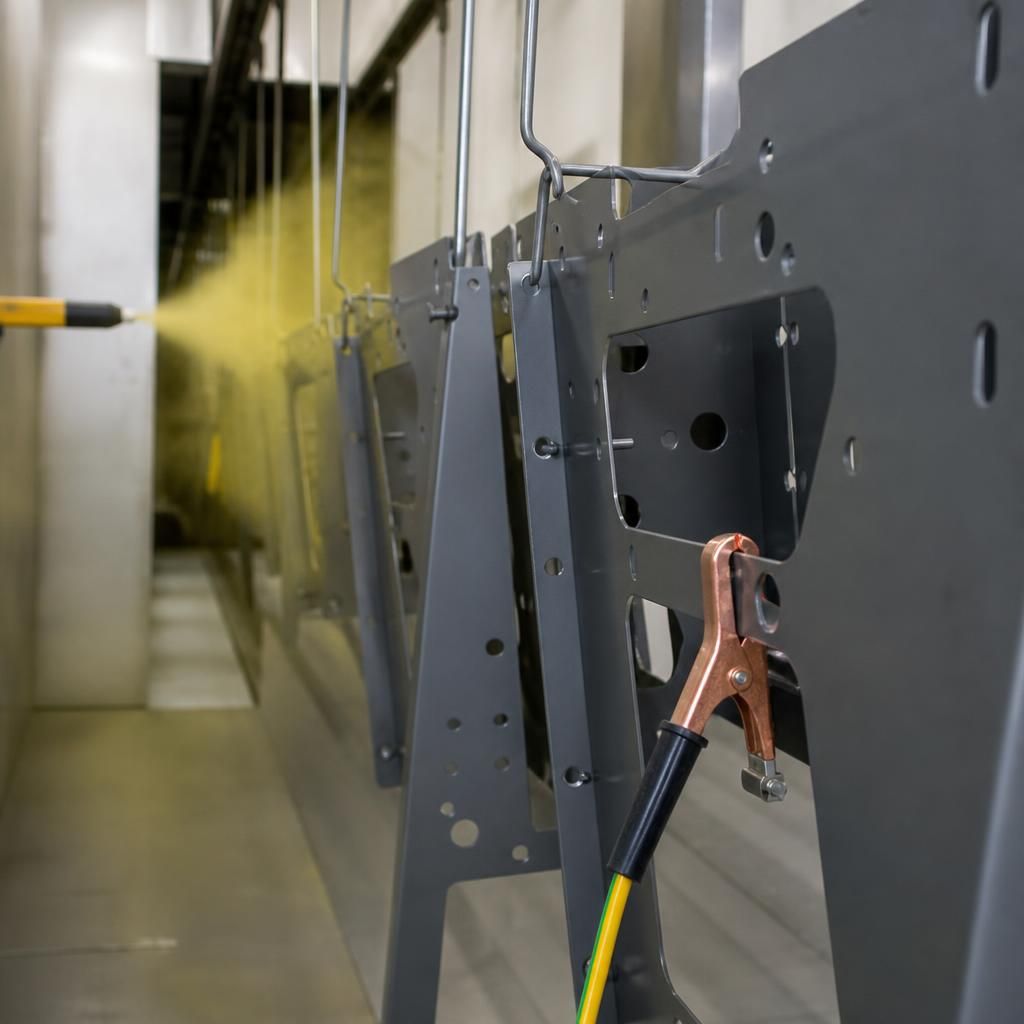
Correct grounding is a fundamental part of electrostatic powder coating because it creates the electrical field that attracts charged powder particles to the metal component. This attraction helps the powder remain on the intended surface before curing, supporting more consistent deposition than relying on mechanical contact alone.
Grounding must be maintained through clean contact points between the component, its hanger and the coating equipment. Paint build-up, rust or contamination at these points can interrupt the electrical path, reducing attraction and causing uneven powder transfer. Checking the grounding arrangement is therefore an important process control measure when durable, consistent finishes are required across batches of industrial metalwork.