

How does temperature control impact the quality of nylon powder coating preparation?
Temperature control affects how effectively the metal substrate is cleaned, dried and pre-heated before nylon powder is applied. Keeping the component and preparation stages within the coating system’s specified temperature range helps prevent moisture, uneven powder melt and inconsistent adhesion, supporting a more uniform and durable finish.
Temperature control determines whether nylon powder coating develops the intended film structure, mechanical performance and appearance. It affects the condition of the metal before coating, the rate at which powder melts and flows, the time available for fusion, and the way heat is distributed through the component. A controlled thermal process is therefore essential rather than treating oven temperature as a setting that can be judged by appearance alone.
Preparation begins with the temperature of the workpiece, not simply the temperature shown on the oven controller. Components with substantial mass, enclosed sections or different thicknesses can heat at different rates. If the surface reaches the required condition while colder areas remain below it, the nylon may form differently across the same part. Thin edges can also become hotter than heavier sections. Temperature checks should therefore take account of the coldest and hottest relevant areas, particularly on fabricated assemblies and complex metal shapes.
The surrounding environment also affects preparation. Metal brought into a warmer coating area can still carry condensation if its temperature is close to the surrounding air’s dew point. Even a small amount of moisture in recesses, seams or surface texture can interfere with the coating system. Allowing parts to reach a stable, suitable temperature before further preparation helps reduce this risk. Storage and handling conditions for the powder should likewise be controlled, because temperature changes combined with humidity can encourage clumping or alter how freely the powder feeds and distributes.
During application, the workpiece temperature influences how the powder behaves when it contacts the metal. A substrate that is too cool may not provide enough heat for the particles to soften and join evenly. This can leave a rough or insufficiently fused film, with variations in texture and coverage. If the component is excessively hot, powder can melt prematurely at the point of application, reducing control over film build and increasing the chance of defects such as runs, excessive gloss variation or an uneven surface.
The heating cycle must be assessed by the temperature of the metal and the time it remains at that temperature, rather than by oven air temperature alone. Oven air can reach its displayed setting before the centre of a thick component does. Conversely, a thin section may spend too long at an elevated temperature while a heavier section is still catching up. Recording the thermal profile of representative parts helps establish whether the full component receives the required treatment without exposing vulnerable areas to unnecessary heat.
Overheating can be as damaging as insufficient heating. Excessive thermal exposure may change the appearance of the nylon, affect gloss or colour uniformity, and reduce control of the finished film. It can also highlight differences between sections of a part that were heated at different rates. The correct process is therefore a balanced combination of target temperature, ramp rate and dwell time, selected for the particular nylon system, substrate and component geometry.
Temperature uniformity is particularly important where a batch contains mixed sizes or designs. Loading a large, cold component alongside small parts can influence the recovery of the oven and create different thermal histories within one production run. Separating parts by comparable mass and geometry, avoiding excessive loading, and allowing air to circulate around the workpieces can make the heating cycle more repeatable. These controls are useful for batch work because visual inspection alone may not reveal differences in fusion or film performance.
Practical checks should include:
- measuring the actual metal temperature at representative points rather than relying only on the oven display;
- checking thick sections, enclosed areas, edges and joints for thermal differences;
- confirming that parts have stabilised sufficiently before coating where condensation is a risk;
- matching the heating cycle to the nylon powder manufacturer’s technical requirements;
- reviewing the effect of load size, component spacing and part geometry on heat distribution; and
- examining the coating for changes in texture, gloss, colour and film build that may indicate a thermal imbalance.
Temperature records are especially valuable when a coating shows localised defects or when identical parts produce different results in separate batches. Comparing the measured part temperature, heating time and oven loading can distinguish a preparation issue from problems involving application equipment, powder condition or surface contamination. This prevents unnecessary changes to the entire process when the underlying fault is a local thermal variation.
For Midlands manufacturers, fabricators and other businesses preparing metal components for nylon coating, the most reliable approach is to define a repeatable thermal process for each component type. That process should consider substrate material, thickness, shape, batch loading and the requirements of the selected nylon powder. Controlled measurement at the preparation and curing stages gives a more dependable indication of coating quality than oven settings or surface appearance on their own.
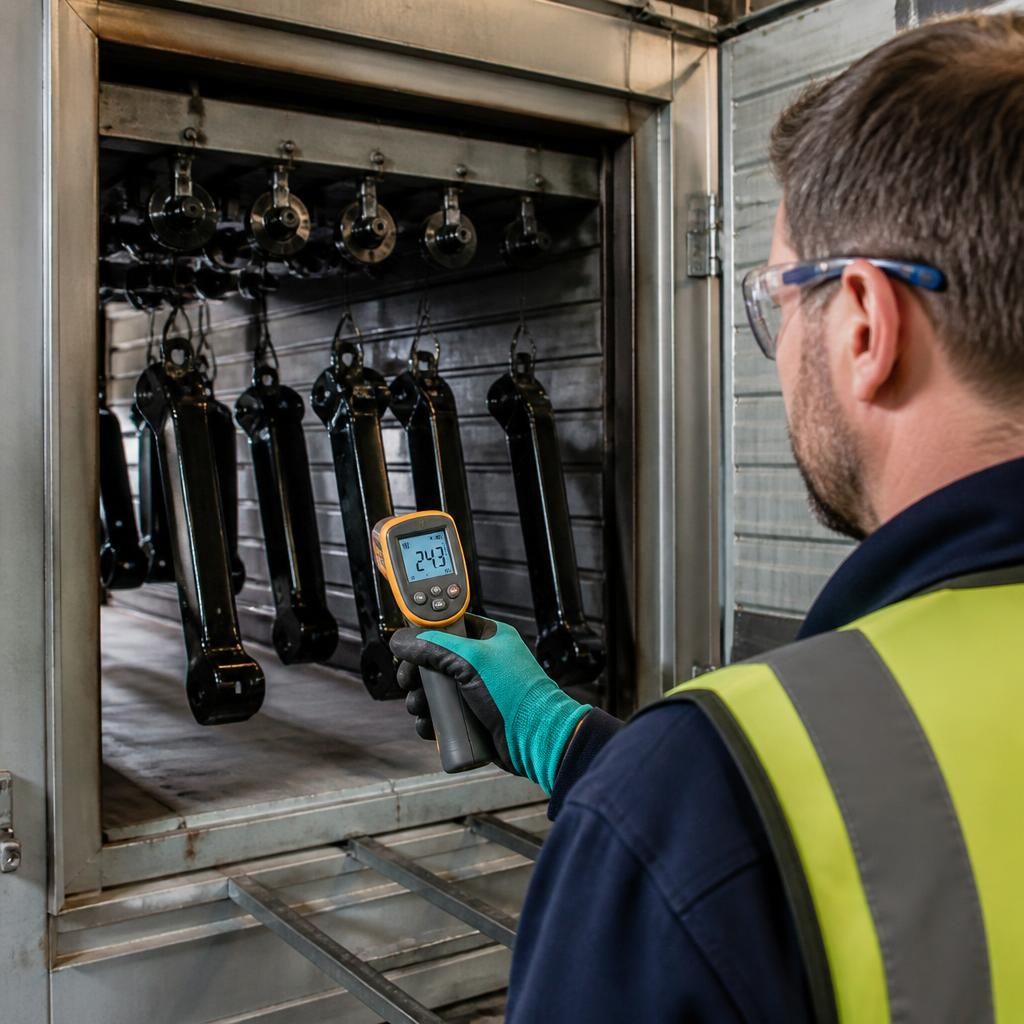
Temperature control in nylon powder coating preparation also includes the cooling stage after fusion. Once the coating has formed, the metal component and nylon film should cool evenly so that differences in contraction do not place unnecessary stress on the coating or the substrate.
Removing parts from the oven into a cold or damp environment can create abrupt temperature changes and condensation, particularly in recesses, seams and enclosed sections. Forced cooling can also produce different cooling rates across thin edges and heavier areas. Unless the coating system specifies otherwise, allowing components to cool in a clean, controlled area supports more consistent film condition and reduces the risk of handling parts before the coating has stabilised.
Cooling should be considered when assessing defects that appear after curing rather than immediately during application. Localised changes in appearance, distortion or adhesion can result from uneven heat loss as well as from the heating cycle itself. Reviewing how parts are positioned, transferred and cooled provides a more complete assessment of temperature control in nylon powder coating preparation.