

How does shotblasting improve the adhesion of powder coating on metal surfaces?
Shotblasting improves powder coating adhesion by removing rust, mill scale, old coatings and other contaminants while creating a controlled roughened profile on the metal surface. This textured, clean surface gives the powder coating more area to grip and form a stronger mechanical bond during curing.
Shotblasting improves powder coating adhesion by preparing a mechanically stable surface rather than leaving the coating to sit on a weak or contaminated outer layer. The abrasive action produces a consistent series of microscopic peaks and valleys. During application, the powder settles across this profile and, once cured, forms a more secure mechanical key with the metal.
That improvement depends on controlling the preparation process. The shot size, abrasive type, pressure, travel speed and blast angle all affect the resulting surface profile. A profile that is too shallow may not provide sufficient anchoring, while an excessively aggressive profile can increase powder usage, create an uneven appearance or leave high points with inadequate coverage. The correct specification therefore depends on the metal, the component’s geometry and the powder system being applied.
How the adhesion mechanism works
- The abrasive action removes the loosely attached surface layer that could otherwise separate from the metal beneath the powder.
- It exposes a more uniform substrate, allowing the coating to make contact with the part over a greater proportion of its surface.
- The profile provides physical anchor points that help resist peeling, lifting and edge separation when the finished component is handled or exposed to service conditions.
- A consistent surface gives the powder a more predictable foundation, which supports more even film formation during curing.
Shotblasting is particularly useful where metal has a tenacious surface layer, previous coating remnants or corrosion products that ordinary wiping cannot remove. It can also help reveal defects such as deep pitting, weld spatter or areas of inconsistent previous preparation. These issues can then be assessed before coating rather than being concealed beneath the finish.
It is not a substitute for cleaning
Although blasting removes many solid contaminants, it does not make oil, grease, cutting fluid or other residues harmless. Contamination can be spread across the surface, driven into recesses or interfere with the powder’s wetting and curing behaviour. A suitable cleaning and degreasing stage is therefore normally required before blasting, after blasting, or at both points depending on the condition of the part and the process specification.
Abrasive residue must also be controlled. Loose shot, dust and embedded particles can affect the appearance of the coating or create local defects. Blasted components should be inspected and handled in a way that avoids recontamination. Where freshly prepared steel is exposed to moisture, surface oxidation can develop before powder application, reducing the benefit of the preparation.
Choosing the treatment for the metal
Steel components generally tolerate more robust blasting than thin-gauge materials, delicate edges or parts with tight dimensional tolerances. Excessive impact can distort thin sections, soften sharp details or alter the appearance of machined areas. Aluminium and other softer metals require particular control because an overly aggressive treatment can roughen the surface beyond what is appropriate for the intended finish.
Complex fabrications also need careful coverage. Welds, corners, holes, folded sections and sheltered faces can receive less abrasive impact than broad exposed areas. If those locations are not prepared consistently, they may become the first points where adhesion problems or corrosion-related failure appear. Blast access, component orientation and inspection of difficult areas are therefore part of achieving a uniform result.
Inspection before powder application
Preparation should be checked rather than judged solely by appearance. Practical checks include confirming that visible scale and old coating have been removed, looking for remaining oil or dust, assessing whether the profile is consistent and checking for flash rust or other oxidation. The prepared metal should also be free from sharp abrasive build-up and loose particles that could become trapped in the coating.
Where a primer is part of the coating system, the prepared surface must meet the primer manufacturer’s requirements. Some systems are designed to work with a particular level of roughness or cleanliness, and applying powder over an unsuitable or deteriorating intermediate layer can undermine adhesion even when the initial blasting was effective. The powder must then be applied at the specified film thickness and cured according to the system requirements; surface preparation alone cannot compensate for incorrect application or curing.
In practice, shotblasting is one stage in a controlled preparation sequence. Its value lies in giving the powder coating a sound, consistent interface with the metal. When the abrasive treatment, cleaning, handling, inspection and curing stages are matched to the component and service environment, the finished coating is better placed to retain adhesion and resist premature flaking.
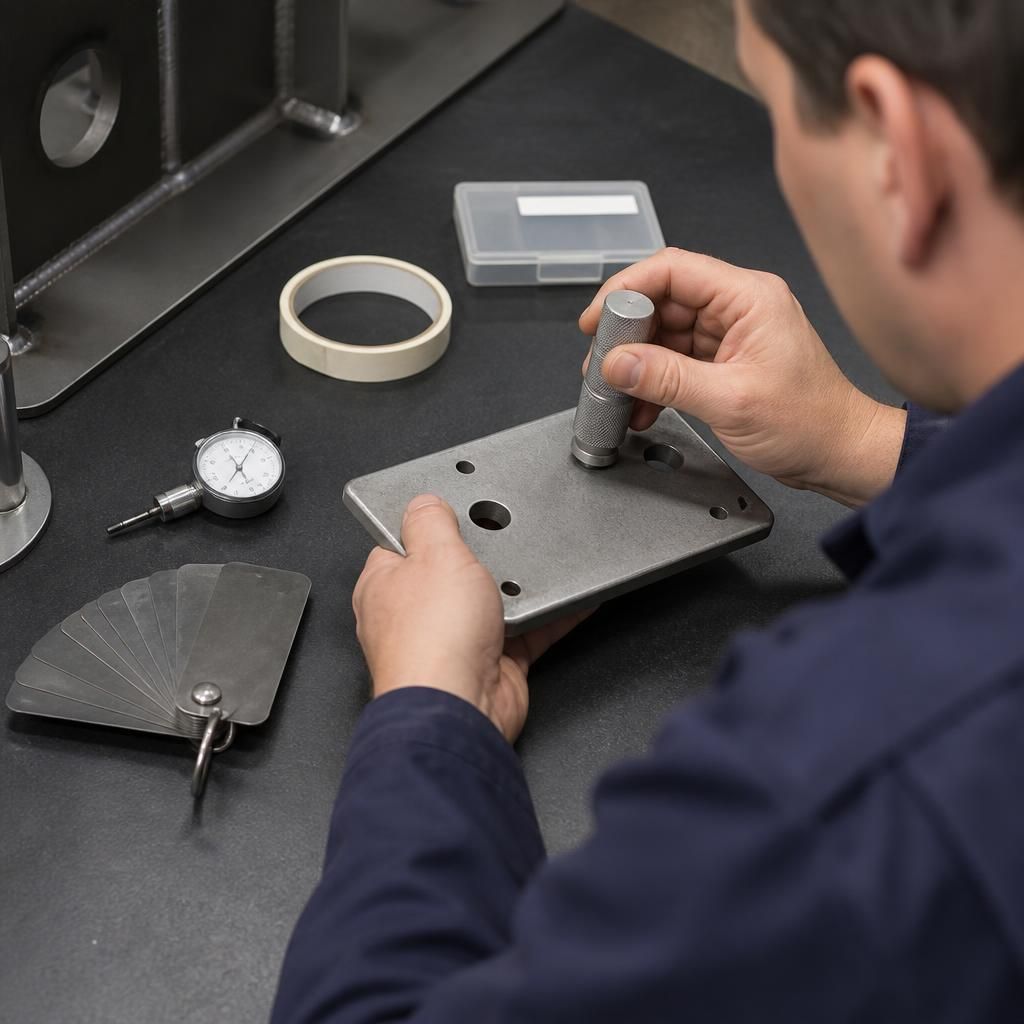
Shotblasting supports reliable powder coating adhesion only when the resulting surface profile is suitable for the coating system. A surface that looks evenly blasted may still have variations between broad faces, welds, edges and recessed areas, so profile assessment is an important quality check.
Depending on the specification, the profile can be assessed with a surface comparator, replica tape or a suitable profile gauge. These checks help confirm that abrasive treatment has produced a consistent key without creating an unnecessarily coarse finish. Inspection should also consider whether the prepared surface remains free from loose abrasive, dust and oxidation before powder is applied.