

How does electrostatic powder coating contribute to the longevity and appearance of metal components?
Electrostatic powder coating improves metal component longevity by applying charged powder evenly to a prepared surface, where it is cured into a hard, continuous protective film. The resulting finish helps resist wear, corrosion and handling damage while providing a consistent colour, texture and appearance.
Electrostatic powder coating contributes to the longevity and appearance of metal components by creating a controlled, well-adhered finish suited to the component’s service environment. Its performance depends not only on the powder itself, but also on the metal substrate, pre-treatment, application control, curing conditions and the selected finish specification.
How it supports longer service life
- Barrier protection: The coating separates the metal from moisture, salts, atmospheric pollutants and other contaminants that can initiate surface deterioration. This is particularly important for components used outdoors or in areas exposed to condensation and industrial handling.
- Resistance to mechanical damage: A correctly specified and cured coating can withstand routine abrasion, contact and handling more effectively than an unsuitable or poorly bonded finish. This helps protect edges, faces and other exposed areas during assembly, transport and use.
- Improved adhesion: Cleaning and pre-treatment remove contaminants and help the coating bond to the substrate. Good adhesion reduces the likelihood of lifting, flaking or under-film deterioration when the component is exposed to moisture, temperature changes or physical stress.
- Protection tailored to the environment: Powder chemistry and formulation can be selected for requirements such as outdoor exposure, chemical contact, impact, abrasion or flexibility. A coating intended for interior equipment should not automatically be treated as suitable for aggressive external conditions.
The coating system should also be considered alongside the component’s design. Sharp edges, recesses, joints and areas where water can collect may be more vulnerable than broad, accessible surfaces. Drainage, suitable edge design and the avoidance of trapped contaminants allow the finish to perform more consistently. Where the metal requires enhanced corrosion protection, the powder coating may form part of a multi-stage system rather than being considered in isolation.
How it improves visual quality
Powder coating provides a broad choice of colours, gloss levels and surface textures. This allows a specification to balance appearance with practical requirements: a smooth finish may suit visible panels, while a textured or matt finish can help disguise minor surface variation and reduce the prominence of handling marks. The selected formulation also affects colour stability, gloss retention and resistance to chalking when components are exposed to sunlight.
Visual consistency is influenced by more than the colour reference. Powder batch, application settings, film build, curing conditions, substrate condition and component geometry can all affect the final result. Parts with different shapes or thicknesses may heat at different rates, while recessed areas and internal corners require careful process control. Consistent preparation and curing are therefore essential when separate components must appear as a matched assembly.
The importance of curing and film build
Curing converts the deposited powder into its final coating structure. If the component receives insufficient heat, the finish may not develop the intended hardness, adhesion or chemical resistance. Excessive or uneven curing can affect colour and gloss. The relevant cure schedule must be considered in relation to the metal’s temperature, thickness and mass rather than relying only on the oven air temperature.
Film thickness also requires control. Too little coating can leave weak coverage, while excessive build may affect appearance, fit, edge definition or the operation of moving parts. Consistent application is especially important for fabricated assemblies, covers, brackets, frames and components that must meet dimensional or assembly tolerances.
Factors that can limit performance
- Rust, oil, mill scale, moisture or previous coatings left on the substrate can compromise adhesion.
- Sharp handling damage, impact or cutting after coating can expose the metal beneath the finish.
- Prolonged exposure to strong chemicals, heat or ultraviolet radiation may require a specialist formulation.
- Hidden faces, cavities and Faraday areas can be more difficult to coat consistently because of their geometry.
- Incorrect packing, stacking or transport can mark a finish even when the coating itself has been properly applied.
For this reason, longevity is best assessed against the component’s actual use rather than by treating powder coating as a single, universal specification. The required colour and texture should be agreed alongside the exposure conditions, expected handling, corrosion risk, substrate type and any dimensional limits.
Routine care also helps preserve both protection and appearance. Components should be kept free from deposits that may retain moisture or contain corrosive substances, and cleaning methods should be compatible with the coating. Abrasive tools and unapproved solvents can dull, scratch or soften the surface. With appropriate specification, preparation, application, curing and maintenance, electrostatic powder coating can provide a durable finish that remains functionally protective while retaining a controlled industrial appearance.
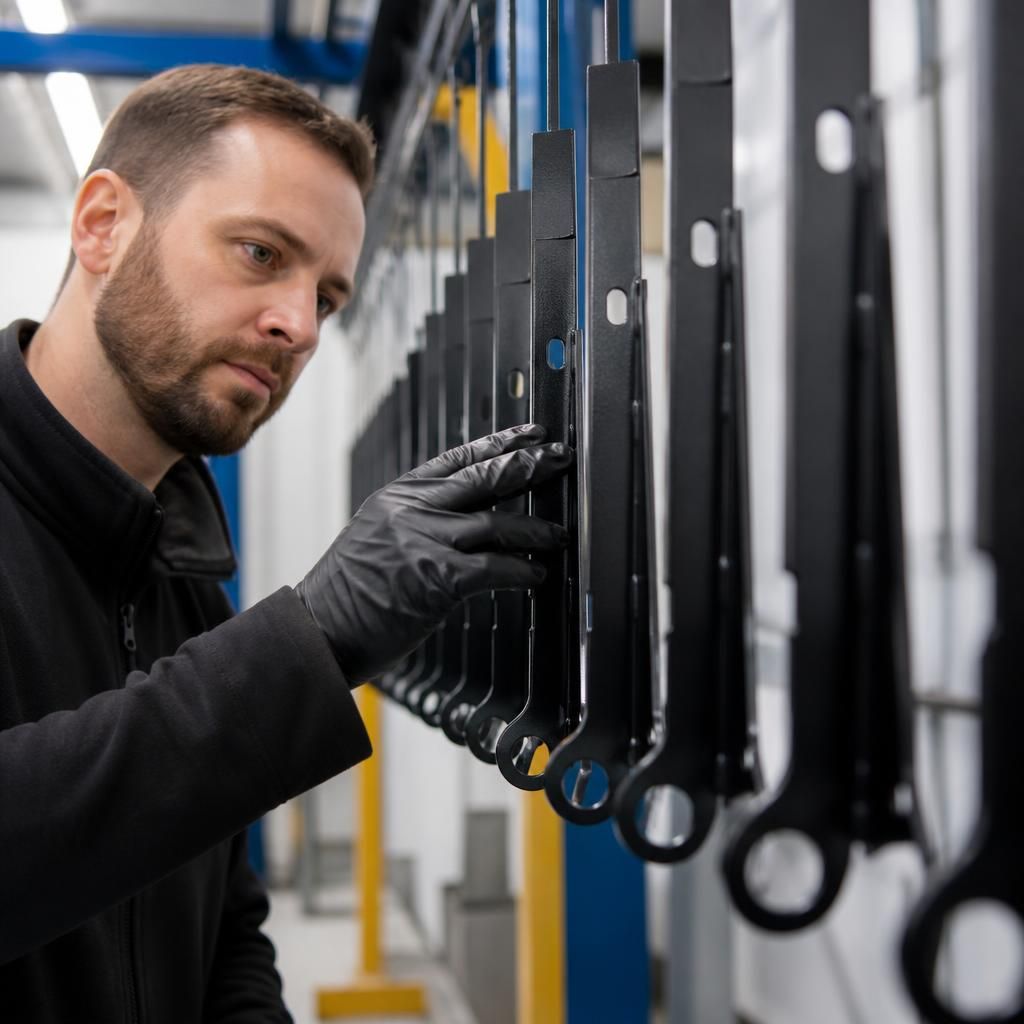
Appearance can also provide an early indication of coating integrity. Pinholes, bare patches, blistering, runs or inconsistent gloss may indicate problems with preparation, application or curing rather than being purely cosmetic defects. On a metal component, an interruption in the coating can provide an entry point for moisture and contaminants, reducing the protection available to the substrate.
Inspecting the finish against the agreed colour, texture and coverage requirements helps identify issues before the component enters service. This links visual quality with functional performance: a consistent appearance generally reflects controlled deposition and curing, while visible defects may warrant investigation before assembly or installation.