

How does abrasive shot blasting differ from sandblasting in terms of effectiveness and application?
Abrasive shot blasting uses metallic shot or grit to clean and prepare robust metal components, generally producing a controlled, uniform profile with strong impact and potential peening effects. Sandblasting uses sand or another fine abrasive for more adaptable cleaning and profiling, but its suitability depends on the substrate, required finish and the health and environmental controls for the chosen media.
Abrasive shot blasting and sandblasting differ mainly in the type, shape and impact behaviour of the abrasive used. Shot blasting normally uses manufactured metallic particles, such as round steel shot or angular steel grit, in a controlled blasting system. Sandblasting traditionally uses sand, although the term is now often used more broadly for blasting with fine non-metallic media. The choice affects cleaning power, surface roughness, production control, dust, substrate suitability and the condition of the surface before coating.
How abrasive shot blasting works
Metallic shot is propelled at the workpiece at high velocity. Round shot is effective for removing loosely bonded contamination, scale and some coatings while also compacting the outer surface through repeated impact. This compaction effect is commonly called peening. Angular metallic grit cuts into the surface more aggressively and is generally selected when a stronger mechanical key or more intensive removal is required.
Because metallic media can often be recovered, separated and reused within suitable equipment, shot blasting is well suited to repeatable industrial processing. The operator can control variables such as abrasive grade, blast pressure, nozzle distance, angle, exposure and part rotation. These variables are important when components must have a consistent condition before powder coating or another finish.
How sandblasting works
Sandblasting uses a relatively fine, non-metallic abrasive to abrade contamination and create a surface profile. The result depends heavily on the actual media rather than the word “sandblasting” itself. Natural sand, where permitted, behaves differently from mineral grit, glass-based media or other alternatives in terms of hardness, particle shape, dust generation and breakdown during use.
Fine non-metallic abrasives can be useful where a lighter touch, detailed cleaning or a particular surface texture is required. They may reach recesses and irregular areas effectively, but softer or friable media can break down more quickly. That can increase dust and make the blasting pattern less consistent if the process is not carefully controlled.
Comparison of effectiveness
- Heavy contamination: Metallic grit is often more effective for firmly bonded mill scale, corrosion products and robust industrial residues because its angular particles deliver a strong cutting action.
- General cleaning: Round shot can remove surface contamination efficiently while producing a relatively even treated surface, provided the abrasive and equipment are matched to the component.
- Delicate or thin sections: A fine, non-metallic abrasive operated at an appropriate pressure may reduce the risk of distortion or excessive removal. However, the process still requires careful testing because thin material can be damaged by impact.
- Profile control: Metallic grit generally creates a more pronounced mechanical profile than round shot. Fine blasting media can create a shallower profile, which may be preferable for some finishing specifications.
- Complex components: Both methods require attention to line of sight, shadowed areas, internal corners and narrow recesses. Neither method automatically cleans every surface uniformly simply because the abrasive is suitable.
More aggressive blasting is not necessarily more effective. Excessive impact can round edges, enlarge surface defects, distort thin components or leave a profile that is unsuitable for the intended coating thickness. The correct process removes the unwanted material while preserving dimensional accuracy and producing a surface that the next finish can properly wet and anchor to.
Differences in surface finish
Round shot tends to produce a dimpled, peened texture, whereas angular grit cuts small valleys into the surface. Sand or other fine non-metallic media may create a finer or more open texture, depending on particle size, hardness and blasting pressure. Surface profile should be assessed against the coating system and the component specification rather than judged by appearance alone.
A surface can look clean but still be unsuitable for coating if it contains embedded abrasive, loose dust, oil, moisture or remaining corrosion. After either process, the component should be thoroughly inspected and cleaned as required. Particular attention is needed around welds, folds, holes and joints, where residues can remain hidden and later interfere with coating adhesion or appearance.
Application suitability
Abrasive shot blasting is commonly selected for robust steel fabrications, castings, structural parts and batches of components that can be processed using enclosed or automated equipment. It is especially practical where repeatability, substantial cleaning action and a defined surface profile are priorities.
Sandblasting or fine non-metallic abrasive blasting may be considered for selected maintenance work, intricate items, localised preparation or substrates that could be adversely affected by metallic impact. The media must be compatible with the base metal and the required finish. Some abrasives can contaminate a surface or leave residues that are unsuitable for subsequent coating, so media selection should be confirmed before processing.
Neither method should be chosen solely because it is familiar. The decision should take account of:
- the base metal, hardness, thickness and dimensional tolerances;
- the type and strength of corrosion, scale, paint or other contamination;
- the surface profile specified by the coating system;
- the component’s size, shape, recesses and masking requirements;
- whether the abrasive can be recovered, screened and kept free from contamination;
- the required visual finish and any risk of media embedment;
- how the prepared surface will be protected from flash rusting before coating.
Health, environmental and process controls
Traditional sand containing respirable crystalline silica presents serious health risks when its dust is inhaled. For that reason, suitable substitute media, enclosed equipment, extraction, cleaning procedures and appropriate personal protective equipment are central to compliant blasting practice. Metallic abrasives also generate dust and can create hazards from rebound, noise and contaminated coating residues; they are not risk-free.
The blasting method should therefore be assessed alongside containment, ventilation, abrasive recovery, waste handling and operator protection. Where old paint or other hazardous coatings are being removed, the residue may require separate identification and controlled disposal regardless of whether shot or non-metallic abrasive is used.
For powder coating preparation, the most effective option is the one that leaves a clean, appropriately profiled and uncontaminated surface without damaging the component. Metallic shot or grit is often preferable for durable industrial parts requiring strong, consistent preparation, while a carefully selected fine non-metallic medium can be better for sensitive, detailed or localised work. A trial on a representative area is a sensible way to confirm the cleaning result, profile and appearance before processing a full batch.
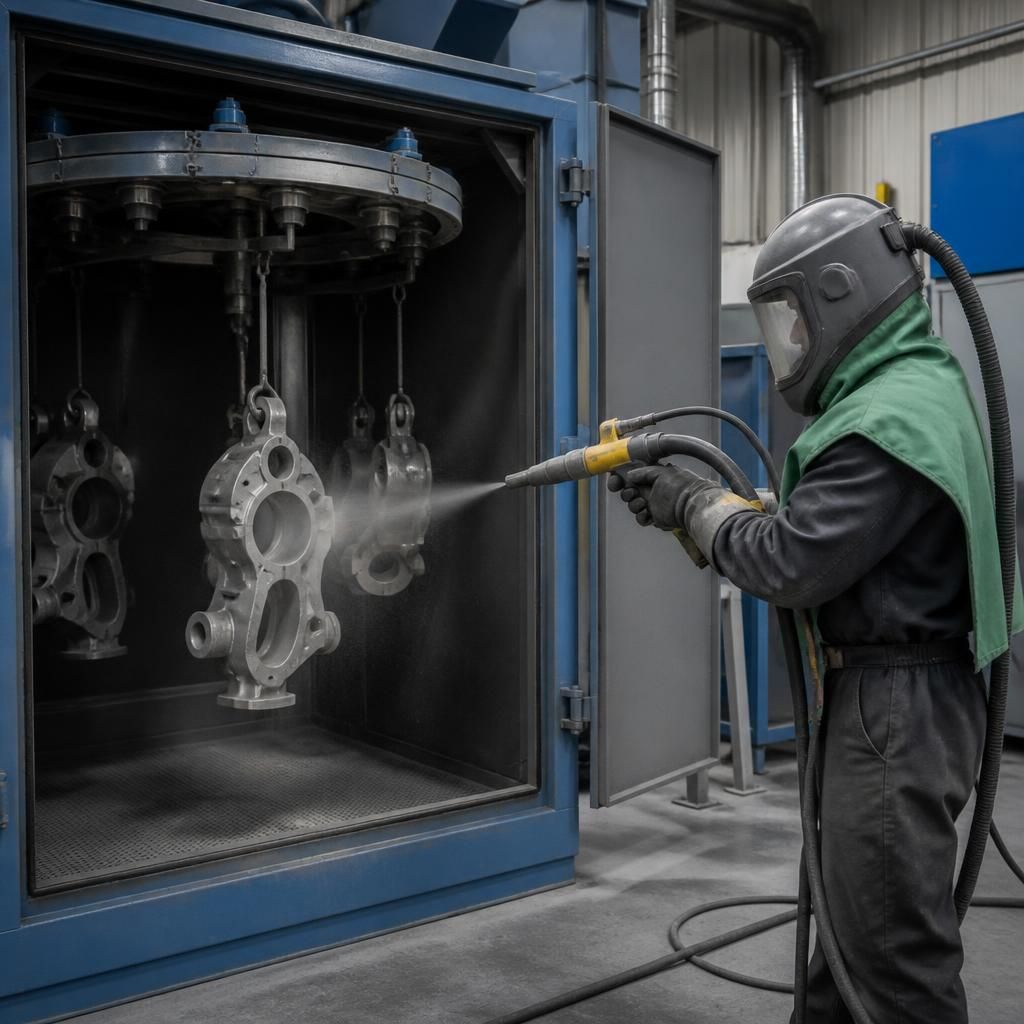
The equipment used to propel the abrasive is an important practical difference between shot blasting and sandblasting. Metallic shot is often applied in enclosed wheel-blast systems, where rotating wheels project the media consistently across batches of suitably shaped components. This supports repeatable industrial processing but requires parts that can be loaded, exposed and handled safely within the equipment.
Sandblasting and other fine-abrasive processes are more commonly delivered through a compressed-air nozzle. The operator can direct the blast towards selected areas, which is useful for awkward profiles, repair work and components that cannot be processed through a wheel-blast system. This flexibility does not automatically make sandblasting gentler or more effective: nozzle distance, pressure, abrasive grade and operator technique still determine the result. The most suitable method is therefore influenced not only by cleaning power, but also by how the component can be presented to the equipment.