

What are the benefits of using specific RAL powder coat colours for aluminium?
Choosing a specific RAL powder coat colour for aluminium provides a recognised colour reference, helping manufacturers, fabricators and their customers specify consistent finishes across components and production batches. The powder coating also forms a durable surface that protects the aluminium while delivering the required appearance, with the selected finish influencing sheen, texture and visual uniformity.
Using a specific RAL powder coat colour on aluminium provides controlled specification, reliable visual identification and a finish suited to the component’s intended environment. The main benefits are easier communication between designers, manufacturers and coaters, better alignment with project requirements, and a more predictable result when colour, gloss and coating chemistry are selected together.
Clearer technical specification
A RAL reference gives a project a defined colour target rather than relying on descriptions such as “dark grey”, “off-white” or “silver”. This is particularly useful where aluminium parts are made by different suppliers or incorporated into a larger assembly. Drawings, schedules, purchase orders and inspection records can all refer to the same colour code, reducing ambiguity during manufacture and approval.
The RAL code should still be accompanied by relevant finish details. The same colour can look different in matt, satin or gloss versions, and textured powder can alter how light is reflected from the surface. Stating the required sheen, texture and coating type alongside the RAL reference gives the coater a more complete specification.
Consistent appearance across a project
Specific colour selection helps maintain a planned visual relationship between aluminium frames, panels, trims, enclosures and other coated components. This is valuable in architectural metalwork, shopfitting, signage, transport equipment and branded commercial installations, where inconsistent colour can be more noticeable than a minor variation in component dimensions.
Where parts are produced at different times, the original RAL reference provides a useful basis for checking later work. Physical samples or an approved coated reference panel are also advisable, because lighting, surface profile, viewing angle and gloss level can affect perceived colour. A colour card is a specification aid, not an absolute guarantee that every surface will appear identical in every setting.
Better coordination with design and brand requirements
Many manufacturers and fabricators need aluminium components to correspond with a building scheme, product range or corporate colour palette. A defined RAL choice makes it easier to coordinate metalwork with adjacent materials and to obtain approval before a production batch is coated. It can also support repeat production of replacement or additional parts, provided the substrate preparation, powder system and finish requirements remain suitable.
Colour can serve a practical identification purpose as well as an aesthetic one. Different colours may distinguish equipment types, access points, service zones or product variants. On industrial components, a carefully chosen contrast can make labels, controls and edges easier to recognise, although colour should not replace required safety markings or signage standards.
Potential contribution to thermal performance
Colour influences how much radiant energy a surface absorbs. Darker aluminium finishes generally absorb more solar heat than lighter or more reflective finishes, which may affect surface temperature in exposed applications. This can be relevant to external panels, screening, housings and architectural components where thermal movement or heat transfer must be considered.
Colour alone is not a substitute for thermal design. The effect depends on the coating formulation, gloss, component geometry, exposure, ventilation and the properties of the complete assembly. Where temperature is a design concern, the selected RAL colour should be assessed alongside the aluminium grade, fixings, insulation and operating conditions.
Choice of appearance can support maintenance planning
Some colours and finishes make dust, handling marks, surface deposits or minor damage more visible than others. A textured or lower-sheen finish may provide a different visual character from a high-gloss surface, while a carefully chosen mid-tone can help make everyday contamination less conspicuous. This does not remove the need for cleaning, but it can influence how frequently a component needs to be presented to a particular visual standard.
For equipment exposed to industrial contamination, coastal conditions, chemicals or frequent handling, the protective system should be selected for the environment rather than choosing a colour in isolation. Pretreatment, powder chemistry, film thickness and curing are important to the coating’s service performance. A RAL code identifies colour; it does not by itself specify corrosion resistance, chemical resistance or suitability for external exposure.
How to select a specific RAL colour for aluminium
- Define the required RAL reference and confirm whether the project uses a particular RAL colour range.
- Specify the gloss level, texture and any requirements for a smooth or decorative finish.
- Consider sunlight, heat, moisture, chemicals, abrasion and handling in the operating environment.
- Check the colour against adjoining materials under representative lighting rather than relying only on a screen image.
- Request or approve a sample where visual accuracy is important.
- Confirm that the chosen powder system and aluminium pretreatment are appropriate for the intended use.
- Record the full finish specification so replacement parts can be assessed against the same requirements.
For manufacturers and fabricators, supplying the aluminium component details, expected exposure and required RAL finish at quotation stage helps establish whether a standard decorative system or a more specialised protective specification is appropriate. Powder-coating providers serving businesses across the Midlands can also advise on the practical implications of batch size, component dimensions, collection and delivery, and the finish information needed before production.
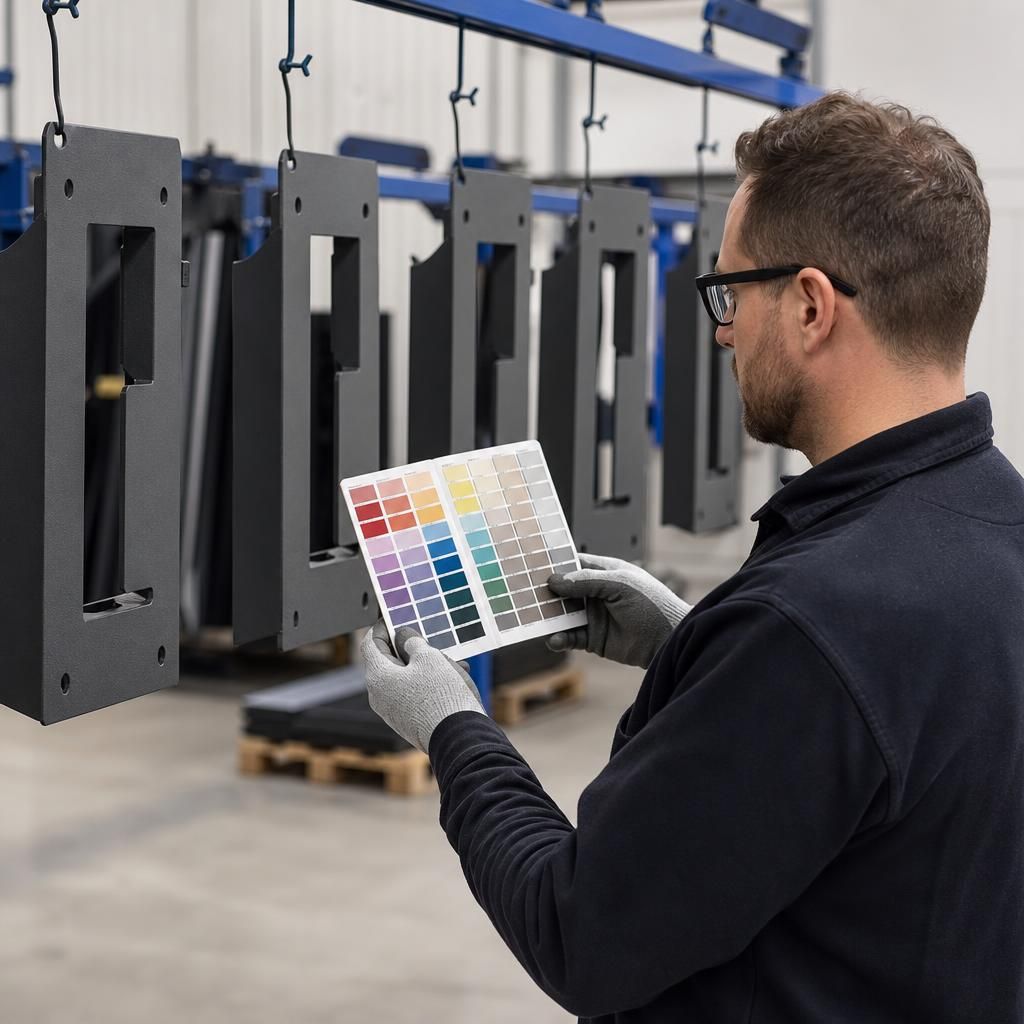
A specific RAL colour helps separate the visual requirement from the performance requirement. The chosen shade can be assessed for its appearance and project suitability, while the coating system is selected according to exposure to moisture, chemicals, abrasion, sunlight and handling. This avoids treating a colour reference as evidence that the coating is suitable for every application.
For aluminium components, the final specification should therefore identify the RAL colour alongside the required gloss or texture, pretreatment and powder type. This gives production and inspection teams a clearer basis for confirming that the finished part meets both its appearance requirements and its intended service conditions.