

What specific surface preparation methods are most effective for ensuring optimal adhesion in nylon coating?
The most effective preparation for nylon coating combines thorough degreasing, removal of existing corrosion or scale, and controlled abrasive blasting to create a clean, lightly profiled surface. After blasting, remove all dust and moisture, then use a compatible primer or conversion treatment where the substrate and coating specification require additional adhesion support.
Optimal adhesion in nylon coating depends on matching the preparation route to the substrate, the component’s geometry and the intended service conditions. In addition to general cleaning and surface conditioning, the most effective approach includes careful edge and weld preparation, control of surface profile, removal of manufacturing defects, suitable thermal treatment where required, and disciplined handling before coating.
Prepare edges, welds and fabrication details
Sharp edges are difficult to coat evenly because powder tends to pull away from acute corners during application and curing. Deburring and lightly radiusing exposed edges helps produce a more continuous film. Welds should be free from spatter, sharp projections, porous deposits and residues from fabrication processes. Any remaining flux, anti-spatter material, silicone or grinding residue can create local adhesion failures, even when the surrounding metal appears sound.
Crevices, overlapping joints and enclosed sections also need attention. Where the design permits, drainage and vent holes should allow preparation residues and trapped air to escape. Components with sealed cavities may release gas during heating, producing pinholes or blisters in the nylon film. If the component cannot be redesigned, its construction and likely outgassing behaviour should be considered when selecting the preparation and coating cycle.
Use mechanical finishing selectively
Power-tool abrasion, rotary finishing or other mechanical methods can be useful for local repairs, weld zones and areas that cannot be treated uniformly by the main preparation process. The objective is to remove weak surface layers and provide a consistent key without leaving deep directional scratches, embedded abrasive particles or smeared metal. Abrasive tools should be clean and suitable for the substrate; using the same tool indiscriminately on carbon steel, stainless steel and aluminium can transfer particles and introduce corrosion problems.
Mechanical finishing is most reliable when it is followed by a defined inspection rather than judged solely by appearance. Check for remaining mill scale, burrs, heat tint, embedded debris and areas of visibly different texture. A surface that looks bright may still contain a weak mechanically disturbed layer or contamination in grooves.
Control the surface profile
Nylon requires sufficient mechanical interlock, but an excessively rough or irregular surface can increase coating thickness variations and leave peaks insufficiently covered. The preparation specification should therefore define the required surface texture for the particular nylon system and substrate. Profile comparators, replica materials or suitable surface-measurement equipment can be used to confirm consistency where the application is critical.
Profile checks should be made across representative areas rather than at a single convenient point. Pay particular attention to corners, welds, recessed sections and regions prepared by a different method. If the texture varies significantly, the finished coating may show inconsistent appearance, premature wear at exposed peaks or weak coverage in valleys.
Consider chemical and thermal treatments by substrate
Some metal types benefit from a specified chemical pretreatment or etching stage rather than relying on mechanical preparation alone. The correct route depends on the alloy, existing surface condition and nylon formulation. Aluminium, galvanised steel, castings and previously coated components can each present different adhesion or gas-release risks, so a process suitable for plain steel should not automatically be applied to every job.
Porous castings, zinc-rich surfaces and some fabricated parts may require controlled preheating or an outgassing stage before the final nylon application. This is intended to release absorbed moisture, oils or gases from the substrate and reduce defects that appear during heating. The treatment must be compatible with the metal and coating specification; excessive heat can alter the substrate, affect dimensions or create further surface oxidation.
Protect the prepared surface before coating
Handling after preparation is part of the adhesion process. Components should be supported on clean contact points and handled with suitable gloves so that skin oils, workshop dust and marking compounds are not transferred back onto the metal. Racking should avoid damaging the prepared surface and should provide reliable electrical contact where an electrostatic application process is used.
Masking is also important. Threads, bearing seats, mating faces, drainage holes and electrical contact points may need to remain free of nylon. Masking materials must be stable during the coating cycle and should not leave adhesive, fibres or silicone residue on adjacent areas. Poor masking can force unnecessary rework and may expose the coating edge to damage during assembly.
Verify preparation before applying nylon
- Confirm that burrs, weld spatter, sharp projections and fabrication residues have been removed.
- Check that the surface texture is consistent with the coating specification.
- Inspect enclosed sections, recesses and joint lines for trapped residues or preparation defects.
- Verify that masking, racking and electrical contact arrangements are suitable for the component.
- Record any substrate-specific treatment, thermal conditioning or deviation from the standard preparation route.
For demanding components, a trial piece or representative test panel can help establish whether the selected preparation produces the required adhesion and appearance before full batch processing. Adhesion testing on the finished coating, combined with visual inspection of cut edges and difficult geometries, can then confirm whether the preparation method is suitable for the component’s intended use.
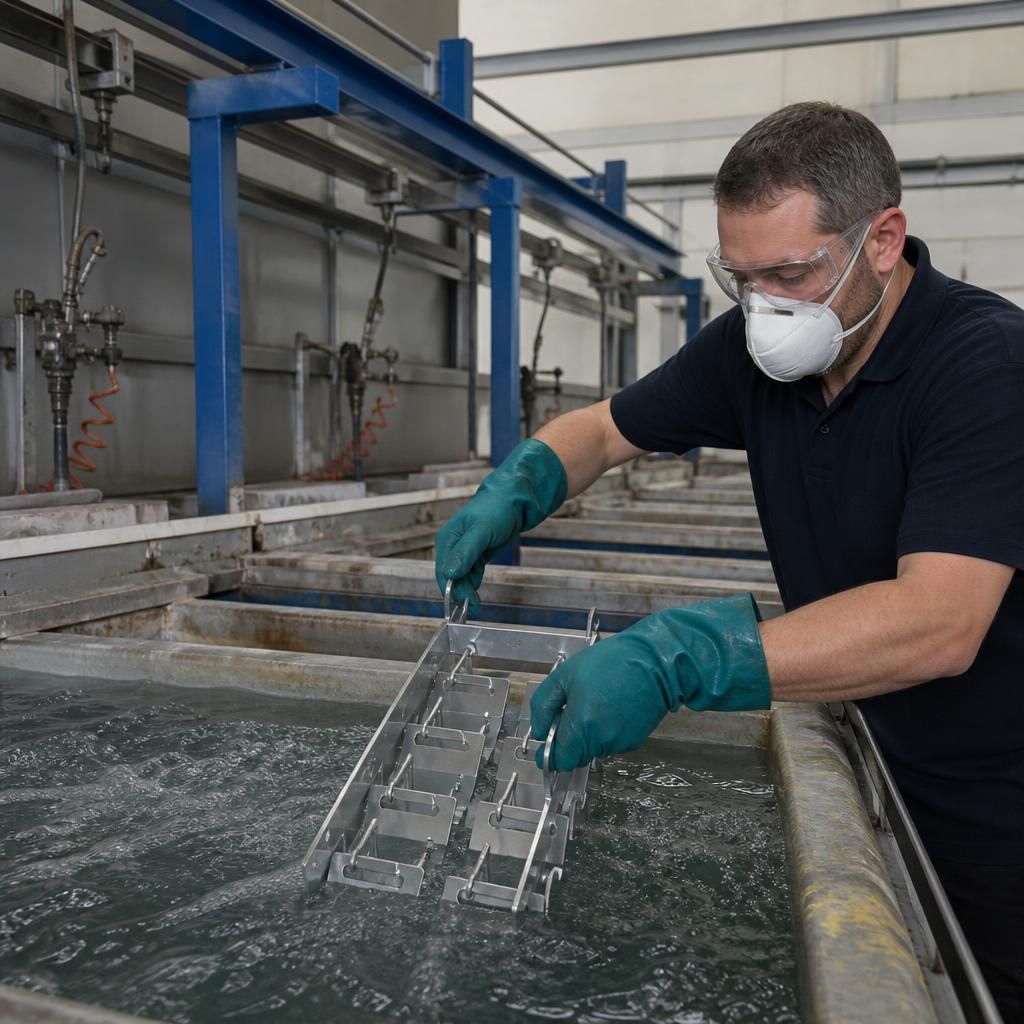
A compatible conversion treatment can be more effective than abrasion alone on aluminium, galvanised steel and other substrates where the surface is chemically different from plain carbon steel. It conditions the metal, helps provide a stable base for the nylon film and can reduce the risk of inconsistent adhesion across the component.
The treatment must match the substrate and nylon coating specification. Any process residue, incomplete rinsing or retained moisture can become a weak layer, so treated parts should be thoroughly rinsed, dried and protected from recontamination before coating. Where the component or service conditions are demanding, the selected treatment should be confirmed on a representative test piece rather than assumed to be suitable from its appearance alone.
Discuss Your Nylon Coating Preparation Requirements
Discuss your nylon coating preparation requirements with the Powder-coatings.co.uk team, providing details of the metal substrate, component design and intended service conditions. This information can help establish a suitable preparation specification before batch processing.