

What are the main benefits of choosing electrostatic powder coating over traditional liquid paint for industrial applications?
Electrostatic powder coating provides a tougher, more uniform finish than traditional liquid paint, helping industrial metal components resist wear, corrosion and impact. The electrostatic application process also transfers powder efficiently to the grounded workpiece, reducing overspray and avoiding solvent-based liquid paint during application.
Electrostatic powder coating is often preferable to traditional liquid paint for industrial metalwork because it applies a dry coating that is then heat-cured into a continuous film. Its main advantages are process consistency, efficient material handling, reduced solvent use, and a finish that can be specified for particular service conditions. The best choice still depends on the component, required film properties, production volumes and whether the part can tolerate curing heat.
More controlled film formation: Powder is applied as dry particles and cured under controlled conditions rather than relying on liquid paint to release its solvent as it dries. This can make the coating process less sensitive to issues such as runs, sags, uneven drying and solvent entrapment. Correct preparation, powder selection and curing remain essential; electrostatic application does not compensate for contamination, poor masking or an unsuitable substrate.
Efficient use of coating material: Liquid paint systems commonly involve solvent evaporation and may require thinners, mixing and management of wet residues. Powder contains the coating material in a dry form, so the application process does not depend on solvent being driven off to leave the required film. In suitable production equipment, unused overspray may also be collected and managed for potential reuse, subject to the powder type, colour control requirements and the coating system in use.
Less reliance on solvent-based application: Traditional liquid paint can release volatile organic compounds as solvents evaporate during application and drying. Powder coating avoids those solvents in the coating application itself, which can simplify material handling and reduce the need to manage solvent-related vapours. This is an operational and environmental advantage, although powder coating still requires proper ventilation, housekeeping and control of airborne particles.
Repeatable results for production work: Electrostatic systems can be integrated with controlled application equipment, defined curing conditions and inspection procedures. That makes the process suitable for repeat batches where the same specification must be applied to multiple metal components. Consistency depends on maintaining the correct powder, application settings, earthing, part preparation and oven conditions. Liquid paint can also produce high-quality results, but its wet application introduces additional variables such as viscosity, mixing ratios, solvent balance and drying conditions.
Broad choice of functional and visual specifications: Powder formulations are available for different levels of chemical resistance, weathering performance, flexibility, texture, gloss and colour. This allows the coating specification to be matched to the component’s intended environment rather than treating appearance as the only consideration. A coating for an internal fabricated assembly may need a different formulation from one exposed to handling, moisture, industrial contamination or outdoor conditions.
Potentially simpler post-coating handling: Once the powder has been correctly cured, the finish is dry rather than wet. This can reduce the risk of marks caused by contact during subsequent movement, assembly or packing, provided the part has cooled and the cure has been verified. Liquid-painted parts may need carefully managed drying and handling stages before they can enter the next production operation.
There are, however, situations in which liquid paint remains more suitable. Powder coating requires the component to enter a curing oven, so the part must fit the available equipment and withstand the curing temperature without distortion or damage. Heat-sensitive materials, bonded assemblies and components containing temperature-sensitive parts may require an alternative process. Liquid paint may also be more practical for very small touch-up areas, on-site application or work that cannot be transported to a controlled coating facility.
Component design also affects the result. Recesses, narrow openings and enclosed sections can restrict powder penetration through the electrostatic effect, while sharp edges, threaded features and close tolerances may require masking or a coating specification that accounts for added film thickness. These details should be reviewed before production rather than treated as finishing-stage corrections.
For industrial applications, the decision should therefore compare the complete process rather than coating material alone. Consider the substrate and pre-treatment, required appearance, exposure conditions, dimensional tolerances, batch size, curing requirements, masking, inspection and likely maintenance conditions. When the component and production route are suitable, electrostatic powder coating offers a controlled dry application, reduced solvent dependence and repeatable cured finishes that can be specified for both functional and appearance requirements.
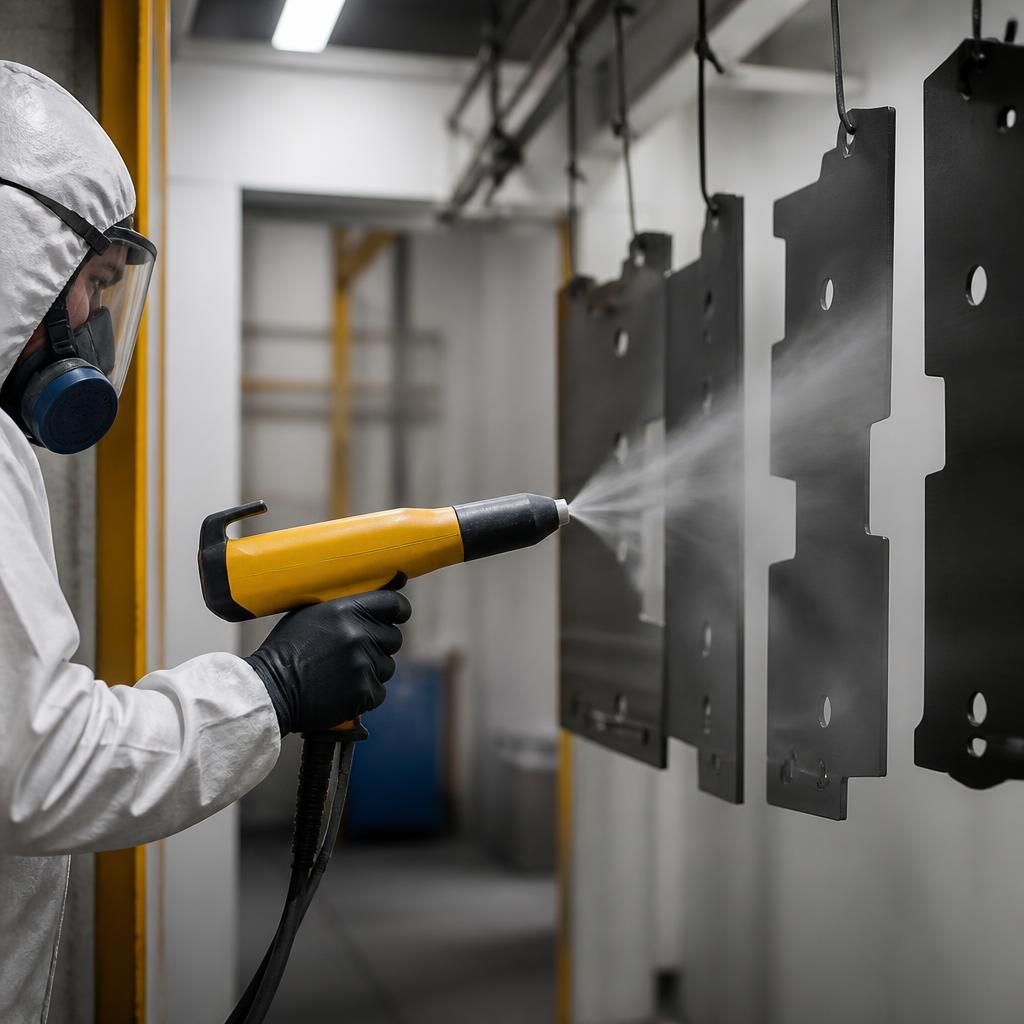
A key advantage of electrostatic powder coating is that the finish can be selected to combine protection and appearance in one controlled specification. For example, a formulation intended for outdoor metalwork can be chosen for weathering and colour retention, while an internal component may require greater resistance to chemicals or abrasion instead. This avoids treating decorative appearance as separate from the component’s operating conditions.
The specification should consider the substrate, exposure and expected handling before coating begins. Matching the powder to those conditions helps ensure that the visual finish supports the required industrial performance, rather than simply covering the metal.