

What are the main differences between epoxy and polyester powder coatings, and how do I choose the right one for my project?
Epoxy powder coatings generally provide strong adhesion, chemical resistance and mechanical protection but can degrade or chalk in prolonged sunlight, while polyester coatings offer better UV and weather resistance for exterior use. Choose epoxy for protected components exposed to chemicals or abrasion, polyester for outdoor metalwork, or a hybrid where both indoor protection and moderate weather resistance are required.
Epoxy and polyester powder coatings are both thermoset finishes, but they are formulated for different service conditions. Epoxy is generally selected where adhesion, chemical resistance and indoor protection are the priority. Polyester is usually the more suitable choice where the coated component will be exposed to sunlight and changing weather. The right decision should also consider the substrate, surface preparation, handling requirements, appearance, curing facilities and expected maintenance.
Epoxy powder coating contains an epoxy resin that cross-links during curing to form a hard, adherent film. It is well suited to components used indoors or in sheltered environments, including machinery parts, brackets, cabinets, frames and industrial equipment. Its useful characteristics can include:
- Strong adhesion to correctly prepared metal;
- Good resistance to oils, solvents and other chemicals, depending on the formulation;
- Good protection against impact, abrasion and general mechanical handling;
- A smooth, consistent finish available in a range of colours and textures;
- Effective performance where prolonged exposure to direct sunlight is not expected.
Its main limitation is outdoor durability. Ultraviolet exposure can cause an epoxy film to lose gloss, chalk or change appearance over time. This does not necessarily mean that the coating has immediately lost all protective function, but it can make epoxy unsuitable where long-term colour and finish retention are important.
Polyester powder coating uses a polyester resin system designed to provide better resistance to ultraviolet light and weathering. It is commonly considered for external metalwork, architectural components, enclosures, fencing, railings, fabricated parts and equipment exposed to natural light. Depending on the grade selected, it can offer:
- Improved resistance to sunlight and outdoor weather conditions;
- Better retention of colour and gloss in exterior applications;
- Good resistance to general handling and atmospheric exposure;
- A broad choice of decorative finishes, textures and colours;
- Suitable performance for many general industrial and construction applications.
Polyester is not automatically the best choice for every exterior or industrial application. Chemical contact, immersion, severe abrasion, high operating temperatures and exposure to aggressive pollutants may require a more specialised formulation or a different coating system. The technical data for the specific powder should be checked rather than relying only on the resin family.
The substrate and preparation are as important as the powder type. Steel, galvanised steel, aluminium and other metals may require different cleaning, degreasing, blasting or chemical pre-treatment. Rust, mill scale, oil, weld residues, moisture and fabrication contamination can reduce adhesion and create premature defects. Galvanised or porous surfaces may also release gases during curing, causing pinholes or surface bubbling if preparation and outgassing are not properly controlled.
Before choosing a coating, confirm whether the component has sharp edges, recesses, welds, threaded areas or close-fitting interfaces. Powder is applied as a dry film, so design details can affect coverage and the final build. Masking may be needed where electrical contact, accurate fits, earthing points or uncoated sections must be preserved. Components should also be suitable for the coating process and oven conditions, particularly where they contain assembled parts, seals, oils or heat-sensitive materials.
Curing requirements can influence the choice as well. Both epoxy and polyester powders must be heated according to the product supplier’s specified metal temperature and curing schedule. The oven setting alone does not confirm that the coating has cured correctly: part thickness, component geometry, loading and heat transfer can all affect the result. Insufficient curing may leave a coating with poor hardness or chemical resistance, while excessive heat can affect appearance, colour or the underlying material. A coating specification should therefore identify the powder grade and its curing requirements before production begins.
Application is normally carried out by spraying charged powder onto an electrically conductive, prepared component, followed by oven curing. The coating operator must control grounding, powder deposition, film build, contamination and oven conditions. Reclaiming or changing powder colours can also require careful process control to prevent unwanted contamination. For components requiring unusually thick protection or specialist performance, a different application method or coating system may be more appropriate than a standard single spray coat.
Use the operating environment to make the initial choice:
- Choose epoxy for mainly indoor components where chemical contact, adhesion, abrasion or mechanical protection is more important than prolonged sunlight resistance.
- Choose polyester for components exposed to outdoor light and weather where appearance and exterior durability are significant requirements.
- Consider a hybrid system where the specification requires a balance of epoxy’s indoor protection and polyester’s improved resistance to weathering. A hybrid is not a universal replacement for either resin and should be selected against the coating supplier’s performance data.
- Consider a specialist system where the part faces immersion, severe chemicals, sustained high temperatures, unusual wear or demanding corrosion conditions. These situations may require a formulation, primer or multi-coat system designed for that exposure.
Other selection factors include the required colour and gloss, acceptable cosmetic variation, edge coverage, electrical properties, contact with food or potable water where relevant, cleaning chemicals, expected handling and the consequences of coating failure. For a production batch, the specification should also define the metal grade, pre-treatment, powder type, colour, finish, target film build, curing conditions and inspection criteria.
A practical decision process is to describe the component’s environment first, then identify the principal failure risks. Ask whether the part will be indoors or outdoors, whether it will contact chemicals, whether it will be handled or abraded, how important colour retention is, and whether the substrate presents preparation challenges. Samples or test panels can help verify appearance and adhesion before committing a large batch, particularly where the substrate, geometry or service conditions are unusual.
For industrial components, Powder-coatings.co.uk can assess the coating requirement as part of its powder coating service for manufacturers, fabricators, construction businesses and automotive applications. Providing drawings, substrate details, service conditions and any required finish information will help the coating specification match the component rather than selecting epoxy or polyester on resin type alone.
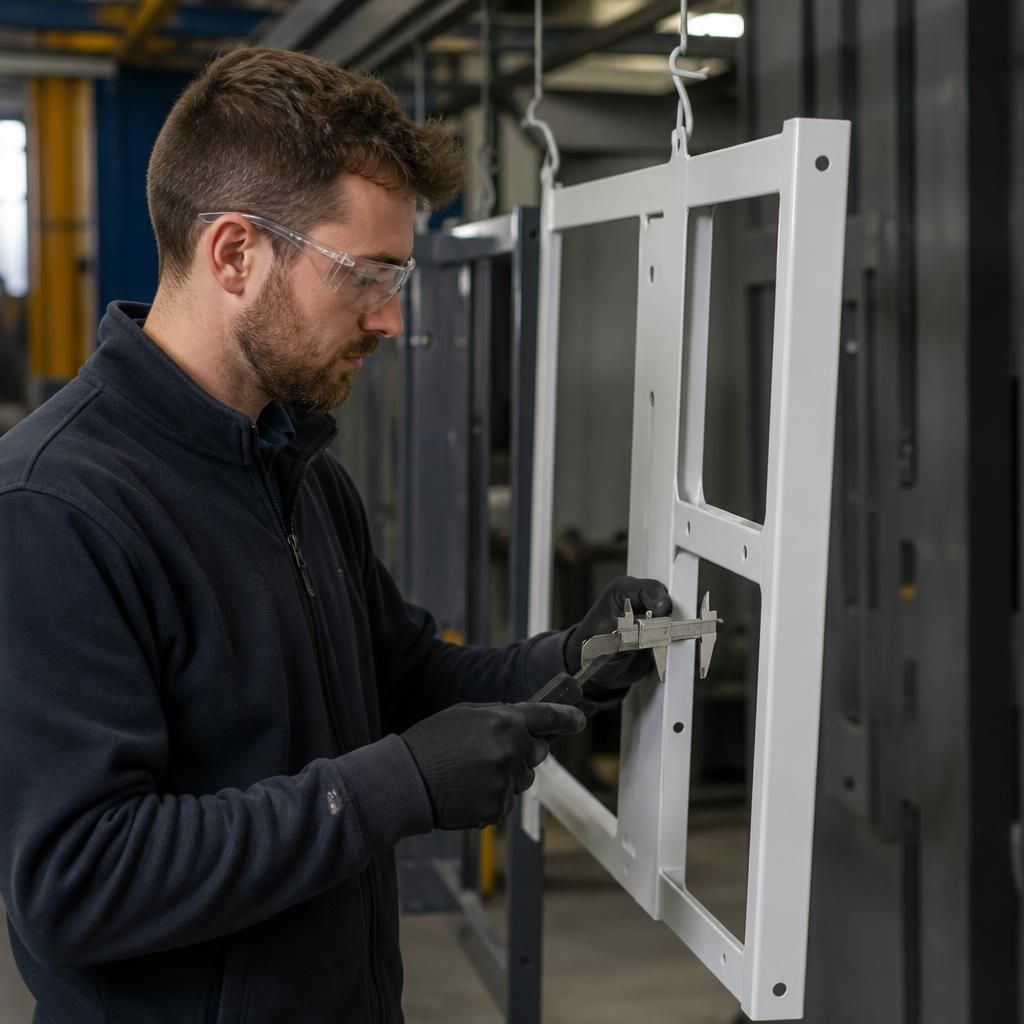
The resin type is only one part of a coating specification. Epoxy and polyester powders are available in different grades, so two products from the same resin family may have different resistance to chemicals, impact, flexibility, corrosion and weathering. Selection should therefore be based on the powder manufacturer’s technical data for the actual operating conditions, not on the name “epoxy” or “polyester” alone.
For a production component, record the performance requirements before requesting a coating quotation or approving a sample. The specification should identify:
- The substances, moisture and environmental exposure the coating must withstand;
- The likely impacts, bending, abrasion or handling during service;
- The required appearance, including colour, gloss and acceptable cosmetic variation;
- The substrate and any areas that must remain uncoated or dimensionally accurate;
- The inspection checks needed to confirm film coverage, adhesion and finish consistency.
This approach helps resolve competing requirements. For example, a component may need both chemical resistance and exposure to sunlight, in which case a standard indoor epoxy may not be suitable even if its adhesion is strong. A polyester grade, hybrid system or additional protective layer may be considered only after the relevant data and process requirements have been checked.
Discuss the Right Epoxy or Polyester Powder Coating for Your Project
For a coating recommendation, contact Powder-coatings.co.uk with details of the component’s intended use and any finish or dimensional constraints. The team can discuss whether epoxy, polyester or a hybrid system is appropriate for the application.