

What should I consider when selecting a powder coating equipment package for my business?
Choose a powder coating equipment package by matching its booth capacity, application method, curing capability and powder-feed system to your component sizes, production volumes and required finish quality. Also assess space, extraction and safety requirements, maintenance needs, operator training, total ownership cost and the level of technical support available.
Select a powder coating equipment package by defining the components, coating specification and production workflow it must handle, then checking that every item in the package is compatible with those requirements. The right choice is not necessarily the largest system; it is the one that provides repeatable application, suitable curing and practical operation without adding equipment that your business cannot use effectively.
Start with the parts being coated
- Record the substrate, material thickness, surface condition and any areas that must remain uncoated. Steel, aluminium and galvanised components may require different preparation and grounding arrangements.
- Measure the largest and heaviest components, including their hanging position. The useful working dimensions of a package matter more than its external dimensions.
- Consider recesses, holes, sharp edges, internal faces and complex profiles. These affect how powder reaches the surface and whether additional application control is needed.
- Identify masking, plugging or protection requirements for threads, bearing surfaces, electrical contact points and close-tolerance features.
Parts that vary considerably in size or geometry may need a more adaptable arrangement than a package designed around one repeatable component. A specification based only on the largest item can result in an unnecessarily cumbersome setup, while one based only on typical parts may be unsuitable for occasional larger work.
Define the finish specification
Equipment should be selected around the finish that must be achieved, not simply the colour of the powder. Establish whether the work requires a smooth, textured, matt, gloss, metallic or protective finish, and confirm the powder manufacturer’s recommended application and cure conditions for each material. Film thickness, edge coverage, appearance and adhesion requirements should be recorded as part of the purchasing specification.
Where several powder types or colours will be used, consider how they will be stored, transferred and changed between jobs. Frequent colour changes can make cleaning and powder recovery more significant than the nominal application speed. A package that is easy to clean may be more suitable for varied batch work than one optimised for a single powder and colour.
Match the package to the production method
Describe the intended workflow from prepared component to finished part. This should include loading, masking, coating, curing, cooling, inspection and unloading. Decide whether parts will be processed individually, on racks, in repeatable batches or through a more continuous sequence. The equipment should support the way parts actually move through the operation, rather than forcing operators to create awkward handling steps.
Production planning should also account for:
- the number of different component types processed;
- the frequency of colour or powder changes;
- the number of operators using the system;
- the amount of rework or touch-up expected;
- the space required for work-in-progress and finished parts; and
- whether future work is likely to involve larger batches, more varied components or additional coating specifications.
When comparing package specifications, ask suppliers to describe the complete process rather than quoting isolated equipment features. A system that appears suitable on paper may be impractical if its loading arrangement, hanging method or cleaning procedure does not suit the parts.
Check electrical and site compatibility
Before ordering, confirm the electrical supply, connection requirements, compressed-air quality and available services at the proposed installation point. Powder application equipment can be sensitive to moisture or contamination in compressed air, so filtration and air treatment should be considered where relevant. The package should also be compatible with the available floor loading, access route, door dimensions and installation constraints.
Site planning should include space for powder storage, masking materials, cleaning equipment, racks and inspection. Leave sufficient access around serviceable components so routine cleaning and inspection can be carried out safely. If the package is being installed in an existing production area, consider how its operation will interact with welding, machining, wet processes, traffic routes and other sources of contamination.
Assess control and repeatability
Look for controls that allow operators to reproduce an approved coating process. Useful considerations include whether settings can be recorded for different parts, how easily an operator can identify the selected parameters, and whether changes can be made without disrupting the rest of the workflow. Consistent results depend on more than the spray equipment: earthing, part presentation, powder condition, surface preparation and cure control all need to be managed together.
For businesses processing repeat orders, ask how the package supports documented procedures and first-off checks. A written process can specify the powder, preparation method, application settings, target film thickness, cure requirement and inspection criteria. This makes it easier to investigate defects and distinguish an equipment issue from a preparation or handling issue.
Consider powder handling and material control
Powder should be kept dry, clean and clearly identified. The package should fit the way your business receives, stores and issues powder, including the handling of reclaimed material if recovery is part of the planned process. Check whether the system can accommodate the containers you intend to use and whether changing material can be done without introducing contamination between finishes.
Do not assume that unused or reclaimed powder can always be mixed or reused. The applicable powder specification and the required appearance may limit how material is handled. These decisions should be settled before selecting the package, because they influence cleaning, storage and process control.
Review documentation, testing and ownership
Request a clear written specification listing every included item, its intended function, installation requirements and any exclusions. Clarify which ancillary items are needed but not included, such as racks, hanging equipment, masking accessories, air treatment or site modifications. This provides a more accurate comparison than assessing the headline package price alone.
Where component geometry or finish requirements are unusual, coating trials can help establish whether the proposed arrangement is suitable. A useful trial should use representative parts or test panels and assess coverage, appearance, adhesion and cure. Ask how results will be recorded and what adjustments are possible if the first settings do not produce the required finish.
Finally, consider the practical support needed after installation. Check the availability of operating instructions, technical documentation, replacement consumables, spare parts and advice on process faults. A package is a combination of equipment and procedures, so the quality of the information supplied with it can affect how effectively your team uses the system.
A sensible buying process therefore begins with a written parts and finish schedule, maps the proposed workflow, confirms site compatibility and identifies future requirements. Compare complete, documented specifications against those criteria, rather than choosing solely by equipment size or purchase price.
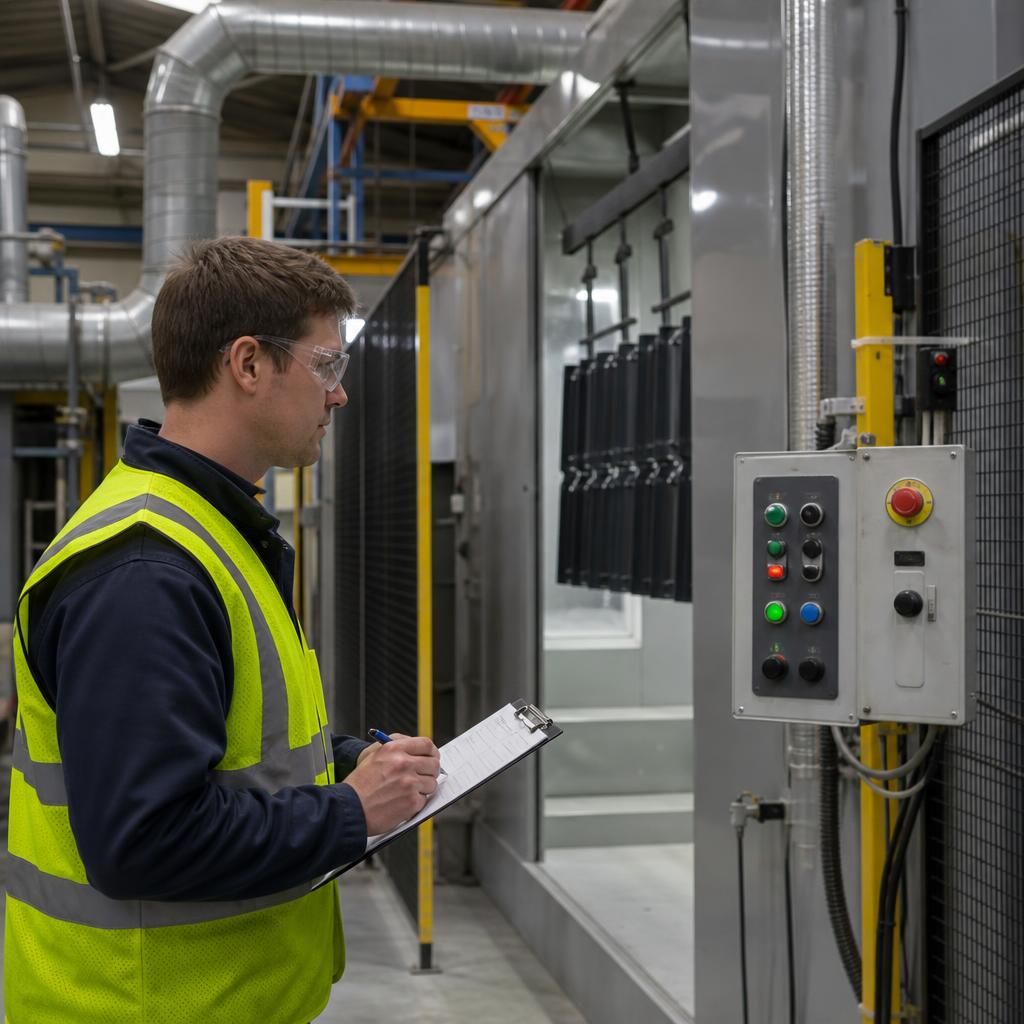
Safety and compliance should be assessed as part of the powder coating equipment package, not treated as separate installation details. Check how the booth, extraction, earthing, controls and curing equipment work together, and identify any guarding, interlocks, emergency stops or protective measures required for the proposed process.
Ask the supplier to state the package’s installation requirements and the safety information provided for operators and maintenance staff. Your assessment should also consider powder deposits, cleaning methods, compressed-air use, access to hot surfaces and the interaction between coating equipment and nearby production activities. A package is suitable only when it can be operated, cleaned and serviced within a documented risk-control procedure for the site.