

What is the process for degreasing metal components before powder coating?
Metal components are degreased by applying a suitable cleaning solution to remove oils, grease, fingerprints and manufacturing residues before powder coating. The parts are then rinsed, thoroughly dried and inspected to confirm the surface is clean and free from contamination before further preparation.
Degreasing is the controlled removal of oil, grease, wax, drawing compounds, cutting fluids, fingerprints and other organic residues from a metal component before powder coating. It is normally the first cleaning stage in a wider preparation sequence, creating a chemically clean surface so that subsequent pretreatment and the powder coating can contact the metal consistently.
1. Assess the component and its contamination
The correct degreasing method depends on the metal, the component’s shape and the type of contamination present. New fabricated parts may carry machining oil, press lubricants, protective films or marking residues. Previously used components can have road dirt, hydraulic oil, carbon deposits or old cleaning products. Heavy deposits may need an initial wipe, scraping operation or separate washing stage so that the main degreasing bath is not rapidly contaminated.
Assemblies should also be assessed for trapped contamination. Oil can remain in blind holes, seams, folded sections, threaded areas and tubular sections, then leak out during heating and cause craters, pinholes or poor adhesion. Where practical, parts should be dismantled and positioned so that fluids can drain freely.
2. Select a compatible cleaning chemistry
Industrial degreasers are commonly aqueous, alkaline or solvent-based. Aqueous alkaline systems are suitable for many steel components and can be used in spray or immersion equipment. Solvent cleaning may be appropriate for particular residues or smaller components, but the solvent must be compatible with the substrate, equipment and site controls. Aluminium, zinc-coated steel and other sensitive metals require particular care because an excessively aggressive or poorly controlled chemical can etch, discolour or attack the surface.
The cleaning product should be selected according to the contaminant rather than simply the apparent condition of the metal. Wax, silicone, heavy grease and water-soluble machining fluids do not all respond in the same way. Silicone contamination is especially problematic because small traces can lead to surface defects in the cured coating.
3. Apply the degreaser consistently
In a spray system, the cleaning solution must reach all exposed faces at a controlled temperature, concentration and pressure. Immersion systems rely on sufficient contact time and movement of the component or solution. Agitation helps dislodge contamination from recesses, while brushes or other suitable mechanical action may be needed for stubborn deposits. The process should not depend solely on a quick pass over the most accessible faces.
Operators should avoid touching cleaned areas with bare hands. Gloves, clean handling equipment and suitable racking help prevent fingerprints and transferred oil from undoing the cleaning stage. Racking should expose as much of the surface as possible without creating contact points that remain untreated.
4. Control the process rather than relying on appearance
A metal surface can look bright and clean while still carrying a thin film of oil. For this reason, the degreasing process should be controlled through its solution condition and operating parameters. Relevant checks can include chemical concentration, temperature, contamination loading, spray performance and the condition of filters or bath components. If the cleaning solution becomes overloaded with oil, it can redistribute contamination instead of removing it.
Verification can include a water-break assessment, in which water should form an even continuous film rather than separating into beads on a contaminated area. This is a useful process check, but it does not replace knowledge of the metal, the coating specification or the requirements of the following pretreatment stage. Where a component has complex geometry or a known contamination risk, additional inspection may be appropriate.
5. Prevent problems between cleaning and coating
Once degreasing has been completed, the component should be protected from recontamination during transfer and handling. Clean racks, suitable gloves and a controlled preparation area are important, particularly for parts with large visible surfaces. Steel can also begin to oxidise if it remains wet or is exposed to unsuitable conditions after cleaning, so the next preparation stage should follow without unnecessary delay.
Any fluid retained in cavities must be accounted for before the component enters an oven. Heat can draw concealed oil to the surface, where it may cause coating defects even though the outside appeared clean. Drain holes, part orientation and an appropriate preheating or outgassing procedure may therefore be considered for components with enclosed sections, castings or porous material.
Degreasing is not the complete preparation process
Degreasing removes organic contamination, but it does not necessarily remove rust, mill scale, weld discolouration, oxide layers or firmly bonded corrosion products. Depending on the substrate and the required finish, the cleaned component may then need abrasive blasting, chemical pretreatment or another approved preparation stage. The chosen sequence should leave the surface suitable for powder application without introducing a new contaminant.
For batch work, repeatability is as important as the choice of cleaner. Consistent loading, part orientation, chemical control, handling and inspection make it easier to identify whether a coating defect originated during cleaning, pretreatment or powder application. A coating specialist can assess the component material and contamination risk before deciding whether spray, immersion, manual cleaning or a combination of methods is most appropriate.
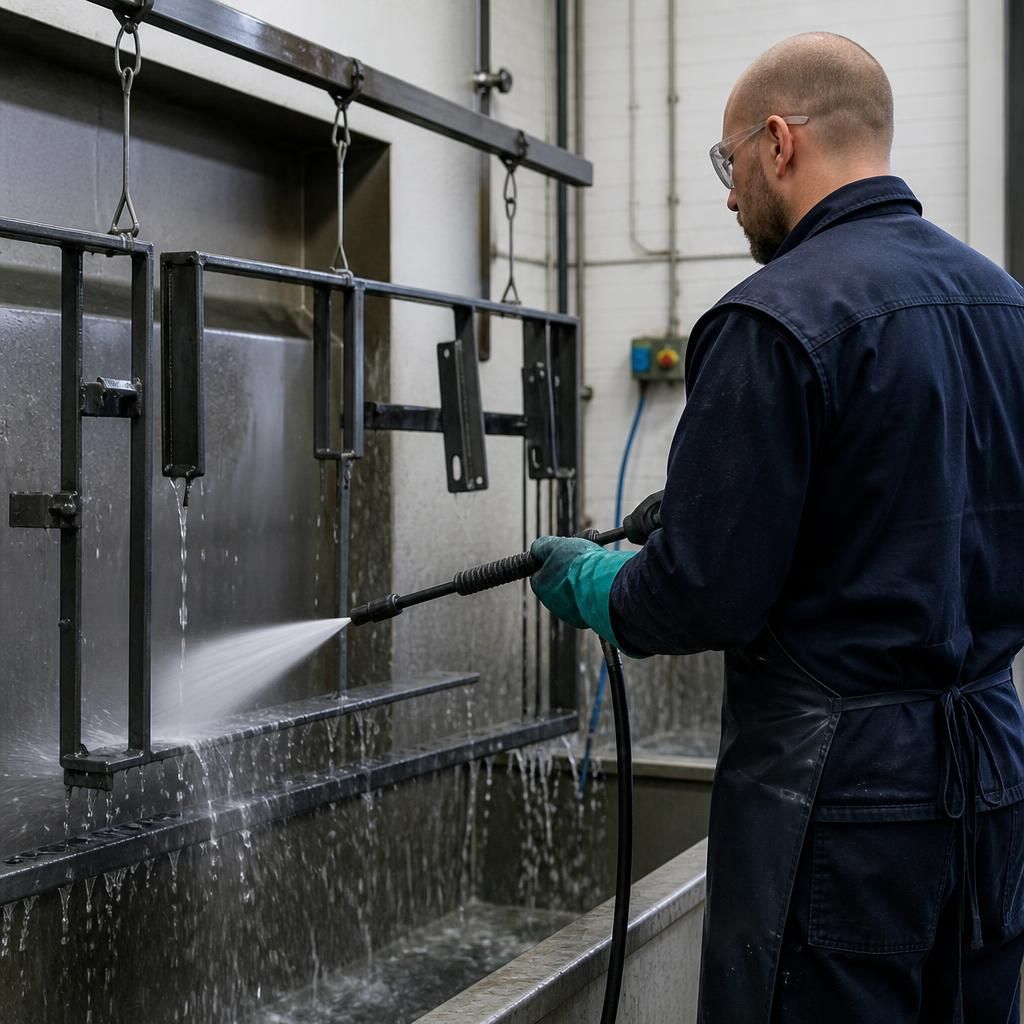
Rinsing must remove the degreaser itself, not just loosened contamination. Residual alkaline cleaner, dissolved salts or concentrated droplets can interfere with pretreatment and contribute to adhesion problems, staining or surface defects after curing. Rinse coverage is particularly important around joints, recesses and downward-facing surfaces where solution can collect.
Components should be positioned to drain freely, with attention given to seams, hollow sections and ledges. The rinse condition should be monitored so that contaminated water is not transferred back onto the metal. After rinsing, parts must be dried without introducing oil or dust; any visible deposits or staining indicate that the cleaning sequence needs investigation before powder coating proceeds.
Discuss degreasing for your metal components
If you are unsure which degreasing approach is suitable for your components, discuss the metal type, contamination and part geometry with a powder-coating specialist before preparation begins. This helps establish a cleaning sequence that is compatible with the subsequent coating process.