

How does the powder coating process work for steel protection?
The powder coating process protects steel by preparing its surface, applying electrically charged powder and heat-curing it to form a bonded, continuous barrier. This finish helps shield the steel from moisture, corrosion, impact and wear while providing a consistent surface for industrial components.
Steel is protected through a controlled sequence of inspection, surface preparation, powder application and curing. Each stage affects the coating’s ability to adhere to the substrate and resist moisture, corrosion, impact and wear; a defect introduced before spraying can reduce the performance of the finished component.
1. Specification and inspection. The process begins by considering the steel grade, component shape, intended environment and required finish. Welds, sharp edges, holes, threaded areas and enclosed sections are identified because they can influence coating coverage and drainage. The steel is checked for mill scale, rust, oil, grease, weld spatter and other contaminants. Existing coatings or unsuitable residues may need to be removed before the component can be treated.
2. Cleaning and abrasive preparation. Degreasing removes oil and handling residues, while abrasive blasting can remove rust, mill scale and previous surface contamination. Blasting also creates a controlled surface profile, giving the powder coating a mechanical key. The prepared steel must then be handled carefully so that it is not re-contaminated before coating. Any dust or loose material left on the surface can interfere with adhesion and leave weak points in the protective layer.
3. Pretreatment and drying. Depending on the steel, the exposure conditions and the specified coating system, a chemical pretreatment may be used after cleaning. This can improve adhesion and support corrosion resistance beneath the powder layer. Components must be thoroughly dried before spraying. Moisture trapped in seams, hollow sections or joints can cause defects during curing and may create a route for corrosion.
4. Masking and racking. Areas that must remain uncoated, such as contact faces, earth points, close-tolerance holes and threaded features, are masked where necessary. Components are positioned on suitable racks so that they remain electrically connected and can be moved through the coating stages safely. Racking points leave small contact areas that may require consideration in the design or subsequent assembly of the part.
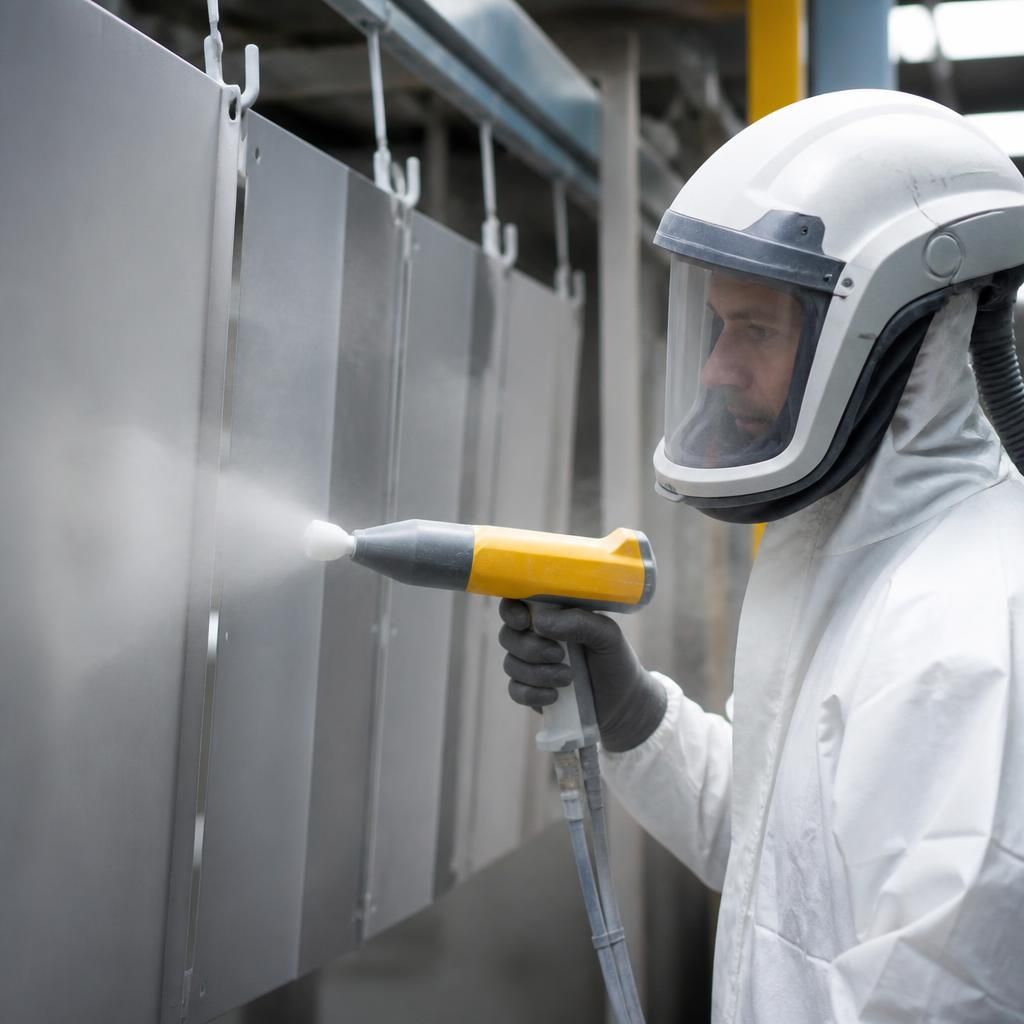
5. Electrostatic powder application. Dry powder is fed through a spray gun and given an electrical charge. The steel component is electrically earthed, so the charged particles are attracted to its surface and form an even layer. Operators control the gun distance, movement and overlap to reach broad faces, edges, recesses and complex profiles. Component geometry matters: deep corners, internal sections and Faraday cage areas can receive less powder, while edges can attract more. Suitable application technique helps maintain a consistent coating rather than relying on thickness alone.
6. Heat curing. The coated component enters an oven where heat causes the powder particles to melt, flow and chemically cross-link. The relevant temperature is the temperature of the steel itself, not simply the oven setting. Component thickness, mass and shape therefore affect the time needed to reach the required curing condition. Insufficient curing can leave a coating with reduced mechanical or chemical resistance, whereas excessive heat exposure can affect appearance or the properties of the finish.
7. Cooling and quality checks. After curing, the component is allowed to cool before inspection and handling. Checks may include visual examination for missed areas, runs, pinholes, contamination, orange peel, colour variation and damage. Coating thickness can also be assessed where the specification requires it, alongside checks on coverage and adhesion. The finished part should be reviewed against its intended use, particularly at edges, welds, recesses and masked areas where protection can be more difficult to achieve.
How the finished coating protects steel
Once correctly applied and cured, the powder coating acts as a continuous barrier between the steel and its surroundings. It limits access by water, oxygen, salts and other corrosive contaminants, while its bonded film helps resist abrasion and handling damage. Protection depends on the complete coating system: good preparation and coverage are as important as the powder formulation and final cure.
Design and fabrication details also influence service performance. Rounded or radiused edges generally allow more even coverage than very sharp edges. Welds should be clean and free from spatter, while joints and hollow sections should be designed to avoid trapping water or treatment chemicals. Drainage and ventilation openings may be needed for fabricated assemblies, and areas that will be cut, drilled or welded after coating may require a compatible repair treatment.
For industrial steel components, the appropriate process is therefore determined by the substrate condition, part geometry, handling requirements and exposure environment. Clear instructions on masking, finish, coverage, thickness and any post-coating machining help the coater produce a finish that is both visually consistent and suited to the component’s protective function.
Powder coating protects steel by interrupting the electrochemical conditions required for corrosion. Rust forms when moisture acts as an electrolyte between areas of the steel surface, allowing an electrical reaction to take place. A correctly bonded powder film separates the steel from that moisture and helps prevent the corrosion reaction from starting.
This is why the coating’s continuity matters as much as its appearance. Small defects, exposed edges or damage can provide local access for moisture, allowing corrosion to develop beneath or around the film. The process therefore combines an electrically bonded coating with careful control of the finished surface, particularly on steel components exposed to condensation, salts or industrial contaminants.