

How does powder coating compare to traditional painting methods for industrial applications?
Powder coating applies dry powder electrostatically before curing it into a solid film, while traditional industrial painting applies liquid paint that dries or cures on the surface. For suitable metal components, powder coating generally provides a tougher, more uniform finish with efficient material use, whereas liquid paint offers greater flexibility for heat-sensitive parts, on-site application and certain complex repair requirements.
For industrial metal components, powder coating is usually the stronger choice where the part can tolerate curing heat and can be processed in a controlled facility. Traditional liquid paint remains more suitable for heat-sensitive substrates, very large or fixed structures, and applications that require extensive on-site work or straightforward local touch-ups. The better finish depends on the component’s material, dimensions, operating environment, appearance requirements and expected maintenance conditions.
Durability and resistance: Powder coating forms a continuous cured film with good resistance to abrasion, impact, chipping and everyday handling. This makes it well suited to fabricated parts, machinery components, architectural metalwork, vehicle components and products that are repeatedly handled or exposed to wear. Liquid paint can also provide a durable industrial finish, particularly when a primer and compatible topcoat are specified, but performance depends heavily on film build, drying or curing conditions and the quality of application.
Neither system is automatically corrosion-proof. Corrosion protection depends on suitable substrate preparation, removal of contamination, correct pretreatment, coating thickness and the selection of a coating designed for the service environment. A powder system may be the appropriate option for general industrial exposure, while a liquid multi-coat system can be advantageous where a primer, barrier coat and specialist topcoat are needed. Edges, welds, recesses, fixings and areas where water can collect require particular attention under either method.
Application and film consistency: Powder is applied as dry particles and then cured, allowing the coating to flow into a uniform film. In a controlled production process, this can provide consistent coverage across repeat batches, with less variation caused by spray technique or solvent evaporation. Overspray can often be collected and reused where the colour and process allow, although not all powder can be reclaimed without affecting finish quality.
Traditional painting uses liquid material that may be sprayed, brushed or applied by roller. It can accommodate a wider range of application locations and methods, but the final result is more sensitive to ambient temperature, humidity, dust, application technique, mixing accuracy and the time allowed between coats. Runs, sags, dry spray, solvent entrapment and uneven film thickness are potential defects that need to be controlled through preparation and inspection.
Appearance and coating choice: Both methods offer a broad range of colours, gloss levels and surface effects. Powder coating is available in smooth, textured, matt and other decorative finishes, while liquid paint can be selected where a particular colour match, fine visual effect or multi-layer appearance is required. Powder is not always the best option for very thin decorative films, intricate colour transitions or work that needs frequent colour changes during a single production run.
The powder type also affects performance. Polyester-based powders are commonly considered for exterior durability and colour retention, whereas epoxy-based materials are often selected for adhesion and chemical resistance in suitable environments but may not be ideal as an exposed exterior finish. Specialist powders, including nylon systems, may be considered where low friction, wear resistance or a particular protective property is required. The coating should be selected against the actual operating conditions rather than appearance alone.
Heat and component size: Powder-coated parts normally pass through an oven so that the coating reaches its specified cure. The component must therefore tolerate the curing cycle without distortion, degradation, loss of temper or damage to seals, bearings, adhesives or other attached materials. Hollow sections and heavy fabrications may also heat differently from thin sections, which can affect cure and finish if the process is not properly controlled.
Liquid paint is useful where an assembly cannot be dismantled or placed in an oven. It can be applied to larger fixed structures and heat-sensitive materials, subject to the paint system’s own application and curing requirements. This flexibility can outweigh the mechanical advantages of powder when the item’s dimensions, construction or installation location prevent factory powder coating.
Repair and maintenance: Powder coating provides a hard, durable surface, but a deep impact or cut can expose the underlying metal and allow corrosion to develop if it is not dealt with. Repairs may involve cleaning, abrading the damaged area, treating any corrosion and applying a compatible liquid repair coating. The repaired area may not exactly match the original texture, gloss or colour, especially after the surrounding finish has weathered.
Liquid-painted surfaces are often easier to blend or recoat locally, particularly when the original paint system and colour are known. However, repeated maintenance coats can increase film thickness and may eventually obscure sharp details, edges or drainage features. In both cases, the most reliable maintenance starts with identifying the coating system and following a compatible preparation and repair method.
Environmental and production considerations: Powder coating avoids the liquid solvents found in many traditional paint systems and can reduce solvent-related emissions. Its environmental profile still includes electricity or fuel used by the curing oven, pretreatment chemicals, compressed air and the management of contaminated waste. Liquid painting may involve volatile organic compounds, solvent handling and waste from mixed or unusable paint, although water-borne and lower-emission systems are available for some applications.
Material efficiency is influenced by transfer efficiency, overspray recovery, colour changes, rejected parts and the number of coats required. Powder can be efficient for repeat production, while a liquid system may be more practical for one-off work, complex assemblies or repairs. A fair comparison should therefore consider the complete process rather than the purchase price of the coating material alone.
Quality control: A sound specification should cover substrate preparation, pretreatment, coating type, colour, gloss, film thickness, curing requirements and inspection criteria. Useful checks may include visual inspection, dry-film thickness measurement, adhesion testing and verification that the coating has reached the required cure. For corrosion-sensitive work, the specification should also address masking, drainage, weld treatment and the protection of cut edges.
In practical terms, powder coating is generally preferable for repeatable factory production of conductive metal parts that can withstand oven curing and need a robust, consistent finish. Traditional liquid painting is often the better technical solution for heat-sensitive items, very large or immovable structures, complex on-site applications, fine colour matching or repairs that require blending. Where the requirements are mixed, a coating specialist can assess the substrate, dimensions, exposure and production method before recommending the most suitable system.
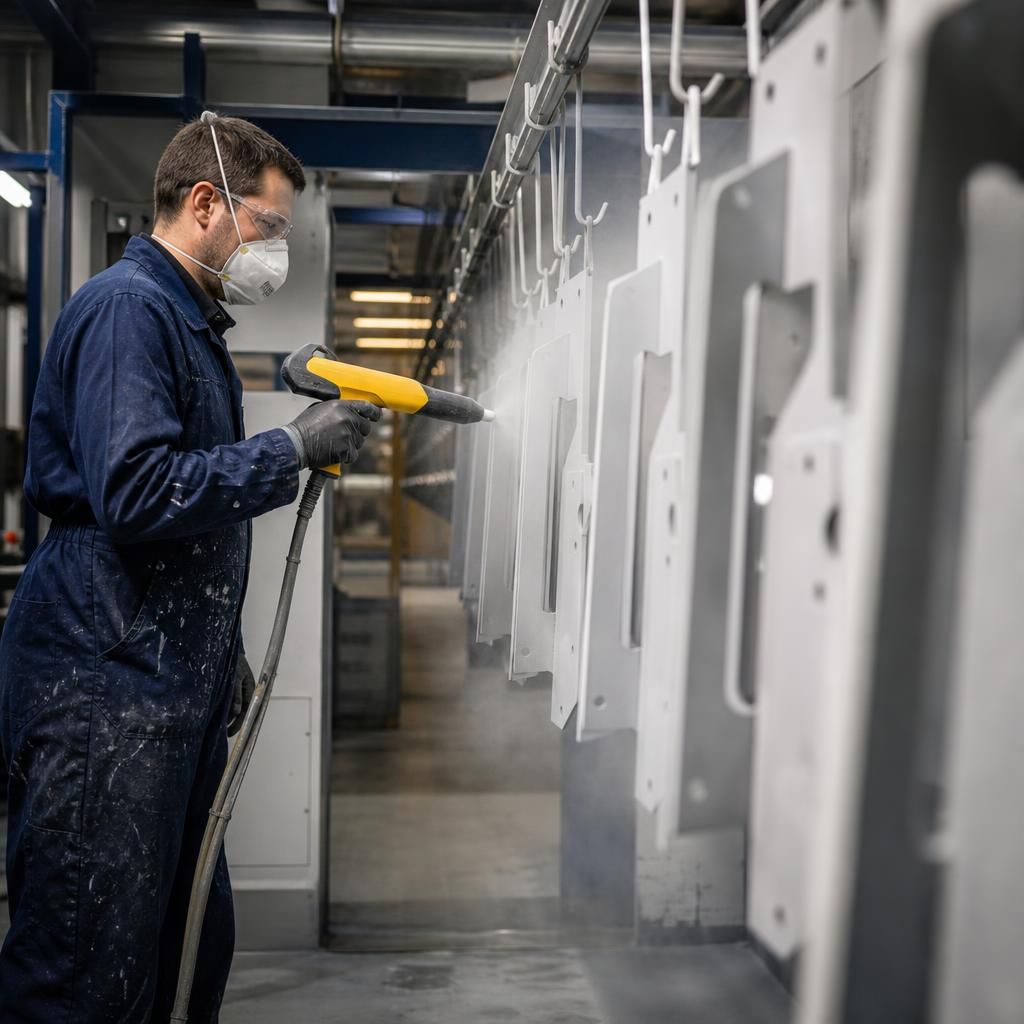
Substrate compatibility is a key difference between powder coating and traditional paint. Powder application relies on electrostatic attraction between the charged particles and a suitably grounded, conductive component. This makes it well suited to many bare or appropriately pretreated metal parts, but non-conductive materials, mixed-material assemblies and components with insulating layers may require a different approach or additional process planning.
Liquid paint is generally more adaptable across different substrates because it does not depend on the same electrostatic application principle. However, adhesion still depends on cleaning, preparation and selecting a paint system compatible with the material. Before choosing either finish, assess the substrate, existing coatings, attached materials and the required service conditions rather than comparing the coating materials in isolation.
Discuss the right finish for your industrial components
Discuss your component’s substrate, dimensions, operating environment and required finish with a powder-coating specialist before selecting a system. Share your specification or project requirements to establish whether powder coating is appropriate for the application.