

How do abrasive blasting and pretreatment chemicals enhance the powder coating process?
Abrasive blasting removes rust, mill scale, old coatings and other surface contaminants while creating a controlled profile for the powder to key into. Pretreatment chemicals then degrease and chemically condition the metal, helping improve coating adhesion, corrosion resistance and the consistency of the finished surface.
Abrasive blasting and chemical pretreatment enhance powder coating by controlling different aspects of the metal surface before application. Blasting provides mechanical preparation, while chemical treatment manages the surface chemistry. Used in the correct sequence, they make the coating process more predictable and reduce the risk of defects caused by residues, unstable substrates or unsuitable preparation.
The two methods are complementary rather than interchangeable. Abrasive preparation is particularly useful where a component has a heavily weathered surface, firmly attached oxide or remnants of an earlier finish. Chemical pretreatment is then used to refine the condition of the substrate and provide a more suitable base for the powder coating system. The required combination depends on the metal, its previous use, the condition of the surface and the performance expected from the finished component.
How abrasive blasting contributes
Blasting uses a controlled stream of abrasive media to alter the surface at a microscopic level. The resulting texture gives the cured coating a mechanical key, but the profile must be appropriate for the component and the powder system. If it is too shallow, the coating may have insufficient purchase; if it is too aggressive, it can affect appearance, consume more coating and leave an uneven finish on thin or detailed parts.
Operators therefore select the blasting medium, pressure, distance and angle according to the substrate. Steel, galvanised materials, aluminium and previously coated components do not respond in the same way. Delicate sections, threaded areas, machined faces and edges may require particular control so that preparation does not alter dimensions or remove features that need to remain precise.
Blasting also exposes defects that may be hidden beneath surface contamination or an old coating. Pitting, weld spatter, sharp edges and poor fabrication can remain visible after coating, so preparation should be treated as an inspection stage as well as a cleaning operation. Powder coating will follow the underlying shape; it will not level out significant dents, deep pits or badly finished welds.
How pretreatment chemicals contribute
Chemical pretreatment normally forms part of a controlled series of stages. These can include cleaning, rinsing, conditioning and the application of a conversion treatment suited to the metal. The purpose is to manage the interface between the substrate and the powder film, rather than simply to make the component look clean.
Conversion treatments can change the character of the outermost layer of the metal, helping it remain a more stable base during coating and service. The treatment must be compatible with the substrate: a process suitable for mild steel may not be appropriate for aluminium or zinc-coated material. Incorrect chemistry, excessive concentration or inadequate rinsing can create its own problems, including staining, residue, poor appearance or reduced coating performance.
Rinsing and drying are as important as the chemical stage itself. Residual salts, cleaner, treatment solution or moisture can interfere with powder application and curing. Components should therefore be allowed to dry fully, with particular attention to joints, folds, hollow sections and other areas where liquid can collect. The prepared surface also needs to be protected from handling contamination before powder is applied.
Why process control matters
The best result comes from treating preparation as part of the complete coating specification. Relevant factors include:
- the base metal and any mixed-metal construction;
- the previous condition and service history of the component;
- the selected abrasive and the required surface profile;
- the pretreatment chemistry and its compatibility with the substrate;
- the time between preparation and powder application;
- the intended environment, including exposure to moisture, chemicals, abrasion or outdoor conditions; and
- the powder type, film thickness and curing requirements.
Inspection should take place at several points rather than only after curing. The prepared part can be checked for remaining contamination, damage, moisture, excessive roughness and areas that have been missed. After coating, visual inspection and appropriate checks of film coverage, cure and adhesion help identify whether the preparation and application stages have worked together as intended.
Preparation cannot compensate for unsuitable fabrication, trapped contamination or an incompatible powder system. For example, oil held inside a joint may emerge during heating, while sharp edges can produce thinner coverage than adjacent flat areas. Components should be designed, fabricated and presented with coating in mind, and any masking, drainage or dimensional requirements should be identified before preparation begins.
For industrial batches, a documented preparation specification helps maintain consistency between components. It can define the substrate, blasting approach, chemical stages, inspection points and application requirements without relying on visual judgement alone. This is particularly useful when parts vary in size or geometry, or when a repeat finish must be maintained across multiple production runs.
In practice, abrasive blasting is most valuable for controlled physical preparation, while chemical pretreatment manages the metal-to-coating interface. Their combined use gives the powder coating system a more suitable foundation and makes the final finish less dependent on uncontrolled surface variation. The exact sequence should be selected for the component, substrate and service conditions rather than applying one preparation method to every job.
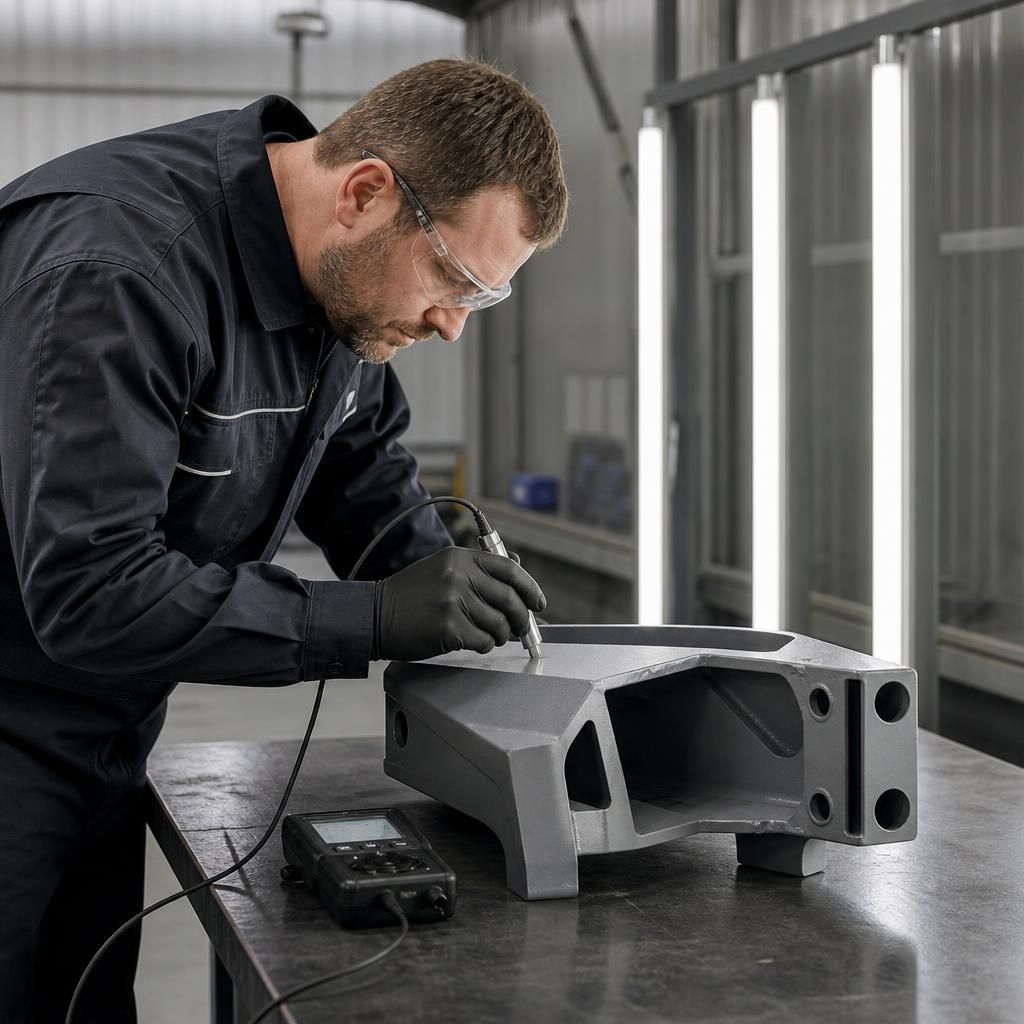
A trial preparation on a representative component can confirm that the blasting and chemical pretreatment stages are suitable before a full production batch is processed. This is particularly useful for unfamiliar alloys, mixed-metal assemblies, intricate parts or components with a previous coating.
The trial should assess whether the chosen preparation leaves the required surface condition without damaging edges, threads, machined faces or other critical features. It can also reveal reactions between the substrate, pretreatment system and powder finish that may not be apparent from visual inspection alone. Any adjustments to the abrasive, cleaning stages or treatment chemistry can then be made before production coating begins.
Discuss your abrasive blasting and pretreatment requirements
Discuss your component’s substrate, existing condition and intended service environment with the powder-coating.co.uk team to identify a suitable abrasive blasting and pretreatment approach. Providing drawings, photographs or sample parts can help establish the preparation requirements before coating begins.