

What environmental and safety measures are implemented in your aluminium powder coating process to comply with regulations?
Our aluminium powder coating process meets UK environmental and workplace-safety requirements through controlled preparation, application and curing, supported by suitable extraction, personal protective equipment, housekeeping and responsible handling of powder and waste. These measures help control airborne dust, protect operators, prevent contamination and manage materials in line with relevant regulations.
Environmental and safety compliance in aluminium powder coating depends on controlling risks at each stage of the process, documenting those controls and managing waste responsibly. The main safeguards cover chemical assessment, combustible-dust risk, equipment safety, operator training, pollution prevention, waste transfer and inspection records, with the precise legal requirements determined by the substances, equipment and activities used.
Risk assessment and chemical control
Each coating powder, pretreatment chemical and cleaning product should be assessed using its current safety data sheet. Under the Control of Substances Hazardous to Health (COSHH) framework, the assessment considers the product’s classification, exposure routes, storage requirements, handling method and the controls needed to prevent or reduce exposure. Safety data sheets are kept available to inform work instructions, emergency arrangements and disposal decisions.
Powders and chemicals are kept in suitable, clearly identified containers and stored according to their compatibility and handling requirements. Unlabelled or damaged containers are not put into use. Changes to the powder specification, pretreatment system or cleaning products require the relevant assessment and operating instructions to be reviewed rather than relying on assumptions based on a previous material.
Combustible dust and fire precautions
Powder coating materials can create a combustible-dust hazard if dust accumulates or becomes suspended in air near an ignition source. The risk assessment therefore considers powder transfer, spraying, recovery, cleaning, waste containers and any preparation activity that may generate fine particles. Where the assessment identifies a dangerous-substance risk, controls are considered under the Dangerous Substances and Explosive Atmospheres Regulations (DSEAR).
Fire prevention includes controlling ignition sources, preventing excessive dust deposits, maintaining suitable separation between incompatible materials and keeping access to emergency equipment clear. Electrical and mechanical equipment used in dusty areas must be suitable for its operating environment and maintained in accordance with the manufacturer’s instructions. Powder waste and contaminated consumables are placed in appropriate containers rather than left to accumulate around the coating equipment.
Safe plant and process operation
Spray equipment, curing ovens, lifting equipment and other work equipment are subject to planned checks and maintenance. Guards, doors, access controls and interlocks must not be bypassed, because they form part of the control system for moving machinery, heated equipment and enclosed process areas. Work equipment is managed in line with the Provision and Use of Work Equipment Regulations (PUWER) where applicable.
Oven operation also requires controls for heat, combustion, electrical energy and safe loading. Operators follow defined start-up, operating and shutdown procedures, and defects are recorded for investigation and correction. Maintenance is carried out with the equipment made safe, including isolation of relevant energy sources where required.
Training and operating instructions
People involved in preparation, coating, curing, cleaning, maintenance or waste handling receive instruction relevant to their tasks. This covers the hazards identified in the COSHH and process risk assessments, correct use of equipment, powder and chemical handling, emergency actions, spill response and the limitations of protective equipment.
Training is supported by written operating instructions and supervision appropriate to the task. Records help demonstrate that personnel have been briefed and that refresher instruction or reassessment is provided when equipment, materials or working methods change.
Environmental controls and waste management
Environmental controls are designed to prevent powder, chemical residues, contaminated wash materials and other process waste from entering drains, soil or surface water. Waste streams are kept separate where their composition or disposal route differs. Recoverable powder may be managed separately from mixed or contaminated waste, subject to its condition and the applicable disposal requirements.
Waste is classified before disposal, stored securely to prevent leaks or wind dispersal and transferred using the appropriate documentation and authorised waste arrangements. Duty-of-care requirements under UK waste legislation apply to the description, storage, transfer and final treatment of waste. Records are retained so that the origin and destination of relevant waste can be traced.
Where surface preparation or pretreatment produces liquid residues, the disposal route must be determined from the chemicals used and any site drainage or trade-effluent controls. Such material must not be discharged simply because it appears dilute. Storage areas, containers and transfer points are checked for damage or leakage, with spill materials available and response procedures defined.
Monitoring, inspection and corrective action
Compliance is maintained through routine inspection rather than a one-off assessment. Checks can include the condition of process equipment, powder deposits, storage containers, emergency equipment, waste areas, protective equipment and relevant control systems. Any defect, spill, near miss or departure from the agreed method is recorded and reviewed to identify corrective action.
Documentation normally includes risk assessments, safety data sheets, training records, maintenance and inspection results, waste records, incident reports and evidence of corrective actions. These records provide a practical audit trail and help demonstrate that environmental and safety controls remain suitable as materials, plant or production requirements change.
For a specific aluminium component, the applicable controls also depend on the chosen preparation method, coating chemistry, component size and curing equipment. Those details should be confirmed during technical review so that the risk assessment, waste route and operating instructions reflect the actual process rather than a generic powder coating method.
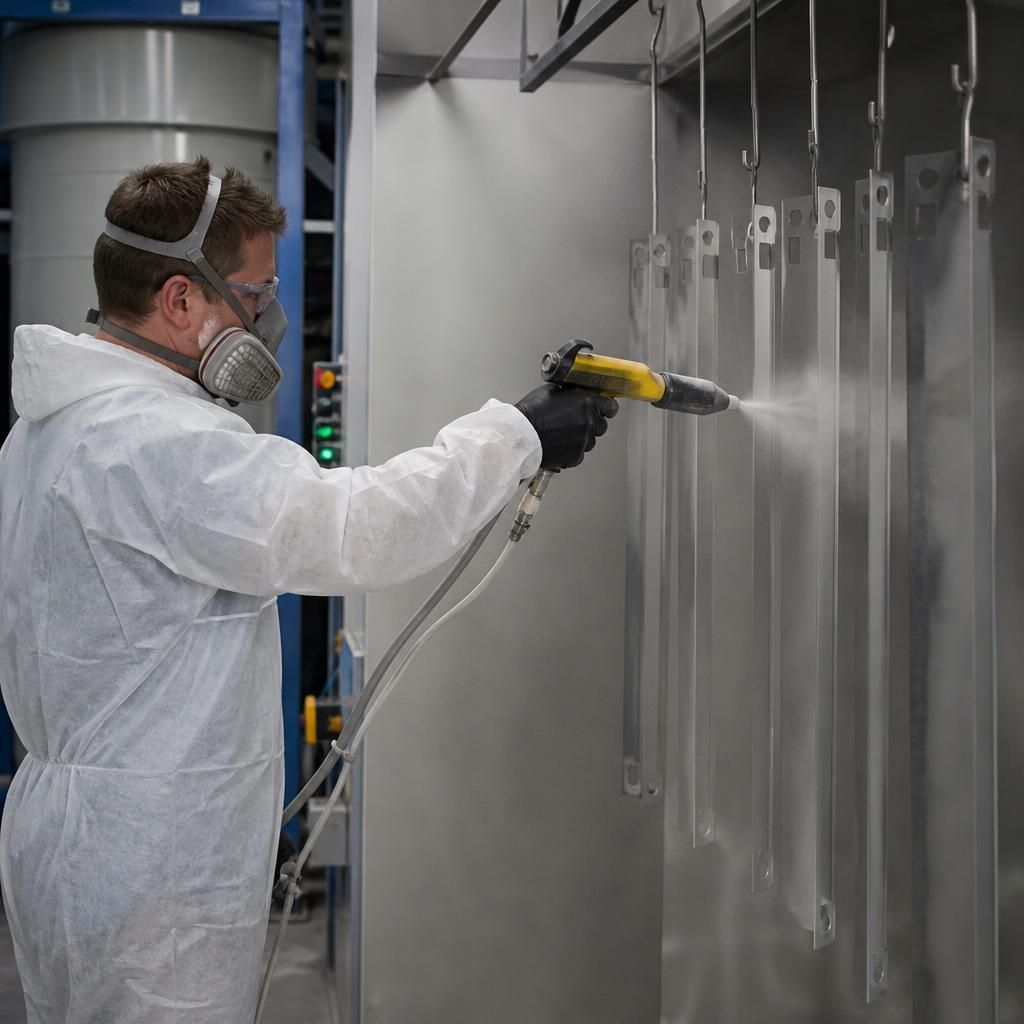
Powder coating has a different environmental profile from solvent-borne liquid paint because the coating is applied as a dry powder rather than carried in a solvent. This can reduce solvent vapour emissions during application, but it does not remove the need for effective controls: airborne powder must still be contained, extracted and handled safely, while curing ovens require responsible control of heat and energy use.
For aluminium components, the chosen preparation and coating system should therefore be assessed as a complete process. Environmental and safety controls need to cover preparation residues, powder application, curing and cleaning rather than focusing only on the finished coating. This helps ensure that lower-solvent processing is supported by appropriate protection for operators and responsible management of materials throughout the work.
Discuss environmental and safety measures for your aluminium powder coating project
Discuss your aluminium components with our technical team so the preparation method, coating chemistry and process controls can be considered together. Provide details of the component, finish and production requirements to support an appropriate project review.