

What are the limitations and potential challenges of powder coating on different metal substrates?
Powder coating limitations vary by substrate because each metal differs in conductivity, heat tolerance, surface condition and reaction to preparation or curing. Aluminium, mild steel, stainless steel and galvanised metal may therefore require different pre-treatment, masking and curing controls to prevent adhesion problems, corrosion, distortion or an uneven finish.
The main limitations of powder coating on different metal substrates arise from the interaction between the metal, its surface condition, the component’s geometry and the required service environment. Powder coating is not a universal finish: the substrate must be suitable for the preparation method, electrical application and curing cycle, and the coating specification must match the component’s expected exposure.
Aluminium can present challenges where the surface has an existing anodised layer, heavy oxidation or residues from machining. Cast aluminium is particularly prone to porosity, which may release trapped air or contaminants during heating and create pinholes, blisters or small surface defects. Aluminium alloys can also have different thermal and mechanical properties, so the specified cure cycle should be checked against any temper or dimensional requirements. Inserts, bearings and precision-fitted areas generally need careful masking because even a relatively thin coating can affect assembly tolerances.
Mild and carbon steel are widely suited to powder coating, but the finished result depends heavily on removing mill scale, oil, weld residue and fabrication contamination. Welds, cut edges and areas beneath spatter can remain visible through the coating if they are not properly cleaned and dressed. Hollow sections need suitable drain and vent holes; otherwise, cleaning fluids or moisture can remain trapped and create both processing hazards and later corrosion points. Designers should also consider whether enclosed sections can be adequately prepared and coated internally.
Stainless steel has a naturally passive surface that can reduce coating adhesion unless it receives an appropriate preparation treatment. Contamination from carbon-steel tools, blast media or workshop handling may also leave iron deposits on the surface, which can discolour or corrode independently of the stainless substrate. Welded stainless components may require additional cleaning to remove heat tint and fabrication residues. A coating can provide an additional finish or barrier, but it should not be used to conceal unsuitable weld cleaning or contamination.
Galvanised and zinc-coated steel requires particular care because the zinc layer can vary in texture, thickness and condition. Residues from the galvanising process, storage stains and loosely bonded material must be addressed before coating. Zinc can release gases during curing, leading to pinholing, cratering or blistering if the preparation and heating cycle are unsuitable. The specification should therefore account for the type of galvanised surface, the age and condition of the component, and whether a duplex system is required for the intended environment.
Cast iron and other porous castings may contain oil, moisture or foundry residues within their pores. These contaminants can emerge during curing and cause bubbling or local adhesion defects. Rough cast surfaces can also produce a less uniform appearance and may require additional preparation if a smooth decorative finish is expected. Where the casting has deep recesses or pockets, the ability to clean, dry and inspect every area should be assessed before coating.
Copper, brass and other highly conductive metals can require a different approach from conventional fabricated steelwork. Their thermal behaviour and surface chemistry may affect the chosen powder and cure schedule, while tarnish, oxides and polishing compounds can interfere with the finish. Components made from copper alloys should be assessed for appearance, electrical function and operating temperature rather than treated as though they were standard steel parts.
Component design can create limitations regardless of the base metal:
- Threads and close fits: coating build can interfere with bolts, bushes, bearings, sliding faces and press-fit components. These areas normally require masking, post-coating machining or a design allowance.
- Recesses and corners: electrostatic application can give uneven deposition in deep cavities, narrow channels and internal corners. This is commonly associated with the Faraday cage effect, where the electric field makes it difficult for powder to reach sheltered areas.
- Sharp edges: powder tends to pull away from very sharp edges, potentially leaving reduced coverage at a point that is vulnerable to handling damage or corrosion. Edge radiusing and suitable pretreatment improve the result.
- Assemblies of dissimilar metals: different parts may require separate preparation or curing considerations. Coating an assembled unit can also leave concealed interfaces, gaps or contact points untreated, so disassembly is often preferable where practical.
- Drainage and access: components must allow cleaning fluids, rinse water and air to escape. Poor drainage can create defects during processing and make inspection of internal surfaces difficult.
The required service conditions can expose another limitation. A standard decorative powder may not be appropriate for continuous high heat, aggressive chemicals, immersion, severe abrasion, prolonged external exposure or contact with fuels and solvents. The substrate may remain structurally sound while the coating changes colour, loses gloss, softens, chalks or becomes brittle. Powder selection should therefore be based on the actual environment, including temperature cycles, cleaning methods, sunlight, impact and contact with other materials.
Powder coating also has limited ability to correct defects in the underlying metal. Deep pitting, laminate marks, porosity, weld distortion and poor fabrication cannot reliably be hidden by adding more powder. Excessive film build may reduce flexibility, obscure detail, affect fit and increase the risk of finishing defects. Where a component needs a very smooth appearance, the preparation standard must be agreed before coating rather than relying on the powder layer to level the surface.
Repair can be difficult when damage occurs after coating. A local touch-up may differ in colour, texture, gloss or weathering from the original finish, particularly on textured or metallic powders. Removing and recoating the complete component may be more consistent, but stripping can introduce its own risks for thin sections, bonded parts, rubber components and substrates with tight dimensional tolerances.
Before specifying a finish, the coating assessment should record the substrate and alloy, previous treatments, fabrication method, surface contamination, component dimensions, masking points, required tolerances and service exposure. It should also identify whether the part can be disassembled, drained, electrically contacted and inspected after coating. For complex or mixed-metal components, a sample or trial process can help reveal problems with outgassing, coverage, appearance or fit before production quantities are processed.
For manufacturers and fabricators, the most reliable specification combines the metal type with the preparation standard, powder chemistry, colour and texture, film-build requirements, cure conditions and acceptance criteria. This substrate-led approach does not remove every limitation, but it makes the risks identifiable and allows the preparation, masking and coating method to be selected for the component rather than applied as a generic finish.
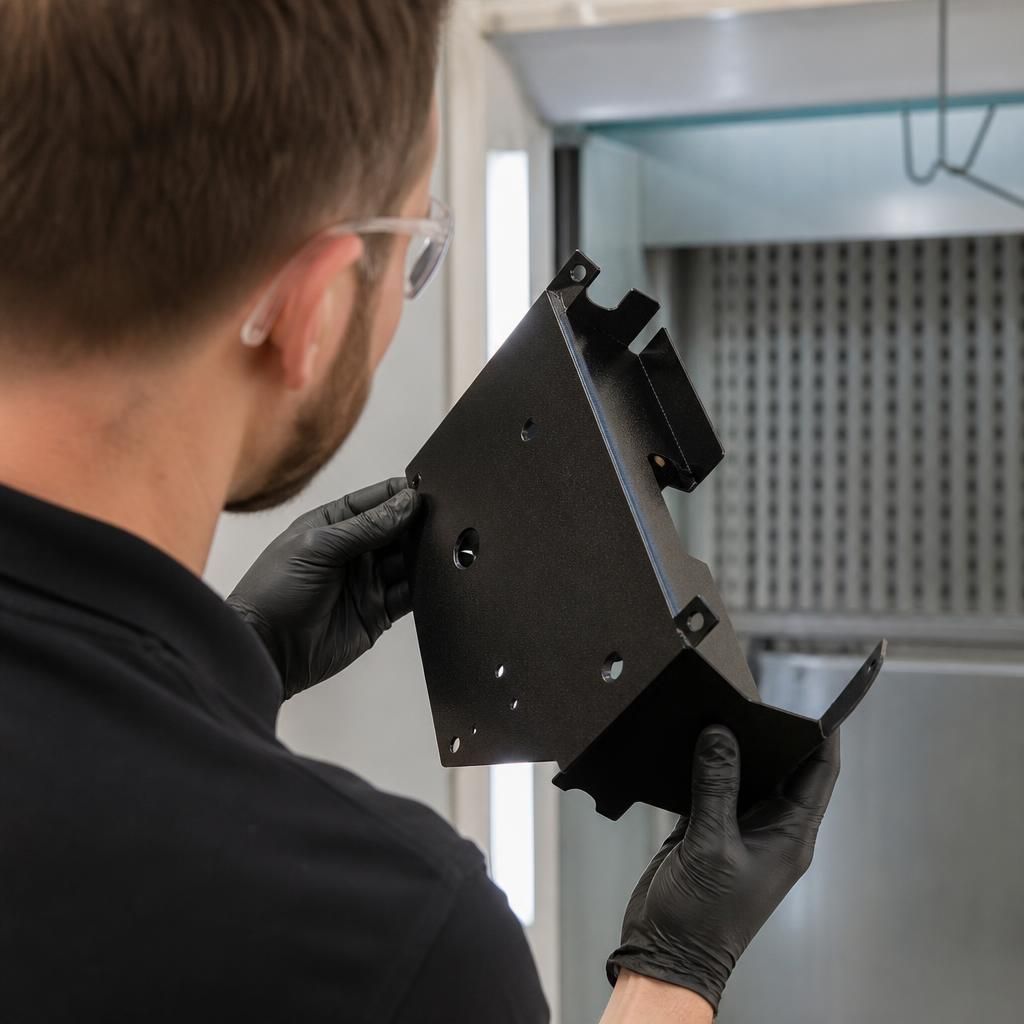
Visual appearance alone does not confirm that powder coating has bonded correctly to a metal substrate. A component may look even while having inadequate adhesion, incomplete curing or inconsistent film thickness. These issues can become apparent only when the part is bent, assembled, exposed to moisture or subjected to impact.
For critical components, inspection should therefore include checks appropriate to the substrate and service conditions. Adhesion, coating thickness, cure and visual finish can be assessed against agreed acceptance criteria, with particular attention to edges, welds, recesses and masked areas. Where a new alloy, surface treatment or component design is being introduced, testing a representative sample before full production can identify compatibility problems without risking an entire batch.